
24/7 Customer Support

Free returns

Same-day & Next-day Delivery

Quality Guaranteed

Unlock Your Welcome Offers: FREE Delivery | Up to 80% OFF | Free 30-day JoyPlus trial
Download the APP
A soundbar can make television dialogue clearer and films more engaging, but choosing one based only on wattage or a Dolby Atmos badge can lead to disappointment. Soundbars with wireless subwoofer systems vary considerably in speaker layout, connectivity and room compatibility.
Before buying, watch for three common traps:
The first number in a soundbar specification refers to the main audio channels, while the number after the decimal point refers to the subwoofer channel. A 2.1 channel soundbar, such as the LG SH5A, generally provides left and right audio with a dedicated subwoofer. This layout is suitable for improving everyday television, music and gaming audio without adding rear speakers.
A 3.1.2 channel soundbar adds a centre channel for dialogue and two height channels for overhead effects. The Samsung HW-QS700F uses this configuration with front-firing and up-firing speakers. A 3.1.3 channel model, such as the LG USC9S, adds a third up-firing channel.
For a more extensive home cinema arrangement, an 11.1.4 channel soundbar such as the Samsung HW-Q990F includes rear speakers, a subwoofer and four up-firing channels. It requires more space and more separate components, but it can produce a more enveloping layout than a single bar.
A Dolby Atmos soundbar can process object-based audio, including height effects. However, the final result depends on compatible content, the TV connection and the room. Up-firing speakers work by directing sound towards the ceiling, so very high, angled or heavily textured ceilings may reduce the reflected effect.
DTS:X and DTS Virtual:X are also worth checking if you watch discs, stream varied content or play games from different sources. Do not assume every source will use the most advanced format: the TV, streaming app, console and soundbar must all support the relevant signal path.
For a straightforward setup, HDMI ARC allows compatible TVs to send audio to the soundbar and use the television remote for volume control. An HDMI eARC soundbar offers greater bandwidth and is more suitable for lossless audio formats and some higher-quality Dolby Atmos signals.
Check the ports carefully. The LG SH5A includes HDMI ARC, optical, USB and Bluetooth, while the Samsung HW-QS700F includes HDMI eARC, Wi-Fi and Bluetooth. A soundbar with optical input can work with older UK televisions, but optical connections have more limited audio-format support than eARC.
Bluetooth is convenient for music and podcasts, although it is not normally the preferred connection for low-latency gaming or the fullest home cinema formats. Wi-Fi, AirPlay 2, Chromecast and Spotify Connect can be useful if you want a wireless soundbar that also acts as a home music system.
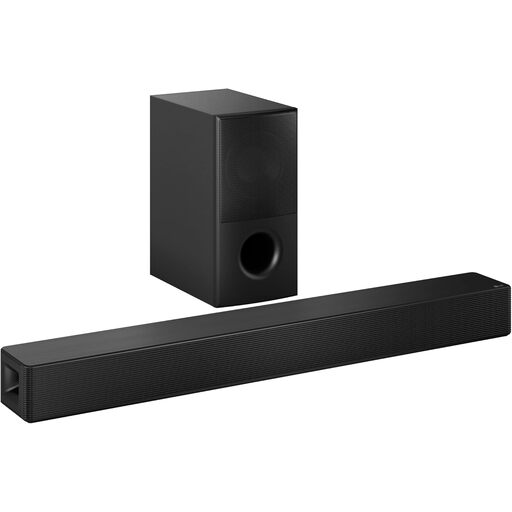
Why This Fits Their Persona: A practical option for upgrading a 43-inch-or-larger TV with a dedicated subwoofer, HDMI ARC and Bluetooth without adding rear speakers.
Its specification identifies the separate 200W wireless subwoofer rather than relying on built-in bass alone, while ASC is designed to adjust the balance for dialogue and action content.
320W total output, Dolby Digital and DTS support, wall-mountable design, optical, USB and HDMI ARC connections.
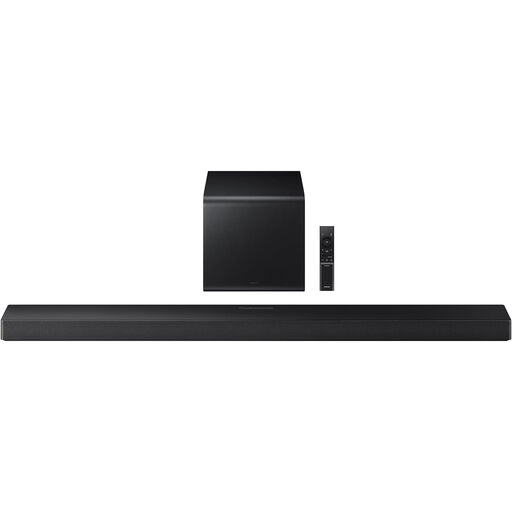
Why This Fits Their Persona: Suitable for viewers wanting Dolby Atmos height channels, room calibration and flexible tabletop or wall placement in a modern living room.
The 3.1.2 layout clearly states where the height effect comes from, while SpaceFit Sound Pro is designed to adjust audio to room conditions.
330W output, Wireless Dolby Atmos, DTS:X, Wi-Fi, Bluetooth, HDMI eARC and a compact wireless subwoofer.

Why This Fits Their Persona: Designed for dedicated home cinema users, film enthusiasts and gamers who have room for rear speakers and want a fuller surround layout.
Its 23-speaker specification and included wireless rear speakers make the physical surround arrangement clear, rather than implying that a single bar creates identical coverage.
11.1.4 channels, 756W RMS rated power, Dolby Atmos, DTS:X, HDMI eARC, Wi-Fi, Bluetooth and room calibration.
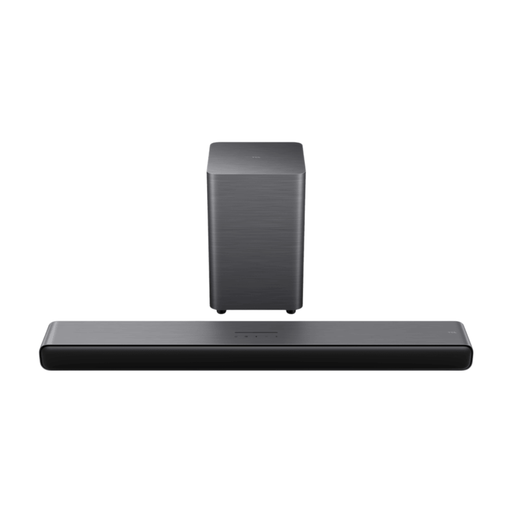
Why This Fits Their Persona: A sensible match for households wanting a compact home cinema soundbar with Atmos support, wireless bass and simple app control.
It combines a stated 2.1 layout with a dedicated wireless subwoofer, HDMI eARC 2.0 and room-adjustment features, making the connection and bass arrangement easier to assess.
220W maximum output, Dolby Atmos, DTS Virtual:X, Bluetooth, TCL Home App support and wall-mounting kit.
We have compiled a complete, real-time list of products that fully satisfy these strict selection criteria and UK safety regulations.
Yes. The subwoofer communicates with the soundbar without a signal cable, but it usually requires a separate power connection. Place it near a suitable socket and avoid routing cables across walkways.
Not always. Some compressed Atmos formats can work through HDMI ARC, depending on the TV and source. HDMI eARC provides greater bandwidth and is a more suitable choice for compatible high-quality audio formats. Check the specifications of every device in the chain.
Service life depends on usage, ventilation, software support and electrical conditions. Keep the unit dry, avoid blocking ventilation or up-firing drivers, and use a surge-protected socket where appropriate. A manufacturer warranty, such as the one-year cover listed on several products above, provides a defined period of support but does not indicate the total operating lifespan.