Who is this choice for?
The first distinction is whether you want less chewing while eating ordinary food, or need a clinically specified food or fluid texture.
People who can eat an ordinary diet
If chewing feels uncomfortable or tiring but you can safely manage ordinary food and liquids, a spoonable soup may appeal. Inspect it for pieces you would find difficult to chew. The Christie NHS Foundation Trust distinguishes a regular easy-to-chew diet from a prescribed texture-modified diet.
Shoppers who want one tin
If you do not want a multipack, check the can count as well as its weight. Tesco Groceries lists individual 300g and 400g Heinz Cream of Tomato tins alongside multipack formats.
People shopping for someone with swallowing needs
If the person has dysphagia or has been given an IDDSI food or fluid level, do not select an ordinary soup by its flavour or apparent smoothness. Royal Berkshire NHS Foundation Trust describes IDDSI as a system of specified food and fluid levels; use the person’s individual clinical instructions.
What should you check before choosing?
Establish whether ordinary soup is appropriate first, then check the quantity, contents and label of the particular tin.
| Priority |
What to check |
Your needs |
| Texture and swallowing |
Look for visible pieces, skins, pasta, beans or meat in the description and in the prepared soup. If you have a prescribed IDDSI level or swallowing symptoms, follow clinical advice instead of judging suitability by a soup’s name. |
I can eat ordinary food, but I want to avoid pieces that take more chewing. If I need a specified swallowing texture, an ordinary tin is not a substitute for my individual instructions. |
| Can quantity |
Check the number of cans and the weight of each one. Tesco Groceries lists individual 300g and 400g Heinz Cream of Tomato tins as well as multipacks. |
One tin is enough for my planned meal; I do not want to mistake several cans for a single-can listing. |
| Salt per tin |
Compare salt per 100g with the amount you expect to eat. M&S lists 0.45g salt per 100g for its 400g Cream of Tomato Soup: that is 1.8g if you eat the whole tin. The UK Government recommends no more than 6g salt a day for adults. |
If I expect to eat the whole can, the per-100g figure alone does not tell me how much salt that meal contains. |
| Ingredients and preparation |
Read the current can for allergens, dietary information and serving instructions. For a condensed soup, check how it must be prepared before assessing the served texture. |
I need the ingredients to suit my dietary requirements, and I want to know what the soup will be like when served—not just what its title suggests. |
Brand and range references
These examples help distinguish single tins and soup styles; a brand or flavour name does not establish a clinically specified texture.
Heinz
Tesco Groceries lists Heinz Cream of Tomato Soup in individual 300g and 400g tins.
- The listed sizes give shoppers two single-tin quantities to check.
- Check the can count carefully: Heinz soup listings also include multipacks. Neither the flavour name nor the can size establishes an IDDSI texture.
Campbell's
Campbell's condensed cream soups are another style to consider when looking at individual tins.
- The individual can lets you check its ingredients and preparation directions before deciding how to serve it.
- “Condensed” does not establish the texture of the prepared soup or its suitability for a prescribed swallowing diet.
Tesco
Tesco Groceries lists an own-label Cream of Tomato Soup 400g single tin.
- The listing identifies a one-can format for shoppers avoiding a bundle.
- Check the received can for its ingredients, allergens and contents; the category listing does not establish a prescribed texture.
M&S
M&S lists a 400g Cream of Tomato Soup among its tinned soups, alongside other soup styles.
- M&S publishes a salt value of 0.45g per 100g and storage directions for this particular soup.
- M&S advises reading the current label because product information can change. Its product description does not assign an IDDSI level.
A single-tin option on Joybuy
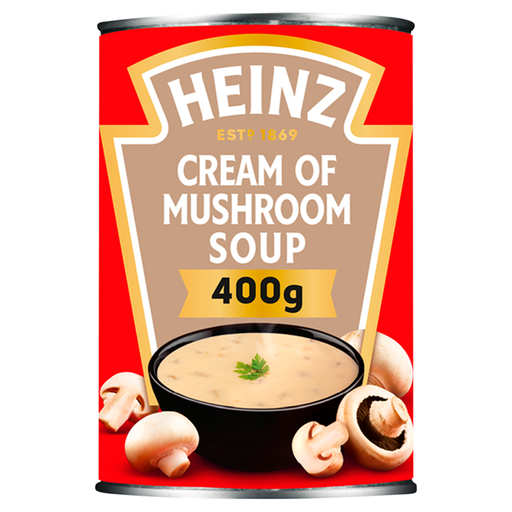
This 400g cream-of-mushroom tin is an option to assess if you can safely eat ordinary food and are comfortable with mushroom pieces. Check the contents against your chewing needs; it is not a substitute for a prescribed swallowing texture.
 No image available
Heinz Cream of Mushroom Soup 400g
This single 400g tin is worth considering if you can manage ordinary food and mushroom pieces. The listing describes tender pieces but does not specify their size, so inspect the soup before serving. Read the current can for allergens and preparation instructions; do not assume it meets a prescribed IDDSI level.
View on Joybuy
Questions about single-tin soup
Is any cream soup suitable if I have swallowing difficulties?
No: “cream” is a flavour or style description, not a prescribed texture level. The Christie NHS Foundation Trust says its regular easy-to-chew guidance is not suitable for people advised to follow a texture-modified diet. If you have an IDDSI prescription, follow your individual food and fluid instructions.
What should I check when buying just one tin?
Confirm the listing is for one can, then check its weight, ingredients, allergens, salt information and preparation directions. For an ordinary easy-chew meal, also check whether the contents have pieces you can comfortably manage; a cream-style title is not a texture guarantee.
How do I work out the salt in a whole 400g tin?
Multiply the label’s per-100g salt value by four if you will eat all 400g. M&S lists 0.45g per 100g for its Cream of Tomato Soup, equivalent to 1.8g for that tin. The UK Government recommends no more than 6g salt a day for adults.
How should I keep soup left after opening a tin?
Follow the directions on the particular can. M&S says to transfer its Cream of Tomato Soup to an airtight container, refrigerate it after opening and eat it within two days; check the label of any other soup for its own instructions.
What if I cough when eating or drinking?
Seek clinical advice rather than trying to resolve a possible swallowing problem by choosing an ordinary soup that looks smoother. Ask for guidance on whether you need a swallowing assessment or an individually specified food or fluid texture.


