Parents packing a drink for a child aged 1–3
A sealed carton may be useful for a nursery handover, lunchbox or dinner away from home. Check its age statement: a small carton is not necessarily labelled for toddlers.


For a child aged 1–3, individual cartons are useful when a sealed portion needs to travel, but the toddler-labelled Alpro Growing Up 3 x 250ml pack contains raw cane sugar and fructose. For regular dinners at home, an unsweetened, calcium-fortified drink is the route identified by an NHS North West Knowledge Now guide for children aged 1 or over with cow’s-milk-protein allergy. Check the current allergen label and the nursery or school’s policy before packing any soya drink.
A sealed carton may be useful for a nursery handover, lunchbox or dinner away from home. Check its age statement: a small carton is not necessarily labelled for toddlers.
If someone can pour a serving at dinner, an individual-carton multipack offers less practical benefit. An unsweetened, calcium-fortified option is worth checking for routine use; NHS North West Knowledge Now identifies this route for children aged 1 or over with cow’s-milk-protein allergy.
A dairy-free claim does not mean a drink is free from soya. Read the current pack’s allergen declaration and ask the child’s nursery or school about its arrangements before sending a carton.
Decide whether the drink is for regular meals or for a journey first; then compare its age statement, formulation and allergens, not just the carton size.
| Priority | What to check | Your needs |
|---|---|---|
| Age and use | Check the pack’s age statement and whether it is presented as a toddler drink or a general soya drink. NHS guidance says to continue breastfeeding or first infant formula until at least age 1. | If the child is under 12 months, I cannot use a soya drink to replace breast milk or first infant formula. For an older child, I want to know what the particular carton is labelled for. |
| Everyday formulation | Look for an unsweetened drink with calcium fortification. Check the current label for other listed nutrients rather than assuming all fortified soya drinks contain the same ones. | For regular dinners at home, I can pour a serving instead of choosing sealed portions. NHS North West Knowledge Now identifies unsweetened fortified soya as a first-choice plant-based route in its guidance for children aged 1 or over with cow’s-milk-protein allergy. |
| Sugar and flavour | Read the ingredients as well as front-of-pack wording. Asda’s label for Alpro Growing Up 3 x 250ml lists raw cane sugar and fructose; a chocolate-flavoured multipack is a different product again. | I may need a portable carton, but I do not want to mistake a toddler age label or a convenient pack size for an unsweetened drink. |
| Portion format | Compare sealed 250ml cartons with a larger carton that can be poured at home. Check whether the child’s setting accepts the chosen drink before packing it. | A sealed portion matters when someone else is handling a lunchbox. At home, I may have no need for individual cartons. |
| Allergens | Check the current milk and soya declarations separately. The Alpro Growing Up multipack is labelled dairy-free but declares soya, according to Asda’s product label. | If I am avoiding milk, I still need to check this specific pack. If the child has a soya allergy, a soya drink is not suitable. |
Alpro Growing Up 3 x 250ml is labelled for ages 1–3, whereas the Alpro chocolate 3 x 250ml drink listed by Waitrose is presented as a flavoured soya drink, not a toddler-specific alternative.
Check the age statement and full label before treating a portable carton as the child’s regular drink.
Asda’s ingredient list for the Alpro Growing Up multipack includes raw cane sugar and fructose. Its toddler positioning does not make it an unsweetened option.
If an unsweetened drink is the aim, check both the ingredient list and nutrition panel rather than relying on the front of the pack.
The Alpro Growing Up multipack is labelled dairy-free and also declares soya. Those are separate checks for a child’s lunchbox.
Read the current allergen statement and ask the nursery or school about its allergy policy before sending a new drink.
These examples show the difference between a toddler-labelled multipack, unsweetened drinks for home use and a flavoured multipack; check the current label for any product you choose.
Alpro’s Growing Up soya drink comes in a 3 x 250ml pack labelled for ages 1–3.
Tesco Soya Drink Unsweetened is an own-label example to consider when a larger drink for home meals is more useful than individual cartons.
Sainsbury's Unsweetened Soya Drink is a chilled own-label example for the home-dinner route.
M&S Plant Kitchen Unsweetened Soya Drink is another own-label example for meals at home rather than a sealed-carton lunchbox.
Waitrose lists Alpro Soya Chocolate Long Life Drink as a flavoured 3 x 250ml multipack.
This selection is a multipack of larger cartons for pouring at home, not sealed individual portions for a toddler’s lunchbox.
 No image available
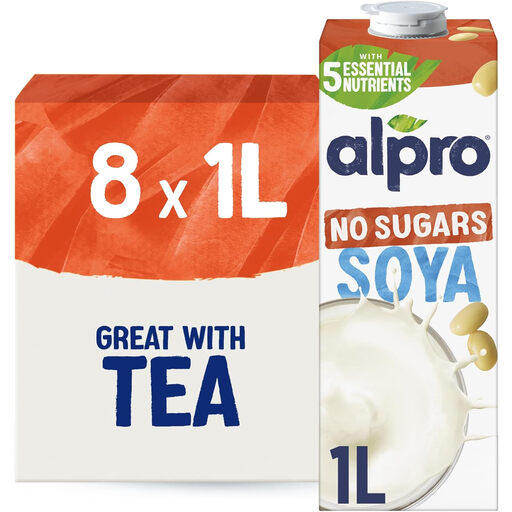
The 8 x 1L format allows a drink to be poured for dinner at home but does not provide sealed individual lunchbox portions. Before choosing it as a regular drink for a child aged 1 or over, check the current pack for calcium fortification, age suitability and allergens.
No. NHS guidance says to continue breastfeeding or giving first infant formula until at least age 1; a soya drink should not replace either for a younger baby.
Start with whether it is unsweetened and calcium-fortified, then read the current label for its other listed nutrients and allergens. NHS North West Knowledge Now identifies unsweetened fortified soya as a first-choice plant-based option in its guidance for children aged 1 or over with cow’s-milk-protein allergy.
No. Although the pack is labelled for ages 1–3, the ingredient list published by Asda includes raw cane sugar and fructose. Check the current pack if an unsweetened drink is what you need.
Yes. The Alpro Growing Up multipack is labelled dairy-free but declares soya. Check the carton’s current allergen statement and the nursery’s own arrangements before putting it in a lunchbox.