What matters when choosing a soya drink?
Decide whether the drink is for cooking or for drinking, then check age suitability before comparing cartons and pack sizes.
| Priority |
What to check |
Your needs |
| Age and intended use |
Department for Education guidance says plant-based drinks should be avoided before 12 months, apart from small amounts in cooking. Check the carton’s age guidance before considering it as a drink after the first birthday. |
I’m buying an ingredient for a weaning recipe, not a replacement for my baby’s main milk feed. If it would replace milk for an older child, I need to establish that the exact product is appropriate. |
| Fortification |
Compare unsweetened status and the stated calcium, iodine and vitamin additions on each carton. The UK Scientific Advisory Committee on Nutrition and Committee on Toxicity report that the nutrient content of plant-based drinks varies considerably. |
For an age-appropriate use, I want to compare what the drink actually contains rather than assume every soya drink has the same added nutrients. |
| Allergens |
Read the ingredients and allergen statement on the exact pack. Soya is an allergen, and some products also carry nut or peanut warnings. |
A dairy-free label does not answer whether a drink is suitable when soya, nuts or peanuts are also a concern. |
| Pack size and storage |
Check the stated volume, whether cartons are individually sealed, and the refrigeration and use-after-opening instructions. Do not treat a search for a 4-pint pack as confirmation of that format. |
For occasional cooking, I’d compare the amount in each carton with how much the household will use after opening. |
Which brands offer relevant soya drinks?
These brand and retailer examples show why the exact variant and its label matter; a standard drink and a child-specific range should not be treated as interchangeable.
Alpro
Alpro has standard soya drinks as well as a separate Growing Up range.
- ASDA lists calcium and vitamins B2, B12 and D for Alpro Soya No Sugar Long Life Drink 1L.
- That standard drink’s listed additions do not establish its suitability as a main drink for a child under two; check the exact variant and age guidance.
Tesco
Tesco lists an own-label unsweetened soya drink in a 1-litre carton.
- Tesco’s product information lists added calcium, iodine and vitamins B2, B12 and D2.
- An ingredient list alone does not establish that an ordinary soya drink should replace an infant’s main milk feed.
Asda
Asda lists own-label and branded 1-litre soya drinks.
- Its Just Essentials Unsweetened Soya Drink identifies soya in the allergen advice.
- The same product information says it may contain nuts. Check fortification and warnings for each variant rather than inferring them from the retailer.
Waitrose
Waitrose lists an Essential Unsweetened Soya Drink.
- Its product information gives an explicit age warning that can be checked before buying.
- Waitrose states that this drink is not suitable for children under two years old.
M&S
M&S lists an Unsweetened Soya Drink in its Plant Kitchen range.
- The product information makes its nut and peanut warnings explicit.
- M&S states that this product is not suitable for people with a nut or peanut allergy.
Joybuy soya drink for cooking
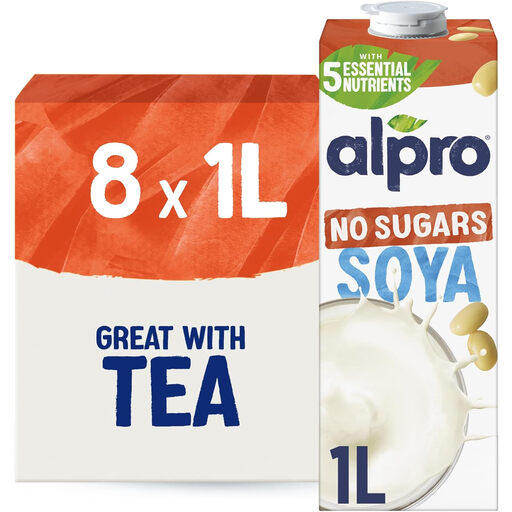
This Alpro multi-carton option is relevant when a small amount of soya drink is needed for cooking during weaning. Its 8 × 1 L format is not a 4-pint bottle, and a standard soya drink should not be chosen as an infant’s main milk feed.
 No image available
Alpro Soya No Sugars Long Life Drink 8 × 1 L
For small amounts used in weaning recipes, rather than as a baby’s main drink. The listed format is eight 1-litre cartons, not one 4-pint bottle; check the exact carton for age guidance, fortification, allergens and instructions after opening.
View on Joybuy
Questions about soya drink and weaning
Can a baby starting solids have ordinary soya drink?
Not as a main drink before 12 months. Department for Education guidance says plant-based drinks should be avoided before that age, although small amounts can be used in cooking; breast milk or suitable infant formula remains the main milk feed.
Can I use soya drink in weaning recipes?
Small amounts of plant-based drink can be used in cooking before 12 months under Department for Education guidance. NHS milk-free-diet guidance discusses cooking use from six months; this does not make a standard soya drink suitable as an infant’s main drink.
Does soya drink contain dairy?
A soya drink labelled dairy-free is not a dairy milk drink, but it contains soya, which is an allergen. Check the exact pack for its ingredients and any additional warnings, including those concerning nuts or peanuts.
What should I check after a child’s first birthday?
Check the exact drink’s age suitability and intended use first. If it is appropriate for the child, compare unsweetened status and stated fortification; where it would replace milk because of an allergy or restricted diet, discuss the choice with a health professional.
Should I expect a 4-pint soya drink pack?
Check the stated volume rather than assuming a 4-pint format. The Tesco, Asda, Waitrose and M&S examples discussed here are 1-litre products, while the Joybuy Alpro option is eight 1-litre cartons; also check how each carton must be stored after opening.


