Who is the drink for?
The intended drinker changes the decision: an adult’s everyday carton, a baby’s main milk drink and a toddler’s dairy-free option are not interchangeable.
Adults replacing dairy
For cereal, drinks or cooking, compare unsweetened soya cartons by their ingredients and fortification. The NHS advises breastfeeding parents choosing dairy alternatives to look for calcium and vitamin D, and iodine if following a vegan diet.
Parents of babies under 12 months
A standard supermarket soya drink is not a substitute for breastmilk or appropriate infant formula as a baby’s main milk drink. NHS-linked feeding guidance makes this distinction even though plant drinks may be used in cooking from six months.
Parents of children aged one to three
For a child who tolerates soya, check the product’s age label, ingredients and fortification. A general age threshold does not override a warning on an individual carton: Waitrose Essential Unsweetened Soya Drink, for example, is labelled as unsuitable for children under two.
What should you check before buying?
Identify who will drink it before comparing cartons. Age suitability and allergens can rule out an option regardless of its sugar or fortification details.
Adult parent
Choose this route: An ordinary soya drink can be an everyday dairy-free option for an adult who tolerates soya.
Keep in mind: Plant drinks differ in fortification, so the words “dairy-free” do not settle the nutrient comparison.
Baby under one
Main milk drink: Use breastmilk or appropriate infant formula, not an ordinary retail soya drink, in line with NHS-linked feeding guidance.
Keep in mind: If an allergy is suspected, ask a health professional about the appropriate feeding option rather than switching to a standard soya carton.
Child over one
Consider: An age-appropriate soya option for a child who tolerates soya, with the exact pack’s guidance checked.
Keep in mind: Age-labelled growing-up drinks and unsweetened adult cartons have different ingredients and may carry different age warnings.
| Priority |
What to check |
Your needs |
| Infant feeding |
Check whether the drink is intended as a main milk drink or for cooking. NHS-linked guidance permits plant drinks in cooking from six months but says they must not replace breastmilk or formula as the main drink before age one. |
If I’m feeding a baby under one, I need breastmilk or appropriate infant formula for their main milk drink, not a supermarket soya carton. |
| Age guidance |
Read the age statement on the exact pack. Waitrose labels its Essential Unsweetened Soya Drink unsuitable for children under two; Alpro Growing Up is labelled for ages one to three and over. |
For a toddler, I want to know whether this particular drink is labelled for my child’s age before considering its other features. |
| Fortification |
Compare calcium and vitamin D on adult dairy alternatives; check iodine if following a vegan diet, as the NHS advises. A 2025 UK government summary of the SACN and COT assessment says nutrient content varies considerably between plant drinks. |
For my own dairy-free meals and drinks, I want to compare what the carton is fortified with rather than rely on “plant-based” wording. |
| Allergens |
Check the current allergen declaration and any product-specific warning. Soya itself may be unsuitable, and M&S says its Unsweetened Soya Drink is not suitable for people with nut or peanut allergy. |
If someone in the household has a food allergy, I need to check the exact product. A dairy-free label alone does not tell me whether it suits them. |
| Sugars and use |
Compare sugars using the same stated basis, such as per 100 ml, and read the ingredients as well as “unsweetened” wording. Check the carton’s storage and hot-drink instructions. |
I’d prefer an unsweetened drink for regular adult use and need to know how to store it after opening or add it to tea and coffee. |
Brand and range references
These range details help distinguish adult cartons from age-labelled drinks; a brand name alone does not determine whether a particular product suits the intended drinker.
Alpro
Alpro lists both standard soya drinks and a separate Growing Up product with age-specific labelling.
- Alpro UK lists 0 g sugars, 3.3 g protein, 120 mg calcium and 22.5 µg iodine per 100 ml for Soya No Sugars Drink.
- Alpro Growing Up is labelled for children aged one to three and over; that does not make it an infant-formula substitute or the same product as an unsweetened adult drink.
Tesco
Tesco Longlife Soya Drink Unsweetened is an own-label adult-use carton.
- Tesco lists added calcium, iodine, vitamin B12, riboflavin and vitamin D2.
- Tesco advises checking the physical pack because recipes and allergen information can change.
Waitrose
Waitrose Essential Unsweetened Soya Drink is a fortified long-life option with a product-specific age warning.
- Waitrose lists added calcium, vitamin D, vitamin B12, vitamin B2 and iodine.
- The product page warns that this drink is not suitable for children under two years old.
M&S
M&S Unsweetened Soya Drink is a fortified carton in its Plant Kitchen range.
- M&S lists added calcium, iodine, vitamin D and vitamin B12.
- Its product page states that the drink is not suitable for people with nut or peanut allergy.
Joybuy options for adult use
The option below is an Alpro soya drink for an adult parent seeking a dairy-free everyday carton. Its inclusion does not make it suitable as a baby’s main milk drink or establish that it suits a toddler.
 No image available
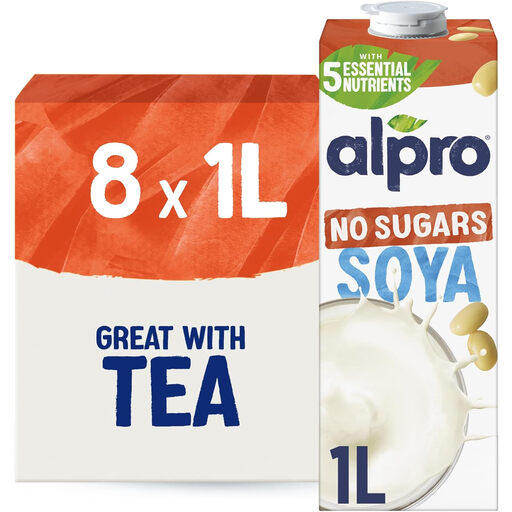
Alpro Soya No Sugars Long Life Drink 8 x 1L
An option for an adult parent who wants a soya drink for everyday dairy-free use. The listing identifies an 8 x 1L pack; check the current pack’s fortification and allergen information before buying. It contains soya and is not a substitute for an infant’s main milk drink. Refrigerate after opening and use within five days; do not freeze.
View on Joybuy
Questions about soya drinks
Can ordinary soya milk replace infant formula for a baby under one?
No. NHS-linked feeding guidance says an ordinary plant drink should not replace breastmilk or appropriate infant formula as a baby’s main milk drink before age one. The Competition and Markets Authority describes infant formula as the only breastmilk substitute that can, by itself, meet healthy babies’ nutritional requirements in the first months of life.
What should a breastfeeding parent check in a dairy-free soya drink?
For the parent’s own diet, NHS guidance advises choosing a dairy alternative fortified with calcium and vitamin D, plus iodine if following a vegan diet. It also suggests lower-sugar choices where possible. Those adult-diet checks do not establish that the carton is suitable for a baby.
Does cow’s-milk-protein allergy make a soya drink suitable for a child?
Not automatically. NHS-linked guidance notes that some children with cow’s-milk-protein allergy also react to soya. Follow the child’s clinical allergy plan and seek professional advice about a suitable feeding option rather than substituting an ordinary soya carton.
Does “dairy-free” cover other food allergies?
No. Soya is itself an allergen, and an individual drink may carry further warnings. M&S, for example, states that its Unsweetened Soya Drink is not suitable for people with nut or peanut allergy. Check the current pack for the exact product.
How should an opened long-life soya drink be stored?
Follow the instructions on that carton rather than another product’s storage window. Tesco says to refrigerate its Longlife Soya Drink Unsweetened after opening and not to freeze it; Waitrose says to refrigerate its Essential Unsweetened Soya Drink and consume it within three days of opening.


