Gym-goers who need a gluten-free drink
Check the exact carton for an explicit gluten-free claim, then compare protein and sugars per serving. If the drink is part of a post-gym snack, consider what food will accompany it.


Choose a soya drink with an explicit gluten-free claim, then compare the protein in the amount you will actually drink. A higher-protein carton can make a larger contribution after a session lasting over an hour; for a shorter session or a snack alongside other food, a standard gluten-free drink may suit your plans. Being soya-based or unsweetened does not, by itself, confirm gluten-free status.
Check the exact carton for an explicit gluten-free claim, then compare protein and sugars per serving. If the drink is part of a post-gym snack, consider what food will accompany it.
A soya drink may fit a plant-based snack, but vegan and dairy-free labels do not establish gluten-free status. Soya is also an allergen, so check the declaration on the product you choose.
Unsweetened soya drinks vary in protein and fortification. If you must avoid gluten, confirm an explicit claim on the current product rather than assuming that every own-label carton has one.
Start with the gluten-free claim if it is a requirement, then assess the intended serving and the rest of your snack.
| Priority | What to check | Your needs |
|---|---|---|
| Gluten-free label | Look for an explicit claim on the exact current carton. If a particular third-party certification matters to you, check for its mark separately: a gluten-free claim does not establish that certification. The Food Standards Agency states that food labelled gluten free must contain no more than 20 mg/kg gluten. | I need a drink I can identify as gluten free from its current label, not just from the fact that it contains soya. |
| Protein per serving | Compare grams per 100ml and multiply by the volume you plan to drink. Alpro UK lists 5.0g per 100ml for its Soya High Protein Drink: Plain and 3.3g per 100ml for Soya Original. Check the precise variant rather than transferring either figure to another Alpro product. | After a session lasting over an hour, I want to know how much protein the drink contributes. The British Heart Foundation says extra protein alongside carbohydrate can be useful after exercise of that duration. |
| Food alongside the drink | Consider the length and intensity of the session and when you next plan to eat. The British Heart Foundation discusses protein alongside carbohydrate after exercise lasting over an hour; the British Nutrition Foundation notes that needs vary with activity amount and intensity. | If this is my whole post-gym snack, I want to consider whether it needs food alongside it. After a shorter session, my usual meals may already fit my plans. |
| Sugars and fortification | Read sugars per 100ml and the listed nutrients on the exact product. Alpro UK lists 2.5g sugars per 100ml for both its High Protein Plain and Original drinks. Retailer own-label nutrition panels differ, as do their gluten-free claims. | For a drink I use regularly, I may prefer an unsweetened option and want to compare its declared nutrients without assuming it meets my gluten-free requirement. |
| Other allergens | Check the soya declaration and any nut or peanut warnings on the current pack. ASDA lists a possible nut warning for its unsweetened soya drink, while Marks & Spencer flags nut and peanut unsuitability for its Unsweetened Soya Drink. | Even when gluten is my main concern, I need to check any other allergens that apply to me. |
Those descriptions answer different questions. For products sold with a gluten-free claim, the Food Standards Agency specifies a limit of no more than 20 mg/kg gluten; the type of drink alone does not confirm that claim.
When gluten-free labelling is essential, look for it on the exact current carton. Check separately for a certification mark if you specifically require one.
Alpro UK lists 5.0g protein per 100ml for Soya High Protein Drink: Plain, which works out at 12.5g in 250ml. The British Heart Foundation cites 15–30g protein alongside carbohydrate after exercise lasting over an hour, so that serving alone falls below its cited range.
Calculate protein from the nutrition panel and your actual serving. Consider the other food in the snack rather than treating the drink as the whole meal.
Protein figures and allergen information differ between products, and an unsweetened label does not establish gluten-free status.
Compare the current carton’s gluten-free wording, nutrition panel and allergens before substituting it for a drink you already use.
A gluten-free claim does not address a soya allergy. Some soya drinks also carry nut or peanut warnings.
Read the full allergen declaration and any precautionary wording on the exact carton, including when buying a familiar product again.
These examples help distinguish specific product labels and nutrition panels; a retailer’s range does not make every soya drink in it gluten free.
Alpro UK explicitly labels its Soya High Protein Drink: Plain and Soya Original Drink gluten free. Compare those exact variants rather than applying their nutrition figures to other cartons.
Tesco lists Alpro and own-label products in its soya-drinks range.
Sainsbury's lists an Unsweetened Long Life Soya Drink for shoppers comparing own-label options.
ASDA lists both its Plant Based Unsweetened Soya drink and Alpro High Protein Soya Original. Their allergen and gluten-related wording should be assessed product by product.
M&S Unsweetened Soya Drink offers another nutrition panel to compare, with a different measurement basis from panels stated per 100ml.
Waitrose Essential Unsweetened Soya Drink is an own-label option with a published per-100ml nutrition panel.
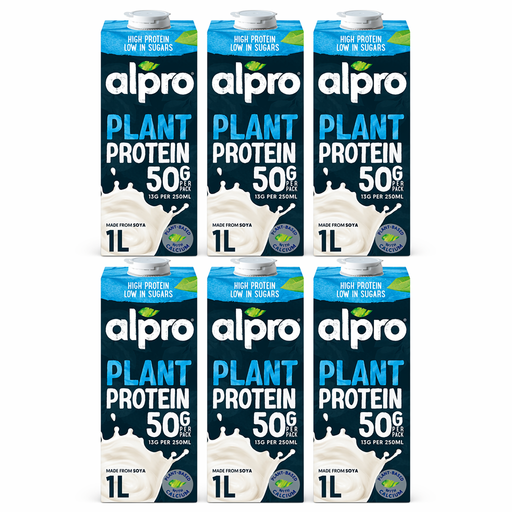
These Joybuy listings cover a Plant Protein soya drink and a No Sugars long-life soya drink. Compare their current cartons for gluten-free wording, protein per serving and allergens before deciding which fits your post-gym snack.
 No image available
Consider this Plant Protein drink when you want the drink to contribute protein to a post-gym snack. Check the exact carton for its gluten-free wording, protein per serving and soya allergen declaration; consider food alongside it after a longer session.
 No image available
This 8 x 1L long-life soya drink suits a comparison focused on the No Sugars variant. If it forms part of a post-gym snack, check the current carton’s gluten-free claim and protein per serving, and consider what food you will have with it.
The Food Standards Agency states that food labelled gluten free must contain no more than 20 mg/kg gluten. Look for that explicit claim on the current product; the claim does not, by itself, establish that a carton carries a particular third-party certification mark.
No. The British Heart Foundation places more emphasis on regular meals containing protein after exercise lasting less than an hour; it says extra protein alongside carbohydrate can be useful after sessions lasting over an hour. Compare the drink’s actual serving contribution with the food you plan to eat.
Do not assume the drink alone covers what you want from the snack. Alpro UK lists 5.0g protein per 100ml for its Soya High Protein Drink: Plain, or 12.5g in 250ml. For exercise lasting over an hour, the British Heart Foundation cites 15–30g protein alongside carbohydrate; consider your serving and any accompanying food.
No. Unsweetened and vegan describe different product characteristics. If you require a gluten-free drink, check the exact current carton for an explicit gluten-free claim rather than inferring one from those descriptions.
Yes. A gluten-free claim does not address soya, nut or peanut allergies. Check the full declaration and precautionary warnings on the exact carton; ASDA and Marks & Spencer product information shows that warnings differ between soya drinks.