Families stocking drinks for snack time
A long-life carton can fit a cupboard-stocking plan for cereal, smoothies or drinks. Compare sugars and fortification, then check how quickly your household will use each carton once opened.


For routine half-term breakfasts and snacks, start by comparing unsweetened, fortified long-life soya drinks rather than assuming every carton has the same nutrients. If the drink is for a child aged 1 year or over, the British Society for Allergy & Clinical Immunology advises choosing an unsweetened, fortified plant drink; check the exact carton’s age guidance, allergen information and instructions after opening.
A long-life carton can fit a cupboard-stocking plan for cereal, smoothies or drinks. Compare sugars and fortification, then check how quickly your household will use each carton once opened.
For children aged 1 year or over, the British Society for Allergy & Clinical Immunology advises unsweetened, fortified plant drinks where they are used. Check the individual product’s age statement; seek professional dietary advice if allergies, a restricted diet or growth are concerns.
If you want a soya drink with little or no sugar, compare the nutrition panels as well as the front of the carton. The UK SACN/COT assessment notes that nutrient composition varies considerably across plant-based drinks.
Start with the intended use and the person drinking it, then compare the same label details across cartons. A long-life format does not replace the storage instructions for an opened carton.
| Priority | What to check | Your needs |
|---|---|---|
| Sugars | Compare “of which sugars” using the same quantity on each nutrition panel. Check whether the carton is unsweetened or sweetened. | I’m choosing a drink for regular snacks and want to know how much sugar the particular carton contains. For children aged 1 year or over, the British Society for Allergy & Clinical Immunology advises an unsweetened option where plant drinks are used. |
| Fortification | Look for calcium, iodine, riboflavin (vitamin B2), vitamin B12 and vitamin D on the exact carton. Do not assume an organic or soya label tells you which nutrients have been added. | If I’m using a plant drink instead of a dairy drink, I want to compare its listed nutrients rather than treat all soya cartons as interchangeable. The UK SACN/COT assessment reports considerable variation in plant-drink composition. |
| Protein and age | Compare protein using the same labelled quantity, and read the product’s age statement. Check separately whether it is described as suitable as a main milk-drink alternative. | For a child, I need the guidance for this carton, not just the words “soya drink”. Sainsbury’s says its Unsweetened Long Life Soya Drink can be used from age 1 as part of a balanced diet, but not as a main milk-drink alternative for children under 2. |
| Allergens | Read the current ingredients and allergen information on the exact pack, including any product-specific warnings. Check again when changing variants or brands. | Someone in my household has a food allergy, so I need to check the carton before serving it. A soya drink is not an option for someone with a soya allergy. |
| Storage | Check the unopened-carton directions and the separate refrigeration and use-by instructions after opening. Consider the carton size alongside how often it will be used. | I may stock up for half term, but I still need to finish each opened carton within its own labelled period. |
The UK SACN/COT assessment says plant-based drinks vary considerably in nutrient composition, so the category name does not tell you what a carton contains.
Compare the exact nutrition and ingredients labels for sugars, protein and the nutrients relevant to your choice.
Packaging aimed at families does not replace the sugar, fortification and age information on the carton. The British Society for Allergy & Clinical Immunology advises unsweetened, fortified plant drinks where they are used for children aged 1 year or over.
Read the nutrition panel and the product-specific age statement before deciding how to use it.
Long-life describes the unopened product; an opened carton has its own storage directions.
Refrigerate and use it according to the instructions on that pack, noting the date you opened it if helpful.
A large carton may be impractical if the household cannot finish it within its labelled period after opening.
Allergen information is product-specific, so a familiar brand name or an older listing is not a substitute for the current pack.
Check the ingredients and allergen declaration on the carton you intend to serve; avoid soya drink for anyone with a soya allergy.
These examples help identify variants and label details to compare; a brand’s wider range should not be assumed to have the same composition as a particular carton.
Waitrose lists an Alpro No Sugars long-life soya drink with added calcium, iodine and vitamins B2, B12 and D2.
Tesco Groceries lists own-label long-life soya drinks in unsweetened and sweetened variants.
Sainsbury’s lists an Unsweetened Long Life Soya Drink fortified with calcium, iodine, vitamin D and vitamin B12.
M&S Plant Kitchen has soya-drink variants, including an unsweetened product listed with calcium, iodine, vitamin D and vitamin B12.
Waitrose & Partners lists Essential Unsweetened Soya Drink as a UHT product fortified with calcium, iodine and vitamins D, B12 and B2.
This long-life, no-sugars soya-drink bundle is an option for households planning cereal, smoothies or drinks across half term. Check whether the bundle size suits your use of each carton after opening.
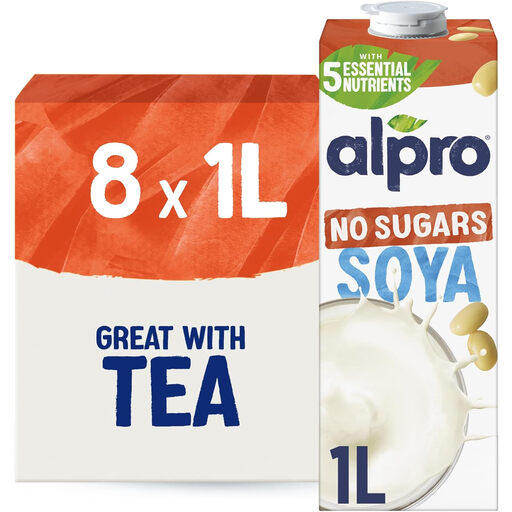 No image available
The long-life bundle can be considered for half-term cereal or smoothies if your household can use each opened carton within its labelled storage period. Check the exact pack’s allergen information and age guidance before serving it to a child.
Compare sugars, protein and listed fortification on the exact soya-drink carton, alongside its allergen and storage instructions. The UK SACN/COT assessment notes that plant-based drinks vary considerably in nutrient composition, so the category name alone is not enough for a like-for-like choice.
The British Society for Allergy & Clinical Immunology advises unsweetened, fortified plant drinks where they are used for children aged 1 year or over, but the individual carton’s age wording still matters. Sainsbury’s says its Unsweetened Long Life Soya Drink can be used from age 1 as part of a balanced diet, but not as a main milk-drink alternative for children under 2. Ask a dietitian about a restricted diet, allergies or growth concerns.
No: long-life storage applies to the unopened carton. Once opened, follow that product’s refrigeration and use-within instructions rather than applying the directions from a different drink.
No. Check the organic soya drink’s own nutrition and ingredients labels for calcium, iodine and vitamins if those nutrients matter to your choice; do not assume its composition matches a fortified carton.
Read the ingredients and allergen information on the exact carton each time you choose a product or variant. Soya drink is unsuitable for someone with a soya allergy, and any additional product-specific warnings need to be checked on that pack.