What should you check before buying?
Decide first whether organic certification or nutrients added to the drink are essential to your choice. Then compare the cartons on the features you will use day to day.
Organic soya drink
Consider it: When an organic-labelled recipe is the priority and you can assess the rest of your diet separately.
Trade-off: GOV.UK states that UK organic plant-based drinks cannot be fortified with nutrients.
Fortified soya drink
Consider it: When you regularly replace dairy and need particular labelled nutrients from the drink itself.
Trade-off: A fortified UK plant-based drink cannot also carry an organic claim; check which nutrients its own carton lists.
| Priority |
What to check |
Your needs |
| Organic status |
Look for the organic label and certification information on the pack. GOV.UK sets rules for certifying and labelling organic food; a plant-based description alone is not an organic claim. |
I want to confirm the carton meets my organic requirement, rather than choosing it because the recipe sounds natural. |
| Ingredients and sugar |
Read the ingredients and the sugars figure per 100 ml; check a no-added-sugar or no-sugars declaration if that distinction matters. Sainsbury’s describes standard Plenish Organic Soya as soya beans and spring water with no added sugar. |
For regular tea, cereal or cooking, I would choose a recipe and sugar declaration that match what I want to use each day. |
| Protein |
Compare protein per 100 ml on the cartons. ASDA lists 3.3 g per 100 ml for Alpro Organic Soya No Sugars 1L; that figure alone does not establish equivalence with dairy. |
If soya drink is a frequent part of my breakfast, I want to compare its stated protein content without overlooking the other nutrients. |
| Added nutrients |
Check calcium, iodine, vitamin B12 and vitamin D individually on any fortified carton. GOV.UK says UK organic plant-based drinks cannot be fortified; Marks & Spencer lists all four nutrients as added to its Unsweetened Soya Drink. |
I use the drink regularly instead of dairy and want to know which nutrients would need to come from other foods if I choose organic. |
| Storage and use |
Check whether the carton is UHT or long-life, then follow its storage and use-after-opening instructions. Compare a standard recipe with a barista recipe if coffee foam matters. |
In a smaller household, I need a carton whose opening instructions fit how quickly we use it. For coffee, foam may matter more to me than it does for cereal. |
| Soya allergy |
Read the current ingredients and allergen declaration. The Food Standards Agency identifies soya as an allergen; a milk-free claim does not mean soya-free. |
If anyone in my household has a soya allergy, I need a drink that does not contain soya. |
Brand and product-line references
These examples show different label and recipe choices; a brand name alone does not establish the properties of every drink it sells.
Alpro
ASDA lists an Alpro Organic Soya No Sugars long-life drink in a 1-litre carton. Compare its exact label with any other Alpro soya drink rather than carrying features across the range.
- ASDA lists 0 g sugars and 3.3 g protein per 100 ml for that organic product.
- Its organic status does not imply added calcium, iodine, vitamin B12 or vitamin D: GOV.UK says UK organic plant-based drinks cannot be fortified.
Plenish
The standard organic soya drink and organic barista soya drink illustrate a recipe-led choice and a coffee-use choice, respectively.
- Sainsbury’s describes the standard drink as made with organic soya beans and spring water, without added sugar, oils or additives.
- Waitrose describes the barista drink as foamable; check its own ingredients and nutrition rather than assuming they match the standard drink.
M&S Plant Kitchen
The M&S Unsweetened Soya Drink provides a label comparison for shoppers considering added nutrients instead of an organic-labelled option.
- Marks & Spencer lists added calcium, iodine, vitamin D and vitamin B12 for this drink.
- Do not assume it meets an organic-only requirement; check the label for the claim you require.
Soya drink on Joybuy
For an Alpro soya drink you are considering for everyday use, check the actual carton’s organic claim, ingredients and nutrition against the priorities above.
 No image available
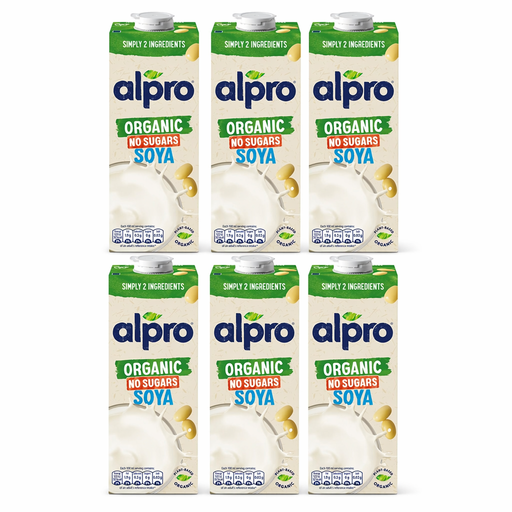
6 Alpro Soya Drink OG
For cereal or hot drinks, compare this soya drink’s current carton with your requirements for organic certification and sugar content. If it will regularly replace dairy, also check the listed calcium, iodine, vitamin B12 and vitamin D; avoid soya drinks for anyone with a soya allergy.
Joybuy
Common questions
How do I check whether a soya drink is organic?
Look for the organic label and certification information on its pack. GOV.UK sets rules for certifying and labelling organic food, so “plant-based” or a simple ingredient list does not by itself answer the organic question.
Does organic soya drink have the same nutrients as dairy milk?
Do not assume it does. GOV.UK says plant-based drinks vary considerably in nutrient content and UK organic versions cannot be fortified; if you use one instead of dairy regularly, check its label for calcium, iodine, vitamin B12 and vitamin D and consider how the rest of your diet supplies them.
What if calcium intake matters after menopause?
Check how an organic soya drink fits with your other sources of calcium rather than relying on its organic label. The British Dietetic Association identifies post-menopausal people as being at greater risk of calcium deficiency and lists calcium-fortified plant-based drinks as a non-dairy source; GOV.UK says UK organic plant-based drinks cannot be fortified. Seek individual dietary advice if you depend on the drink for calcium.
Can someone with a soya allergy drink a milk-free soya product?
No: a milk-free claim does not mean the product is free from soya. The Food Standards Agency identifies soya as an allergen, so avoid soya drinks for anyone with a soya allergy and check the current allergen declaration on any alternative.
Does long-life mean the carton keeps after opening?
No: long-life or UHT describes the product before opening, not an indefinite period afterwards. Check the particular carton’s refrigeration and use-after-opening instructions, especially if a smaller household will use it over several days.


