What should you check first?
Start with the child’s age and whether the drink is going into food or being considered as a regular drink. Then compare fortification, organic status, allergens and sugars on the exact carton.
| Priority |
What to check |
Your needs |
| Age and use |
Check the intended age and any carton warning. North East London NHS Foundation Trust says plant drinks may be used in weaning foods from around 6 months, but not as the main milk drink before age 1. |
I’m adding a little to food, not replacing breast milk or infant formula before my baby turns 1. |
| Fortification |
Look for added calcium and iodine on the exact label. Frimley Healthier Together NHS guidance for dairy-free alternatives gives at least 120 mg calcium per 100 ml as a label check. |
If my child needs a regular dairy-free drink after age 1, I want to compare its added nutrients as well as its ingredients. |
| Organic status |
Check the organic labelling separately from the nutrition panel. Defra describes organic as a production and certification designation; it does not indicate calcium or iodine fortification. |
Organic production matters to me, but I don’t want to assume an organic carton has the same added nutrients as a fortified one. |
| Allergens |
Read the soya declaration and any precautionary allergen statement. NHS advice is to introduce foods that can trigger allergic reactions one at a time and in very small amounts. |
I need to know whether my baby tolerates soya and whether this particular carton carries another relevant allergy warning. |
| Sugars |
Compare the ingredients list and sugars per 100 ml as well as fortification: a sweetened drink can also contain added calcium and iodine. Check the product’s age advice independently. |
When comparing fortified drinks, I’d like to distinguish an unsweetened carton from a sweetened one rather than treating them as interchangeable. |
Brand and retailer examples
These product-line examples show why organic status, fortification and age or allergy warnings need checking separately; they are not interchangeable recommendations.
Alpro
Alpro has distinct organic and growing-up soya drinks.
- Waitrose & Partners lists water and organically grown hulled soya beans for Alpro Organic No Sugar.
- A separate Alpro Growing Up drink is labelled 1–3+ by ASDA Groceries; that age label must not be transferred to the organic drink.
Tesco
Tesco Groceries lists organic branded drinks alongside its own-label soya options.
- Its soya-drinks category includes Alpro Organic, Plenish Organic, and Tesco unsweetened and sweetened options.
- Use each product’s own label to compare fortification, sugars and age advice; a category listing does not establish those details for every carton.
Sainsbury’s
Sainsbury’s listings include both sweetened and no-sugars fortified soya drinks.
- Its Alpro Soya No Sugar listing names added calcium, iodine and vitamins B2, B12 and D2.
- The Sainsbury’s Sweetened Soya Drink listing also names fortification, but warns that this particular drink is not suitable as a main milk-drink alternative for children under 2.
Asda
ASDA Groceries lists an own-label unsweetened soya drink with stated nutrient amounts.
- Plant Based by ASDA Unsweetened Soya lists 122 mg calcium and 35 µg iodine per 100 ml.
- That product’s allergen information says it contains soya and may contain nuts; check its full carton before choosing it for a child.
M&S
Marks & Spencer lists an unsweetened, fortified soya drink.
- Its Unsweetened Soya Drink listing names added calcium, iodine, vitamin D and vitamin B12.
- Marks & Spencer labels this specific drink unsuitable for people with a nut allergy.
Waitrose
Waitrose & Partners lists organic branded soya drinks and an own-label fortified option.
- Its Essential Unsweetened Soya Drink listing names added calcium, iodine and vitamins D, B12 and B2.
- That Essential drink carries an under-2 age warning. The separately listed Plenish Organic drink may contain nuts; check each product’s own label.
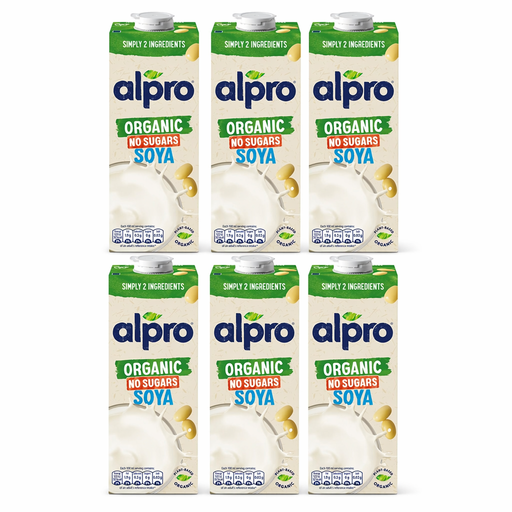
Soya drink option on Joybuy
This soya drink is an option to examine for cereal or cooking when organically grown soya is the preference. Check its carton before considering any regular-drink use for a child.
 No image available
6 Alpro Soya Drink OG
A soya drink listed for cereal or cooking with organically grown soya. If using it in weaning foods, check the soya allergen statement; check the carton’s calcium, iodine and child-specific age guidance before considering regular use. A plant drink must not replace breast milk or infant formula as the main drink before age 1.
View on Joybuy
Questions about soya drink and weaning
Does organic soya drink have added calcium and iodine?
Not necessarily. Organic labelling concerns production and certification, not fortification. Check the ingredients and nutrition panel of the exact carton if added calcium and iodine matter to your choice.
Can I use soya drink in food before my baby turns 1?
Yes, as part of weaning foods from around 6 months, but not as the main milk drink before age 1. North East London NHS Foundation Trust makes this distinction for plant drinks generally, whether organic or not.
What should I check if my child over 1 needs a regular dairy-free drink?
If your child tolerates soya, compare unsweetened drinks fortified with calcium and iodine, and read each carton’s age warning. Frimley Healthier Together NHS guidance gives at least 120 mg calcium per 100 ml as a label check for a dairy-free alternative; seek individual advice for a medically restricted diet.
Is soya drink dairy-free, and can soya cause an allergic reaction?
The soya drinks discussed here are plant-based, but soya itself can trigger an allergic reaction. NHS guidance advises introducing foods that can trigger reactions one at a time and in very small amounts; ask a health professional for advice where your baby has a diagnosed allergy or eczema.
Can I choose soya drink automatically if my child has a cow’s-milk protein allergy?
No. Hertfordshire and West Essex Clinical Guidance says to avoid soya milk if the child is also allergic to soya. Follow your child’s clinical plan when choosing a non-dairy alternative rather than substituting a drink solely because it is dairy-free.


