Carers starting baby-led weaning
From around six months, a plant drink can be used in cooking, according to NHS-linked guidance. Breast milk or first infant formula remains the main milk drink until at least age one.


For a baby under one, do not replace breast milk or first infant formula with an ordinary soya drink: NHS guidance says to continue those milk feeds until at least age one. NHS-linked guidance allows plant drinks in cooking from around six months, so check the carton’s ingredients and fortification if using soya in weaning food. After age one, compare the exact product’s nutrients and age wording; a vegan label does not remove the need to check for soya allergy.
A soya drink has a different role in a baby’s food before age one than it may have in a toddler’s diet. Allergy history can change the decision at either stage.
From around six months, a plant drink can be used in cooking, according to NHS-linked guidance. Breast milk or first infant formula remains the main milk drink until at least age one.
After age one, compare the exact carton’s fortification, sugars, energy, protein and age wording. A standard unsweetened drink and a product labelled for ages one to three do not have identical nutrition panels.
Soya can trigger an allergic reaction even when a product is dairy-free. NHS guidance recommends introducing foods that can trigger allergy one at a time from around six months and seeking GP or health-visitor advice before introduction where a baby has an existing allergy, eczema or relevant family history.
Decide whether the drink is for cooking or for a child over one, then check the individual carton. Fortification and age warnings matter more than the word “vegan” alone.
| Priority | What to check | Your needs |
|---|---|---|
| Age and use | Check whether the drink is going into food or replacing a milk feed. NHS guidance says breast milk or first infant formula should continue until at least age one; NHS-linked guidance allows plant drinks in cooking from around six months. | For porridge or pancakes during weaning, I need an ingredient for food, not a replacement for my baby’s usual milk feeds. |
| Fortification and nutrition | Read the current panel for calcium, iodine, vitamin D and vitamin B12. The NHS advises attention to fortified dairy alternatives and these nutrients in a vegan diet; compare energy and protein using the same stated quantity. | I want to know what this particular carton contributes to my child’s diet, rather than assume all soya drinks contain the same added nutrients. |
| Sugars and product type | Compare sugars per 100ml on the cartons you are considering. Distinguish a standard unsweetened drink from an age-labelled growing-up drink, and read its ingredients as well as its front label. | If I am choosing an everyday drink for a child over one, I want to understand the difference between unsweetened and growing-up formulations. |
| Allergens and age warnings | Check the current ingredients, allergen declaration and age statement. NHS guidance identifies soya as a potential allergen; Waitrose’s Essential Unsweetened Soya Drink listing warns that it is not suitable for children under two. | Before offering soya, I need to know whether it suits my child’s age and whether an allergy concern calls for professional advice. |
Being vegan or fortified does not make an ordinary plant drink a main milk drink for a baby under one. The NHS says to continue breast milk or first infant formula until at least that age.
Use a suitable plant drink in food preparation from around six months, rather than as a replacement milk feed. Seek professional advice about feeding where allergy is involved.
Waitrose & Partners lists Plenish Organic No Added Sugar Soya as containing water and organic soybeans. That ingredient list does not establish that the drink supplies added calcium, iodine or vitamins.
For a vegan child, check the nutrition and ingredients panels for the nutrients you are looking for instead of choosing by an “organic” or “natural” description alone.
Alpro labels its Soya Growing Up Drink for ages one to three, while Waitrose’s Essential Unsweetened Soya Drink listing warns against use for children under two. Similar-looking soya cartons can therefore lead to different age decisions.
Read the warning on the exact carton before using it for a child; do not apply another product’s age wording to it.
A vegan soya drink can still contain soya, which the NHS identifies as a food that can trigger allergic reactions.
Check the current allergen declaration. Introduce foods that can trigger allergy one at a time from around six months, and speak with a GP or health visitor before introducing soya if the baby has an existing allergy, eczema or relevant family history.
These examples show why the exact formulation and its warnings matter; a brand name alone does not establish suitability for a child.
Alpro lists both a standard No Sugars soya drink and a Growing Up Drink labelled for ages one to three.
Tesco lists an unsweetened own-label soya drink with added calcium, iodine and vitamins.
Waitrose lists an Essential Unsweetened Soya Drink fortified with calcium, iodine and vitamins.
M&S lists a Plant Kitchen unsweetened soya drink with added calcium, iodine, vitamin D and vitamin B12.
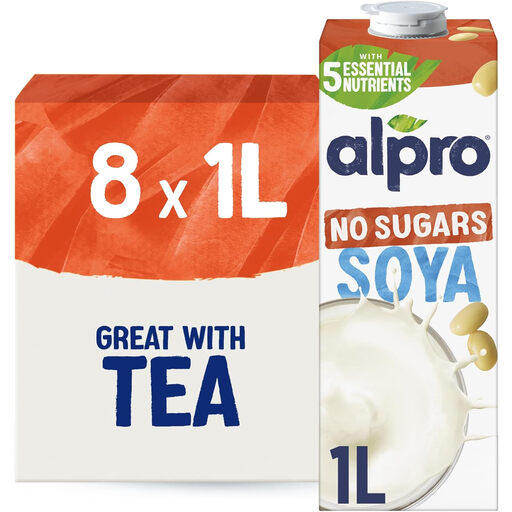
This Alpro No Sugars 8 x 1L multipack is an option for shoppers considering an unsweetened soya drink. For baby-led weaning, a suitable plant drink can go into food from around six months, but it must not replace breast milk or first infant formula as the main drink before age one.
 No image available
This unsweetened soya drink can be considered for cooking during weaning if soya is suitable for the baby; it is not a replacement for milk feeds before age one.
The Joybuy listing gives 0g sugars and 3.3g protein per 100ml and lists calcium and vitamins B2, B12 and D2. Check the current carton for its iodine content, age wording and allergen information before using it for a child.
No, not before age one. The NHS says to continue breast milk or first infant formula until at least then. NHS-linked guidance allows plant drinks in cooking from around six months, but not as the main milk drink before age one.
Check its age wording, ingredients and allergen declaration, then compare calcium, iodine, vitamin D, vitamin B12, sugars, energy and protein on the current nutrition panel. The NHS recommends attention to fortified dairy alternatives and key nutrients in a vegan diet; individual drinks and formulations differ.
A product accurately labelled vegan should not contain dairy, but that does not make it allergen-free. Soya itself can trigger an allergic reaction, so read the exact carton’s ingredients, allergen declaration and any precautionary wording.
The NHS advises introducing foods that can trigger allergy one at a time from around six months, so a reaction is easier to identify. If the baby has an existing allergy, eczema or a relevant family history, speak with a GP or health visitor before introducing soya.
Do not make that substitution without advice. NHS-linked guidance indicates that a baby with cow’s-milk allergy who is not breastfed may need a special formula, and soya may not suit every child. Discuss the feeding plan with the baby’s GP, health visitor or dietitian.