People who prefer a mild drink without sugars
If you plan to drink soya milk plain or add it to a snack, taste may decide the choice. Alpro describes Soya No Sugars as mild and balanced and says it contains no sugars or sweeteners.


Choose a no-sugars soya drink with a stated mild taste if flavour and sweetness matter most: Alpro describes its Soya No Sugars drink as mild and balanced, and lists 3.3g protein per 100ml. A standard unsweetened carton can also be part of a post-gym snack, but compare its protein and added nutrients; choose a higher-protein version for its protein content rather than assuming it will have the same taste or sugar level.
If you plan to drink soya milk plain or add it to a snack, taste may decide the choice. Alpro describes Soya No Sugars as mild and balanced and says it contains no sugars or sweeteners.
A soya drink can be one part of a snack rather than the whole of it. University College London Hospitals describes snacks combining carbohydrate and protein as an option before and after exercise; what to include depends on the activity and the rest of the snack.
Supermarket unsweetened soya drinks differ in their listed protein per 100ml. If you also want added nutrients, compare the exact cartons rather than relying on the word ‘unsweetened’.
Choose when: A stated mild taste and no sugars matter more to you than choosing the drink with the most protein.
Bear in mind: Alpro Soya No Sugars lists 3.3g protein per 100ml; the drink alone does not define the whole post-exercise snack.
Choose when: You want an everyday snack ingredient and can compare protein and fortification on the carton.
Bear in mind: Unsweetened cartons do not all list the same amount of protein or carry a specific mild-taste description.
Choose when: Getting more protein from the drink itself is your main selection criterion.
Bear in mind: Alpro High Protein Plain lists 5.0g protein and 2.5g sugars per 100ml, unlike the no-sugars Alpro option.
| Priority | What to check | Your needs |
|---|---|---|
| Taste and sugars | Look for a taste description for the exact drink, then read sugars per 100ml. Alpro calls Soya No Sugars mild and balanced; Alpro High Protein Plain lists 2.5g sugars per 100ml. | I would rather drink it plain or mix it into a snack without adding sweetness. A no-sugars label helps with the sugar choice, but I still want to check how that particular drink is described. |
| Protein | Compare the same serving size. Sainsbury's lists 2.2g per 100ml, Tesco 3.5g per 100ml and Alpro High Protein Plain 5.0g per 100ml on their respective product information. | If the drink is providing much of the protein in my snack, the amount per serving matters. If I am eating other food with it, I can judge the carton as one component instead. |
| Added nutrients | Check calcium, vitamin D, vitamin B12 and iodine on the exact carton. The UK SACN and COT assessment says nutrient content varies considerably among plant-based drinks. | For a carton I use regularly, I want to know which nutrients it actually lists rather than assuming every soya drink has the same fortification. |
| Carton use | Check pack quantity and the instructions after opening. Tesco says to refrigerate its unsweetened drink and use it within five days; Sainsbury's and Waitrose specify three days for their examples. | I want a quantity I can finish within the instructions on the carton, particularly if I will not use it every day. |
| Soya allergen | Read the current allergen declaration. The Food Standards Agency identifies soya as an allergen; dairy-free does not mean soya-free. | If the drink is for someone with a soya allergy, I need to choose something other than a soya drink. |
The listed amounts differ: Sainsbury's Unsweetened Soya Drink has 2.2g protein per 100ml, while Alpro High Protein Plain has 5.0g per 100ml, according to their product information.
Compare protein per 100ml or for the portion you will use, and check sugars separately when considering a higher-protein variant.
Those descriptions do not tell you which nutrients have been added. The UK SACN and COT assessment reports considerable variation in the nutrient content of plant-based drinks.
Check calcium, vitamin D, vitamin B12 and iodine on the exact carton if they matter to your choice.
Opened-carton instructions differ. Tesco specifies five days refrigerated for its unsweetened drink, while the Sainsbury's and Waitrose examples specify three days.
Check both the pack quantity and its own storage instructions before choosing a carton or multipack.
The Food Standards Agency identifies soya as an allergen that can pose a risk to someone with a soya allergy.
Do not choose a soya drink for someone with a soya allergy; check the allergen declaration on the current pack.
These product lines illustrate different label choices; the brand name alone does not establish taste, protein content or fortification for every carton.
Its Soya No Sugars and Soya High Protein Plain drinks answer different priorities.
Tesco Soya Drink Unsweetened is a supermarket carton to compare by its own nutrition and storage information.
Its Unsweetened Soya Drink offers another fortified carton for comparison.
Essential Unsweetened Soya Drink is a long-life option with listed fortification.
These soya drinks can be used as part of a post-gym snack. One has a stated mild taste; for the other, compare the carton's taste description and added nutrients against your priorities.
 No image available
The listing describes a mild, mellow soya taste for a drink or snack ingredient. It lists 0.0g sugars and 3.3g protein per 100ml, in an 8 x 1L UHT pack. If iodine matters to your choice, check the exact carton; after opening, refrigerate and use within five days. Contains soya.
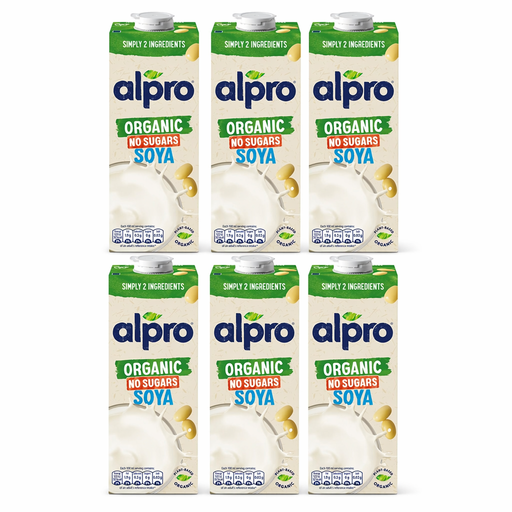 No image available
This organic UHT soya drink lists 0g sugars and 3.3g protein per 100ml. If a specifically mild taste or particular added nutrients matter, check the exact carton. Confirm the pack quantity before ordering; the listing title begins with ‘6’ but its description gives a net quantity of 1L. Refrigerate after opening and use within five days. Contains soya.
It depends on the activity and what else you eat. University College London Hospitals describes snacks combining carbohydrate and protein as an option around exercise; use the carton's protein per serving to judge what the drink contributes, then consider the rest of your snack.
Yes, if particular added nutrients matter to your regular choice. The UK SACN and COT assessment says plant-based drinks vary considerably in nutrient content, so check the exact carton for calcium, vitamin D, vitamin B12 and iodine.
No. The Food Standards Agency identifies soya as an allergen and warns that a product containing it can pose a risk to someone with a soya allergy. Check the current pack's allergen declaration when choosing an alternative.
Do not assume so. Plant-based drinks vary in nutrient content, according to the UK SACN and COT assessment. Compare the exact cartons' ingredient lists and nutrition panels if calcium, iodine or vitamins are part of your decision.