What should you check?
Start with who will drink the soya milk, then compare the current cartons’ nutrition labels and instructions for that use.
| Priority | What to check | Your needs |
|---|
| Fat and sugars |
Compare fat and sugars using the same stated measure, usually per 100ml. Read the energy figure as well; an unsweetened name does not tell you the fat content. |
I’m choosing a drink for my own cereal or hot drinks and want to compare lower-fat, lower-sugar options without assuming they suit everyone in the household. NHS breastfeeding guidance advises lower-fat and lower-sugar dairy alternatives where possible. |
| Fortification |
Look for listed calcium and vitamin D, and check iodine when relevant to your diet. Check vitamin B12 if you follow a vegan diet; compare protein using the carton’s stated measure. |
If soya drink replaces dairy in my meals, I want to know which nutrients the particular carton lists. NHS breastfeeding guidance identifies calcium and vitamin D fortification and highlights iodine for vegan diets. |
| Child’s age and use |
Read the carton’s age guidance. Distinguish use in weaning foods from use as a child’s main milk drink, and consider the child’s wider diet. |
Is this for me, for food prepared for a baby, or for an older child’s main drink? North East London NHS Foundation Trust says plant-based drinks can be introduced in weaning from six months but must not replace breast milk or formula as the main drink before age one. |
| Allergens |
Read the current ingredients and allergen statement for soya. Check any nut or peanut warning against the needs of the person who will drink it. |
Someone in my household needs an allergen check, so I need the warning on this carton rather than an assumption about soya drinks generally. ASDA lists soya and a possible-nuts warning for its unsweetened drink; M&S warns that its listed drink is unsuitable for people with nut or peanut allergy. |
| Pack and storage |
Check the pack quantity, whether it is chilled or long-life, and the refrigeration and use instructions after opening. |
A larger pack only works for us if we can use the opened cartons within their individual storage instructions. |
Brand and own-label references
These examples show why it is worth comparing particular cartons, not assuming every drink from a brand has the same recipe or age guidance.
Alpro
Alpro UK lists Soya No Sugars Drink 1L as a long-life option with 0g sugars, 1.9g fat and 3.3g protein per 100ml.
- The listed drink includes calcium, iodine and vitamins D2 and B12.
- Its listed fat figure is higher than those of the ASDA and Sainsbury’s examples; check the current pack before comparing variants.
Tesco
Tesco Groceries lists both Tesco Longlife Soya Drink Unsweetened and Tesco Soya Drink Unsweetened.
- The two listings give shoppers a choice of pack format.
- Check the specific carton’s nutrition, fortification and storage instructions before comparing it with another drink.
Sainsbury’s
Sainsbury’s Unsweetened Soya Drink 1L lists 1.3g fat, less than 0.5g sugars, 2.2g protein and 120mg calcium per 100ml.
- The listing also identifies iodine, vitamin D and B12 fortification.
- Its stated guidance does not position this carton as a main milk-drink alternative for children under two.
ASDA
Plant Based by ASDA Unsweetened Soya 1 Litre lists 1.1g fat, 19kcal and 2.0g protein per 100ml.
- ASDA also lists calcium, iodine and vitamin B12 per 100ml for this drink.
- The product declares soya and may contain nuts, which matters for allergy-affected households.
M&S
M&S Unsweetened Soya Drink lists 1.4g fat, 0.4g sugars and 2.8g protein per 100g.
- The listed drink is fortified with calcium, iodine, vitamin D and B12.
- M&S says it is unsuitable for people with nut or peanut allergy; its per-100g figures should not be treated as per-100ml figures.
Waitrose
Waitrose & Partners lists 1.9g fat, 0g sugars, 3.4g protein and 120mg calcium per 100ml for Essential Unsweetened Soya Drink.
- The listing also identifies iodine and vitamin D and B12 fortification.
- The carton is labelled unsuitable for children under two years old.
Joybuy soya drink options
These Alpro soya drink listings are options to consider for an adult’s everyday use. Check each current carton’s fat figure, fortification, allergen statement and age guidance before deciding whether it meets your household’s needs.
 No image available
Alpro Soya No Sugars Long Life Drink 8 x 1L
The 8 x 1L long-life pack is an option for a parent using soya drink in cereal or cooking. Joybuy lists calcium and vitamins B2, B12 and D for this pack; check its current carton for fat, iodine, allergens and opened-carton instructions. It is not an infant-formula substitute.
View on Joybuy
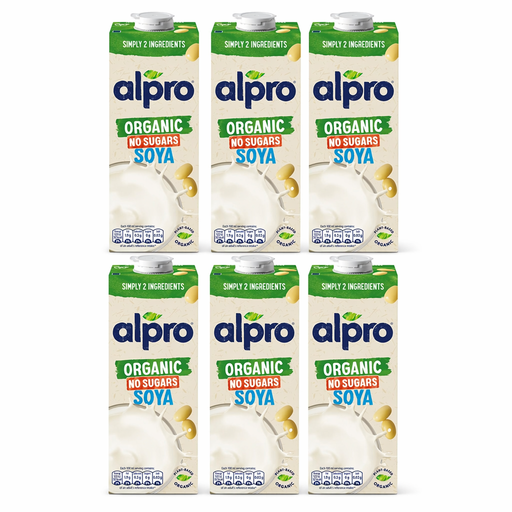 No image available
6 Alpro Soya Drink OG
This Alpro soya drink listing is another option for an adult’s cereal or hot drinks. Compare the current carton’s fat and sugar figures, fortification and allergen statement before choosing it; check its age guidance separately if the drink is intended for a child.
View on Joybuy
Common questions
Can I choose a lower-fat soya drink while breastfeeding?
Yes, for your own diet: NHS breastfeeding guidance advises choosing lower-fat and lower-sugar dairy alternatives where possible as part of a varied diet. Check that the drink is fortified with calcium and vitamin D, and check iodine particularly if you follow a vegan diet. This advice is not a reason to give an adult soya drink to a baby as their main milk.
Can ordinary soya milk replace breast milk or formula for a baby?
No, not as the main milk drink before age one. North East London NHS Foundation Trust says plant-based drinks can be introduced in weaning foods from six months but should not replace breast milk or infant formula as the main drink until the child is one. Seek individual advice if a baby needs an alternative because of allergy or another feeding concern.
What should I check for a child aged one or over?
Check the carton’s age guidance, allergens and whether it is unsweetened and fortified, then consider its protein and energy figures alongside the child’s full diet. North West Knowledge Now NHS guidance identifies unsweetened, fortified soya and pea drinks as plant-based options for children aged one or over with cow’s-milk protein allergy, while noting that soya may not suit some of those children.
How long can I keep an opened carton?
Follow the instructions on that carton and refrigerate it after opening. The listed M&S and Waitrose drinks specify three days; the Joybuy description for Alpro Soya No Sugars Long Life Drink 8 x 1L specifies five days. Do not apply one product’s instruction to another.
What if someone in the household has a soya allergy?
Do not give a soya drink to someone with a confirmed soya allergy. Read the current ingredients and precautionary warnings for the particular carton, including any nut or peanut warning. If you think someone is having an anaphylactic reaction, NHS advice is to call 999.


