Who is this for?
The useful label checks depend on how you use the drink and which details matter to your routine.
People comparing everyday milk alternatives
If you add soya drink to tea, coffee or cereal, compare total carbohydrate per 100ml and consider how much you normally pour. Diabetes UK notes that front-of-pack information does not show total carbohydrate.
People counting carbohydrate as part of an insulin plan
The carbohydrate in your actual portion matters more than the figure for a standard serving you do not use. Follow the individual approach agreed with your diabetes healthcare team rather than someone else’s insulin-to-carbohydrate ratio.
Plant-based shoppers replacing dairy regularly
Check whether an unsweetened drink is fortified with calcium. Diabetes UK recommends checking calcium fortification when choosing a plant-based milk alternative; vitamin D is another ingredient to look for if it matters to your choice.
What should you check?
Start with the nutrition panel, work out the amount you use, then check fortification and allergens on the current carton.
| Priority |
What to check |
Your needs |
| Total carbohydrate |
Compare total carbohydrate per 100ml, not just sugars. Diabetes UK notes that front-of-pack information does not show the total-carbohydrate figure. |
I want to compare drinks on the same basis before deciding how much to use. |
| Portion size |
Use the labelled carbohydrate figure to calculate the amount in your usual pour. If you count carbohydrate for insulin management, follow your agreed plan. |
A splash in tea and a larger serving with cereal are different quantities, so I need to account for the amount I actually drink. |
| Fortification |
Check the ingredients or nutrition panel for added calcium and, if relevant to your choice, vitamin D. Do not assume every unsweetened soya drink is fortified. |
If this regularly replaces dairy for me, I want to know whether the drink contains the added nutrients I am looking for. |
| Allergens |
Read the current pack’s soya declaration and any precautionary nut statement. The Food Standards Agency identifies soya as an allergen. |
For a soya allergy, the sugar or carbohydrate figure cannot establish whether a drink is suitable; I need to check its allergen information. |
Brand and product-line references
These examples show why the exact product label matters more than a brand name alone.
Alpro
Waitrose & Partners lists Alpro Soya Long Life No Sugar as a fortified, long-life soya drink.
- The listing states 0g carbohydrate and 0g sugars per 100ml, with added calcium, iodine and vitamins B2, B12 and D2.
- Check the current carton before using those figures for a purchase or portion calculation.
Waitrose Essential
The Essential Unsweetened Soya Drink listing gives nutrition per 100ml and per 250ml serving.
- Waitrose & Partners lists 0.8g carbohydrate and 0g sugars per 100ml, alongside calcium, vitamin D and other added nutrients.
- Its stated 250ml serving contains 2.0g carbohydrate. The product listing also says it is unsuitable for children under two.
Plenish
Plenish Organic No Added Sugar Soya is an option for shoppers comparing short ingredient lists.
- Waitrose & Partners lists spring water and organic soya beans as its ingredients, with 0.8g carbohydrate and 0g sugars per 100ml.
- The listed ingredients do not show added calcium or vitamins, and the listing says the drink may contain nuts.
Joybuy soya drink options
This Joybuy option is a ready-to-pour, long-life soya drink. Compare its current carton with your usual portion and any fortification requirements before choosing it.
 No image available
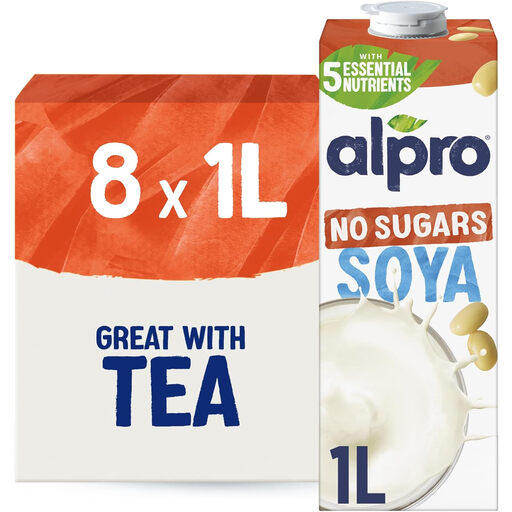
Alpro Soya No Sugars Long Life Drink, 8 x 1L
This ready-to-pour, long-life drink comes in an 8 x 1L pack. For a carbohydrate-aware comparison, check the current carton’s total carbohydrate per 100ml and calculate the amount in your usual serving; check its fortification and allergen information too.
View on Joybuy
Frequently asked questions
Is a no-sugar claim enough to choose a soya drink when managing diabetes?
No. Compare total carbohydrate as well as sugars, then account for the amount you actually drink. Diabetes UK notes that front-of-pack information does not show total carbohydrate.
Which of the listed drinks has the lowest labelled carbohydrate?
Among the three Waitrose & Partners product listings discussed here, Alpro Soya Long Life No Sugar states 0g carbohydrate per 100ml; Waitrose Essential Unsweetened and Plenish Organic No Added Sugar Soya each state 0.8g per 100ml. These are label figures for those products, so check the current cartons before comparing them.
What should I check if soya drink regularly replaces dairy?
Check that the drink is unsweetened and fortified with calcium, as Diabetes UK advises for plant-based milk alternatives. If vitamin D also matters to your choice, check its presence on the particular carton rather than assuming all soya drinks contain it.
How do I account for soya drink when counting carbohydrate for insulin?
Calculate the carbohydrate in the portion you use and follow the individual plan agreed with your diabetes healthcare team. Diabetes UK notes that insulin-to-carbohydrate ratios differ between people.
Does a no-sugar soya drink suit someone with a soya allergy?
No: a no-sugar claim does not change the presence of soya. The Food Standards Agency identifies soya as an allergen; read the current pack’s allergen statement and any precautionary nut information before use.


