Fat-conscious cereal and porridge shoppers
If fat is your main consideration, compare the figures on each carton alongside sugars. “Light” and “unsweetened” describe different things; neither replaces the nutrition panel.


For a lower-fat soya drink with weekend cereal or porridge, compare fat and sugars on the carton rather than relying on “light” or “unsweetened” alone. Marks & Spencer lists 1.4g fat and 0.4g sugars per 100g for its Unsweetened Soya Drink; Waitrose & Partners and its Alpro listing each give 1.9g fat and 0g sugars per 100ml for their respective no-sugar drinks. These are different label units, so check the current cartons before making a direct fat ranking; fortification, allergies and storage also affect the choice.
If fat is your main consideration, compare the figures on each carton alongside sugars. “Light” and “unsweetened” describe different things; neither replaces the nutrition panel.
If soya drink regularly goes into cereal, porridge or tea instead of dairy milk, check the exact product for added calcium, iodine and vitamins. The UK Office for Health Improvement and Disparities notes that fortification varies considerably between plant-based drinks.
A long-life carton can be kept in the cupboard before opening, but the instructions change once it is opened. Choose a pack size you can use within its stated refrigerated period.
Start with the nutrition panel for the specific carton, then check its ingredients and storage instructions against how you use it at breakfast.
| Priority | What to check | Your needs |
|---|---|---|
| Fat and saturates | Read both figures and their stated basis, such as per 100ml or per 100g. Marks & Spencer lists 1.4g fat and 0.2g saturates per 100g for its Unsweetened Soya Drink. | I want a lower-fat drink for cereal or porridge, so I need the carton’s figures rather than a “light” claim. |
| Sugars | Check the sugars line even when a drink is described as unsweetened. Waitrose & Partners lists 0g per 100ml for Essential Unsweetened, while Marks & Spencer lists 0.4g per 100g for its Unsweetened Soya Drink. | If I also want to limit sugars, I can compare the stated amounts without assuming that reduced fat means no sugar. |
| Fortification | Look for calcium, iodine and any listed vitamins on the exact carton. The UK Office for Health Improvement and Disparities says plant-based drinks vary considerably in nutrient composition and fortification. | Soya drink regularly replaces dairy milk at my breakfast, so I want to know what has been added to this particular product. |
| Allergens | Read the ingredients and product-specific allergy advice, including precautionary statements. The Food Standards Agency identifies soya as an allergen. | Someone in my household has a food allergy; “dairy-free” alone does not tell me whether this carton is suitable. |
| Storage and pack size | Check whether the unopened carton is chilled or long-life, then follow its refrigeration and use-within instructions after opening. Waitrose & Partners lists five days after opening for its Alpro Soya Long Life No Sugar carton. | We mainly use soya drink at weekends, so I need a pack size and opening period that fit how much we pour. |
“Light” does not tell you how its fat figure compares with another carton. The published figures also use different bases: Marks & Spencer states values per 100g, while the Waitrose & Partners soya-drink listings state them per 100ml.
Compare the current nutrition panels, including saturates and sugars, and keep the stated units in view.
The UK Office for Health Improvement and Disparities reports considerable variation in fortification between plant-based drinks. A brand-wide description cannot establish what is in every carton.
When soya drink regularly replaces dairy milk at breakfast, check that product’s label for calcium, iodine and the vitamins relevant to your comparison.
Long-life describes storage before opening, not an indefinite period of use afterwards. The Waitrose & Partners listing for Alpro Soya Long Life No Sugar instructs shoppers to refrigerate it after opening and use it within five days.
Check each pack’s instructions and choose a carton size that suits your weekend use.
An opened carton you cannot finish within its stated period may go to waste.
The Food Standards Agency identifies soya as an allergen. Other allergy advice can also be product-specific, so a dairy-free description is not enough for someone with an allergy.
Check the current carton’s ingredients, allergy advice and any precautionary wording before buying.
These examples show why the particular product and format matter more than a brand name alone.
Alpro has chilled and long-life soya-drink options; their labels should be compared by product and format.
Its sweetened and unsweetened soya drinks are distinct products, so check which carton you are comparing.
Essential Unsweetened Soya Drink is a long-life option with a published per-100ml nutrition panel.
Tesco’s soya-drinks listing includes own-label unsweetened cartons and branded alternatives.
Sainsbury's lists Alpro Soya Light Chilled as a reduced-fat drink for uses including cereal, porridge, tea and coffee.
These are long-life Alpro soya-drink options for a breakfast cupboard. Compare their current cartons for fat, sugars and fortification; the pack descriptions alone do not settle those questions.
 No image available
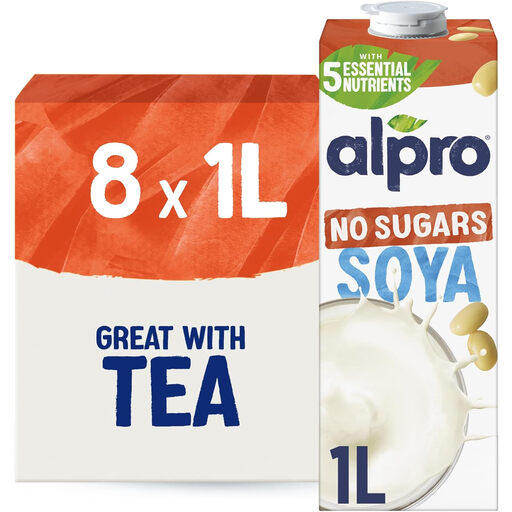
The 8 × 1L long-life pack is a choice to consider if your household uses several cartons. For a lower-fat breakfast choice, check this pack’s fat and sugars per 100ml, its added nutrients and its instructions after opening.
 No image available
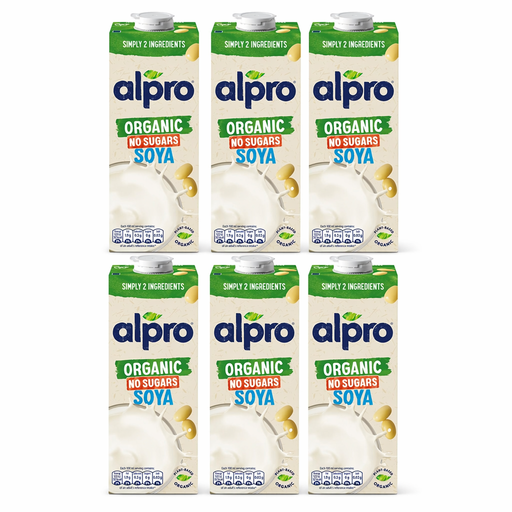
If you are considering this soya drink for cereal or porridge, check the carton’s fat and sugars per 100ml alongside any listed calcium, iodine and vitamins. Follow its storage instructions after opening.
Compare total fat and saturates on the current cartons, keeping each label’s units in view rather than choosing by “light” wording alone. Marks & Spencer lists 1.4g fat per 100g for its Unsweetened Soya Drink; Waitrose & Partners lists 1.9g per 100ml for Essential Unsweetened and Alpro Soya Long Life No Sugar.
No. Marks & Spencer lists 0.4g sugars per 100g for its Unsweetened Soya Drink, while Waitrose & Partners lists 0g per 100ml for Essential Unsweetened. Check the sugars line on the particular carton if that difference matters to you.
Fortification differs between plant-based drinks, according to the UK Office for Health Improvement and Disparities. If soya drink regularly replaces dairy milk at breakfast, check the exact carton for calcium and iodine rather than assuming they are present across a range.
Follow the opened-pack instructions instead. For example, Waitrose & Partners says its Alpro Soya Long Life No Sugar drink must be refrigerated after opening and used within five days.
No: soya is an allergen, as identified by the Food Standards Agency. Check the current carton’s ingredients and any precautionary allergy wording; “dairy-free” does not mean free from soya or other relevant allergens.