Older adults replacing dairy
If soya drink will be an everyday dairy-free option, check its fortification rather than assuming every carton supplies the same nutrients. The NHS includes plant-based drinks with added calcium among sources of calcium.


For an older adult who is maintaining weight and wants a dairy-free everyday drink, a fortified soya drink is an option: check the carton for calcium, vitamin D, vitamin B12 and iodine. An unsweetened version fits a sugar-reduction preference, but ordinary soya drinks should not be relied on to address poor appetite or unintended weight loss. When buying several cartons, plan around how quickly each one will be used after opening; the products discussed here specify either three or five days under refrigeration.
The right carton depends on the person drinking it and how the household will use it, not just whether the front says ‘unsweetened’ or ‘long life’.
If soya drink will be an everyday dairy-free option, check its fortification rather than assuming every carton supplies the same nutrients. The NHS includes plant-based drinks with added calcium among sources of calcium.
Several unopened cartons may be convenient, but each opened carton needs to be used within its own refrigerated period. If the older person has unintended weight loss or difficulty swallowing, NHS and Age UK guidance supports seeking a GP assessment rather than relying on a change of drink.
An unsweetened drink may match a preference to reduce sugars when weight is stable. If appetite is small or weight is falling unintentionally, Age UK cautions against treating weight-loss advice as suitable for that situation.
Start with the intended use and the person’s appetite, then compare nutrition panels and opened-carton instructions. A larger purchase is useful only if the household can manage the cartons it opens.
| Priority | What to check | Your needs |
|---|---|---|
| Fortification | Read the current carton for added calcium and vitamin D, then check vitamin B12 and iodine if these matter in the overall diet. The NHS identifies calcium-fortified plant drinks as a calcium source; the word ‘soya’ alone does not establish fortification. | I’m using soya drink in place of dairy and want to know which nutrients this particular carton supplies. |
| Protein and energy | Compare the stated values on the same per-100ml basis. Waitrose & Partners lists 3.4g protein and 35kcal per 100ml for Essential Unsweetened, versus 3.4g and 42kcal for Essential Original. Neither figure establishes that a drink meets someone’s wider nutritional needs. | With a small appetite or unintended weight loss, I need more than a carton choice. NHS guidance advises seeing a GP after substantial unintended weight loss. |
| Sugars | Check sugars per 100ml rather than relying on the product name. Waitrose & Partners lists 0g for Essential Unsweetened and 2.5g for Essential Original; their energy values also differ. | I’d prefer an unsweetened drink if reducing sugars is my aim, but I don’t want that choice to obscure concerns about appetite or weight. |
| Carton use | Check the carton size, refrigeration instructions and time allowed after opening. Waitrose & Partners specifies three days for its Essential drinks and five days for the Alpro drinks discussed here. | For one person drinking small amounts, I want to open cartons one at a time and choose a stock quantity we can use. |
| Soya allergy | Check the current ingredients and allergen label for the intended drinker. The Food Standards Agency identifies soya as an allergen and a possible risk for someone with a soya allergy. | If the person has a soya allergy, I need a different type of drink rather than a different soya carton. |
A fortified soya drink can contribute to meals, but it does not address the causes of unintended weight loss, persistent poor appetite or swallowing difficulty. The NHS advises a GP assessment for substantial unintended weight loss; Age UK also identifies appetite and swallowing changes as concerns.
Seek a GP assessment for these symptoms instead of trying to resolve them by switching supermarket cartons.
Waitrose & Partners lists 0g sugars and 35kcal per 100ml for Essential Unsweetened. Its Original drink lists 2.5g sugars and 42kcal per 100ml. A lower-sugar choice is not, by itself, an answer to difficulty maintaining weight.
Compare the labels in the context of the person’s usual intake; seek a GP assessment if weight loss or poor appetite is a concern.
The opened-carton period differs between products: Waitrose & Partners gives three days for its Essential drinks and five days for the Alpro drinks listed here. A stock of unopened cartons does not extend the period for a carton already opened.
Open one at a time, note when it was opened and follow that carton’s refrigeration instructions.
In a one-person household, an opened 1-litre carton may go unused if consumption does not fit its stated period.
A 2025 UK supermarket study published in Current Developments in Nutrition found that fortification varied across the plant-based milk alternatives it examined. Its findings do not tell you which nutrients are in a particular carton.
Compare the current nutrition panel for the nutrients relevant to the person’s diet, rather than choosing by the word ‘soya’ alone.
These label examples show why the exact variant matters; they are not a list of brands available in the product selection below.
Waitrose & Partners lists fortified Original and No Sugars long-life Alpro soya drinks. Their opened-carton instruction is to refrigerate and use within five days.
Waitrose & Partners publishes nutrition panels for Essential Unsweetened and Original soya drinks, both described as fortified.
Marks & Spencer describes its Unsweetened Soya Drink as fortified with calcium, iodine, vitamin D and vitamin B12.
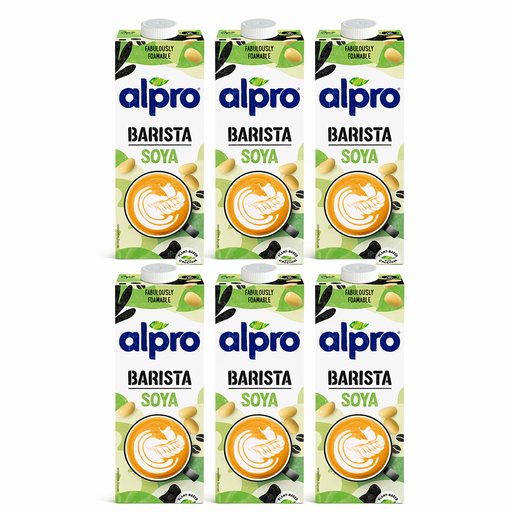
These Alpro options serve different uses: a listed 8 × 1L pack of No Sugars drink for household stock, and a Barista drink for coffee. Compare the current pack details before deciding how either fits the intended daily use.
 No image available
The listed 8 × 1L pack suits a household planning to keep unopened cartons in reserve. Waitrose & Partners lists 0g sugars, 3.3g protein and 33kcal per 100ml for the matching Alpro No Sugars drink, with added calcium, iodine and vitamins B2, B12 and D2. Refrigerate each carton after opening and follow its five-day instruction. It contains soya and is not a response to unintended weight loss or poor appetite.
 No image available
Consider this Barista drink if the soya milk is mainly intended for coffee; check that it also suits any other planned use. Confirm the carton count before treating the listing as a household multi-pack, and read the current pack for the fortification and opened-carton instructions important to you. It contains soya.
A fortified soya drink can be a dairy-free option as part of a varied diet. Check the carton for added nutrients: the NHS lists calcium-fortified plant drinks, including soya drink, as calcium sources. The drink alone does not establish whether the person’s overall diet meets their needs.
No. Unsweetened may suit someone who wants to reduce sugars and is maintaining weight, but it is not automatically the right choice when appetite is poor or weight is falling unintentionally. Age UK identifies these as reasons to consider the person’s wider nutritional situation, and the NHS advises GP assessment for substantial unintended weight loss.
Choose a quantity that fits the household’s use, opening cartons one at a time. Waitrose & Partners instructs users to finish the Essential soya drinks within three days of opening and the Alpro drinks discussed here within five days; follow the instructions on the carton you buy.
Seek a GP assessment rather than relying on ordinary soya drink as a nutritional solution. The NHS advises seeing a GP after substantial unintended weight loss, while Age UK identifies swallowing difficulty and a smaller appetite among concerns that warrant attention.
No: choose a drink that does not contain soya and check its current allergen label. The Food Standards Agency identifies a product containing soya as a possible health risk for someone with a soya allergy.