Tea drinkers who prefer less sweetness
If you add soya drink to a bedtime tea, compare the carton’s ‘of which sugars’ value rather than assuming every original or unsweetened recipe tastes or measures the same.


For bedtime tea, start with an unsweetened soya drink if you prefer less sweetness, and check the carton for the calcium, vitamin D, vitamin B12 and iodine you want from a regular dairy alternative. The UK Office for Health Improvement and Disparities notes that plant-based drinks vary considerably in nutrient content. Choose chilled or long-life by where you will keep unopened cartons and how quickly you will use one after opening; for hot drinks, follow the carton’s instructions to help avoid separation.
If you add soya drink to a bedtime tea, compare the carton’s ‘of which sugars’ value rather than assuming every original or unsweetened recipe tastes or measures the same.
A 1-litre carton may be convenient for regular drinks, but its instructions for refrigeration and use after opening matter whether it was sold chilled or long-life.
If the drink regularly takes the place of dairy milk, check its calcium, vitamin D, vitamin B12 and iodine information. The UK Office for Health Improvement and Disparities says nutrient content varies considerably between plant-based drinks.
Start with the flavour and carton size you will use, then compare the label and preparation instructions on those specific drinks.
| Priority | What to check | Your needs |
|---|---|---|
| Sweetness | Compare ‘of which sugars’ on like-for-like labels, noting whether the value is per 100 ml or per 100 g. M&S lists 0.4 g per 100 g for its unsweetened drink and 2.0 g per 100 g for its sweetened Plant Kitchen drink. | I would rather choose the sweetness of my bedtime drink than rely on the word ‘original’ or ‘unsweetened’ alone. |
| Fortification | Look for calcium, vitamin D, vitamin B12 and iodine on the individual carton. The UK Office for Health Improvement and Disparities notes that plant-based drinks vary considerably in nutrient content. | If I use soya drink regularly instead of dairy milk, I want to know which nutrients this particular carton lists. |
| Hot-drink use | Read the serving and heating directions. Sainsbury’s advises letting hot water cool slightly before adding its unsweetened soya drink; Waitrose advises gentle heating rather than boiling its drink. | A smooth texture in tea matters to me, so I can follow the preparation directions for the carton I buy. |
| Storage | Distinguish storage before opening from instructions after opening. Waitrose says to refrigerate its Essential Unsweetened carton and use it within 3 days of opening; the Alpro No Sugar carton listed by Waitrose says to use it within 5 days. | Will I finish a 1-litre carton within its stated period after opening, even if I only use a little each evening? |
| Allergens | Read the current ingredients and allergen information for the intended drinker. GOV.UK lists soybeans among the allergens for which food businesses must provide information. | Before serving it to someone else, I need to check that soya and any other declared allergens are suitable for them. |
The UK Office for Health Improvement and Disparities says their nutrient content varies considerably and notes that UK organic plant-based drinks cannot be fortified with nutrients.
If fortification matters to your choice, compare calcium, vitamin D, vitamin B12 and iodine on the specific carton rather than relying on ‘plant-based’ or ‘organic’.
Recipes differ: M&S lists 2.0 g sugars per 100 g for its sweetened Plant Kitchen drink and 0.4 g per 100 g for its unsweetened drink.
Compare the ‘of which sugars’ values on the cartons you are considering, alongside the flavour you prefer.
Sainsbury’s warns that its unsweetened soya drink can separate when added to very hot water, while Waitrose advises gentle heating for its soya drink.
Let the water cool slightly before adding the Sainsbury’s drink, and follow the heating instructions on whichever carton you use.
Long-life cartons still have instructions for after opening. Waitrose specifies 3 days for its Essential Unsweetened drink; the Alpro No Sugar carton listed by Waitrose specifies 5 days.
Choose a carton size you can use within its own stated period and follow its refrigeration instructions.
These examples show why it is worth comparing individual cartons rather than treating a brand’s whole soya-drink range as one recipe.
Alpro has original and no-sugars long-life soya drinks in the cited UK retailer listings.
Tesco’s own-label range is another place to compare soya-drink cartons.
Sainsbury’s Unsweetened Soya Drink is a chilled 1-litre option.
Asda’s own-label soya drinks offer another carton-label comparison.
M&S lists both unsweetened and sweetened Plant Kitchen soya drinks.
Waitrose Essential Unsweetened is a long-life 1-litre soya drink.
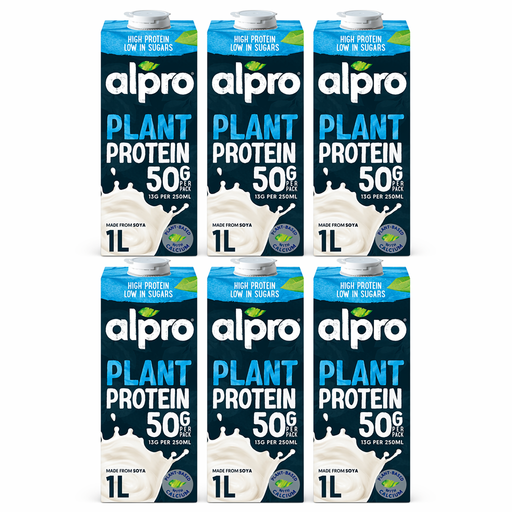
These Alpro listings cover a Plant Protein 1-litre variant and a multipack of No Sugars long-life 1-litre cartons. Compare the exact carton with your preferred sweetness, storage routine and hot-drink preparation needs.
 No image available
This Plant Protein 1L variant is an option to compare for regular tea or coffee. Check its sugar value and fortification against your preferences, and follow the carton’s storage and hot-drink directions.
 No image available
The eight-carton long-life pack is worth considering if you want to keep unopened 1-litre cartons for later use. Check the individual carton’s fortification, instructions after opening and directions for hot drinks.
No: choose it if you prefer less sweetness, but compare the exact recipes. M&S lists 0.4 g sugars per 100 g for its unsweetened drink and 2.0 g per 100 g for its sweetened Plant Kitchen drink; flavour and the carton’s other label details still matter.
Yes, but follow the directions for your carton. Sainsbury’s advises letting hot water cool slightly before adding its unsweetened soya drink to avoid separation, while Waitrose advises heating its drink gently rather than boiling it.
No. The UK Office for Health Improvement and Disparities says plant-based drinks vary considerably in nutrient content. If fortification matters to your purchase, check the individual carton for calcium, vitamin D, vitamin B12 and iodine.
Do not serve a soya drink to someone who needs to avoid soya. GOV.UK lists soybeans among the allergens for which food businesses must provide information; read the current product label for soya and any other declared allergens.