New virtual-spacecraft pilots
If you are moving from keyboard and mouse to physical controls, start by finding reachable bindings for steering, thrust and the ship actions you use most often.


Start with a single stick if you are learning basic steering while keeping the keyboard close; choose a stick and throttle if you want a separate physical thrust control. Consider two sticks when your simulator supports separate analogue controls for movement and you are ready to map them. Several monitors do not determine the controller layout, but they make desk space and continued keyboard and mouse access important.
If you are moving from keyboard and mouse to physical controls, start by finding reachable bindings for steering, thrust and the ship actions you use most often.
If you plan to practise movement along several axes, look at which analogue inputs and programmable controls your simulator can actually map—not just the total number of buttons.
With several displays on the desk, leave workable positions for the controller, keyboard and mouse. The placement of each device may matter more to your first lessons than adding another control unit.
Choose the controls you need to practise first, then decide how many devices can fit beside your keyboard and mouse.
Choose it when: You want to learn steering with one device and keep the keyboard available for other commands.
Trade-off: It does not give your other hand a dedicated analogue controller.
Choose it when: You want a separate physical thrust control alongside the steering stick.
Trade-off: A throttle is not automatically a substitute for a second stick when you want to control sideways or vertical movement directly.
Choose it when: Your simulator supports separate analogue movement controls and keyboard-assisted manoeuvres have become restrictive.
Trade-off: Two sticks need two positions on the desk and a binding scheme you can learn.
| Concern | Buying check | Who this matters to |
|---|---|---|
| Movement axes | Check which axes your game lets you bind independently and whether the controller has the twist, thumb controls or second stick you want to use. | If I am practising sideways and vertical movement, I want direct control rather than switching to the keyboard mid-manoeuvre. Around 33% of consumers put analogue movement first. |
| Reachable commands | Check the position of hats, triggers and thumb controls, not only the advertised command count. | I want to find common ship actions by feel while I learn, without memorising a crowded layout at once. Roughly 27% of consumers prioritise reachable commands. |
| Desk space | Measure usable space beneath the monitors, allowing for both control units if applicable and continued keyboard and mouse access. | My displays already occupy the desk, so I need a controller position that leaves room to use the keyboard and mouse. About 20% of consumers put workspace fit first. |
| PC and game support | Confirm operating-system support, game bindings, any required configuration software and the USB connections the setup needs. | Before settling on a layout, I need to know that my PC and simulator will recognise the controls I intend to use. Approximately 20% of consumers make compatibility their primary concern. |
A stick and throttle provide a particular control layout, not a promise that every movement axis will have its own analogue input. Logitech says the X56 has thumb mini-sticks providing four additional axes, illustrating why the specific layout matters.
List the movements you want under your hands and check your simulator’s binding options before deciding between keyboard assistance, a HOTAS and two sticks.
More assignable controls also mean more decisions about where commands go. A dense layout is less useful during early lessons if you cannot reliably find the controls you have mapped.
Bind essential movement and common actions first. Add secondary functions once the initial layout feels familiar.
A separate throttle or second stick needs its own position. For example, Turtle Beach describes VelocityOne Flightdeck as two USB-connected devices; that arrangement also calls for space around the keyboard and mouse.
Measure the usable desk area beneath your monitors and confirm mount compatibility for the precise controller and base before changing your setup.
A mount or revised cable layout may add another setup task if the tabletop arrangement does not fit.
The X52 and X56 illustrate two stick-and-throttle layouts for flight and space simulation.
The T.16000M FCS range offers an ambidextrous stick with throttle and optional pedal arrangements.
The Gladiator NXT EVO Space Combat Edition can be considered as a single-stick start or as part of a later left- and right-hand arrangement.
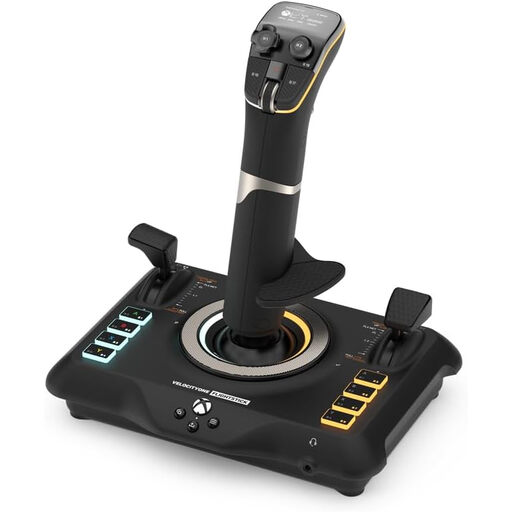
VelocityOne Flightdeck is a control-dense PC stick-and-throttle system.
These choices cover a single flight stick and two stick-and-throttle setups. Compare their layouts against the movements your simulator can bind and the space left beside your monitors.
 No image available
Consider this single-stick format if you want to begin with one controller while keeping the keyboard close. The product name identifies Xbox and PC versions; check that your particular simulator recognises the controls you need to bind, and measure the space available beside your keyboard and mouse.
 No image available
Consider this stick-and-throttle format if you want separate controls for steering and thrust. The named bundle includes a mount and specifies Windows 11/10; confirm that your simulator supports the controller and required bindings, and check where both units and the mount would sit.
 No image available
This stick-and-throttle option suits a learner who wants a physical throttle alongside the stick. The product name identifies PS5, PS4 and PC; before choosing it for spacecraft controls, confirm support in your specific game, the axes you can bind and the desk space it needs.
No. Choose the stick layout for the movements and bindings in your simulator; for a multi-monitor desk, also measure where the controller will sit while leaving the keyboard and mouse usable.
No. A HOTAS pairs a stick with a throttle, while two sticks give each hand a stick. If you want separate analogue controls for sideways or vertical movement, check whether your simulator can map them across the devices you plan to use.
Begin with steering, thrust and the ship actions you use most often, then add secondary bindings as you learn the layout. If you intend to use Thrustmaster T.A.R.G.E.T software, its support information specifies Windows 10 or 11.