Dried pasta works as an optional side with beans or tomatoes, rather than a conventional part of a full English breakfast. Choose plain spaghetti if you want a straightforward addition, or consider a wholewheat or protein-enriched variant if its labelled nutrition is your priority; check the exact pack’s cooking time and allergens before planning it around the rest of the meal.
Who is this for?
Breakfast hosts juggling several pans
If eggs, beans and other components need to reach the table hot, the pasta’s cooking time matters. Barilla states 10 minutes for Spaghetti No. 5 and 9 minutes for its Whole Wheat Spaghetti; check the time on the pack you buy.
Shoppers choosing by labelled nutrition
If the pasta’s fibre or protein content is part of your decision, compare the exact variants. Barilla lists 8 g fibre per 100 g for its Whole Wheat Spaghetti and 20 g protein per 100 g for Protein+ Spaghetti.
Households checking allergens
Spaghetti shape alone does not establish allergen suitability. M&S says its named spaghetti contains gluten and is not suitable for people with an egg allergy; Barilla says its Protein+ Spaghetti may contain traces of soy and mustard. Read the current pack for the product being served.
What matters when buying?
Decide whether preparation time, the pasta’s labelled nutrition or ingredient suitability is the main constraint for your breakfast, then check the corresponding details on the exact pack.
| Concern |
What to check |
Who this matters to |
| Cooking time |
Read the time for the exact shape and variant. Barilla lists 9, 10 and 13 minutes for its cited wholewheat, classic and Protein+ spaghetti respectively. |
If I have eggs and other hot items on the go, I do not want the pasta to delay serving. Timing would be the primary concern for about 45% of consumers. |
| Fibre or protein |
Compare the per 100 g nutrition on the packs you are considering, alongside their cooking times. |
When I choose a pasta variant for its labelled fibre or protein, that distinction matters more to me than choosing the familiar option. About 33% of consumers would put the pasta’s nutritional profile first. |
| Ingredients and allergens |
Check the current ingredient list, allergen statements and relevant precautionary wording for the exact product. |
If someone eating breakfast has an allergy or ingredient restriction, I need to establish whether this particular pasta is suitable before serving it. Ingredient and allergen suitability would come first for about 22% of consumers. |
Buying pitfalls
-
Expecting pasta to be a conventional breakfast component
The English Breakfast Society’s reference includes accompaniments such as beans, tomatoes, mushrooms and toast, but does not list pasta. Adding it changes the plate rather than recreating a usual component.
Buy it if you specifically want a pasta side with beans or tomatoes; keep the breakfast elements you want to retain.
-
Assuming every spaghetti cooks at the same rate
Barilla’s stated times for the cited wholewheat, classic and Protein+ variants are 9, 10 and 13 minutes. That difference matters when several foods must be served hot.
Check the chosen pack’s instructions before deciding when to start cooking.
-
Judging allergen suitability by appearance
M&S marks its cited spaghetti as containing gluten and unsuitable for people with an egg allergy. Barilla’s cited Protein+ variant carries a precautionary statement for soy and mustard.
Check the current label of the exact variant against the needs of everyone eating it.
-
Overlooking sauce when planning the plate
Dolmio lists 1 g salt per 75 g portion for its Tomato and Basil Stir In sauce. Sauce is another part of the meal to consider alongside the other breakfast components.
Compare the sauce’s stated portion information with what you plan to serve, rather than assessing the pasta alone.
Brands to consider
Barilla
Its named spaghetti variants offer different stated cooking times and nutritional profiles.
- Barilla lists 10 minutes for Spaghetti No. 5, 9 minutes and 8 g fibre per 100 g for Whole Wheat Spaghetti, and 13 minutes and 20 g protein per 100 g for Protein+ Spaghetti.
- Those figures belong to the named variants; check the pack rather than applying them to another Barilla spaghetti.
Tesco
Its dried-pasta range includes standard, wholewheat and free-from categories.
- Tesco’s range listing includes different pasta formats and a separate wholewheat, organic and free-from section.
- Use the exact product listing or pack to check ingredients, cooking instructions and whether a particular variant suits your needs.
Sainsbury's
Its cited own-label options include standard and organic dried spaghetti.
- Sainsbury's describes its cited 500 g spaghetti as dried pasta made with 100% durum wheat, and its cited SO Organic version as organic durum-wheat semolina pasta.
- Check the current pack for the preparation and allergen details of the variant you choose.
M&S
Its cited spaghetti page provides cooking and ingredient details for one named product.
- M&S describes that spaghetti as made from durum-wheat semolina and water, with an 11-minute cooking time.
- The same product page identifies gluten and says it is not suitable for people with an egg allergy; check the current label before serving.
Dolmio
A sauce option for cooked pasta, rather than a dried-pasta choice.
- Dolmio says its Tomato and Basil Stir In sauce can be stirred into hot, freshly cooked pasta without heating the sauce separately.
- The pasta still needs cooking. Dolmio lists 1 g salt per 75 g portion of the cited sauce.
Dried spaghetti on Joybuy
These 500 g spaghetti packs are options for an additional pasta side with beans or tomatoes. Check each pack’s cooking time and allergen information before fitting it into a multi-item breakfast.
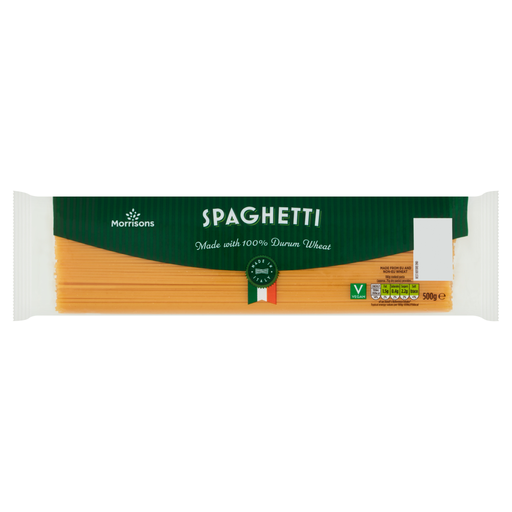 Image unavailable
Morrisons Spaghetti 500 g
Consider this 500 g spaghetti pack if you want pasta alongside breakfast beans or tomatoes. Check its current cooking instructions and full ingredient and allergen statements before serving.
View on Joybuy
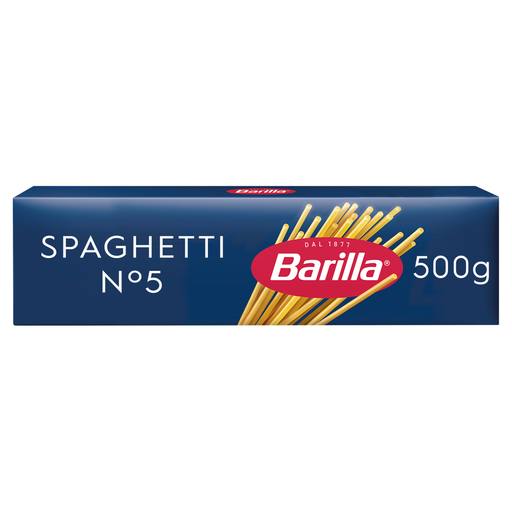 Image unavailable
Barilla Spaghetti 500 g
This 500 g spaghetti pack is another option for an additional pasta side. Use the cooking time and allergen statements on this exact pack when planning the meal; do not assume it has the specifications of Barilla Spaghetti No. 5.
View on Joybuy
 Image unavailable
Napolina Spaghetti 500 g
For a spaghetti addition to the plate, this is a 500 g pack. Read its cooking instructions before scheduling it with other hot items, and check the current pack’s ingredient and allergen information.
View on Joybuy
Common questions
Is dried pasta a traditional replacement for toast in a full English breakfast?
Treat it as an optional addition, not a traditional replacement. The English Breakfast Society’s reference names toast among the accompaniments to a full English breakfast but does not list pasta.
Which spaghetti is easiest to schedule with the other hot food?
Choose by the cooking time on the exact pack you intend to use. Barilla states 9 minutes for its Whole Wheat Spaghetti, 10 minutes for Spaghetti No. 5 and 13 minutes for Protein+ Spaghetti; M&S states 11 minutes for its cited spaghetti. Start the chosen pasta in time for the rest of the plate.
Can I assume ordinary dried spaghetti is suitable for someone with an egg allergy?
No. M&S says its cited spaghetti is not suitable for people with an egg allergy, despite listing durum-wheat semolina and water as ingredients. Check the current pack of the exact product you plan to serve.
What should I check on pasta and breakfast-item labels?
Read the current ingredients and allergen statements for each exact product, including any sauce or other breakfast component. A pasta’s shape or a different variant’s label cannot establish its suitability for someone with an allergy.


