
24/7 Customer Support

Free returns

Same-day & Next-day Delivery

Quality Guaranteed

Unlock Your Welcome Offers: FREE Delivery | Up to 80% OFF | Free 30-day JoyPlus trial
Download the APP
A mixed hand-tool kit can appear good value until you discover that the sizes you use most are missing, the handles are uncomfortable or the spanner cannot reach the fastener. For DIY enthusiasts, vehicle owners, plumbers and workshop users, choosing spanner and pliers tool sets requires more than counting the number of pieces.
The most common buying traps are:
Most cars, bicycles, appliances and domestic plumbing fittings used in the UK require metric sizes, so check the actual size list rather than relying on a product title such as “multi-size” or “universal”.
A metric combination spanner set normally combines an open end with a ring or box end. This is useful for general fastening, but the size coverage determines how often you will need another tool. A set covering 8–19 mm provides broad coverage for everyday maintenance, while a smaller set may suit occasional household repairs.
For vehicle work, consider whether you need both standard and compact options. A stubby spanner set can fit around restricted fasteners where a conventional handle is too long. Conversely, a full-size spanner or breaker bar provides more leverage when access is available.
A ratcheting spanner or socket ratchet set needs enough room for the handle to move. A 72-tooth ratchet typically requires a smaller working arc than a lower-tooth mechanism. The DURATECH 144-P ratcheting combination spanner set specifies a 2.5° swing arc, which is intended for particularly narrow spaces. Its double-stacked pawls and 8–17 mm size range are practical features for compact mechanical assemblies.
A flex-head ratcheting spanner adds another form of access. A hinged head can be positioned around obstructions, but it should be kept aligned with the fastener when applying significant force. For stubborn wheel bolts or seized nuts, a breaker bar is more appropriate than relying on a compact ratchet mechanism. The DURATECH breaker bar has a 60 cm handle, a 1/2-inch drive and a head that rotates up to 240 degrees; the product information states torque up to approximately 780 Nm.
Look for clearly stated materials such as chrome vanadium steel or heat-treated alloy steel. These descriptions indicate the tool’s construction, but they do not remove the need for correct use, cleaning and storage. Chrome or black chrome finishes can help resist surface corrosion, especially when tools are stored in a garage or vehicle.
Handle design matters for pliers. Non-slip PP, TPR or resin grips can improve control, but always choose the jaw type for the task. Water pump pliers are intended for gripping pipes and irregular shapes; side cutters are designed for cutting; long nose pliers are useful where access is narrow.
Storage is also practical rather than decorative. A roll-up pouch is convenient for a car boot or maintenance bag, while a rigid case may offer more protection in a workshop. Tool sets with storage pouch or case can reduce misplaced tools and make it easier to identify a missing size.
The following options focus on different requirements rather than assuming one kit suits every user.
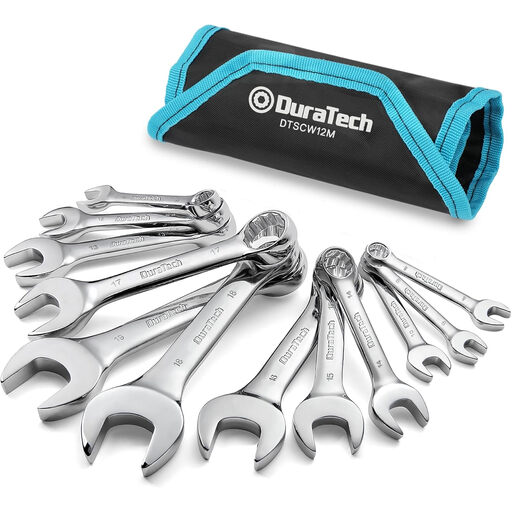
Why This Fits Their Persona: A compact choice for flat-pack assembly, bicycle maintenance, household repairs and occasional vehicle work where storage space is limited.
The set lists all 12 metric sizes from 8 to 19 mm, avoiding vague size claims. Its shorter beams are intended for hard-to-reach fasteners.
Heat-treated chrome vanadium steel, 12-point box ends, 15-degree offset and a roll-up carry pouch.
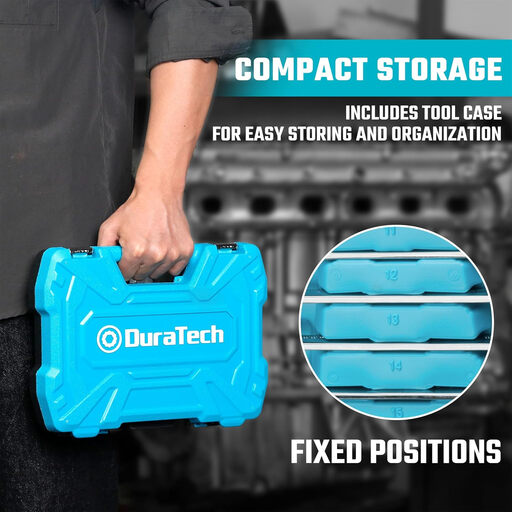
Why This Fits Their Persona: Suitable for workshop users who want a full metric range with flexible access for regular maintenance and mechanical assembly.
It provides a stated 8–19 mm range, 72-tooth gears and a flex head that tilts up to 180 degrees, rather than relying only on “access” wording.
Chrome vanadium steel construction, 5-degree working arc, 12-point box ends and a storage case.
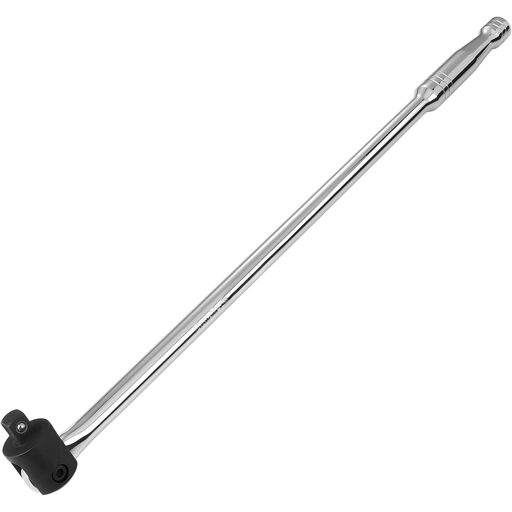
Why This Fits Their Persona: Designed for vehicle owners, mechanics and garage users dealing with tight wheel bolts or high-resistance fasteners.
It separates leverage work from fine ratcheting, reducing the risk of using a compact socket ratchet for a task requiring a longer handle.
60 cm handle, 1/2-inch drive, spring-loaded socket retention and a 240-degree swivelling head.
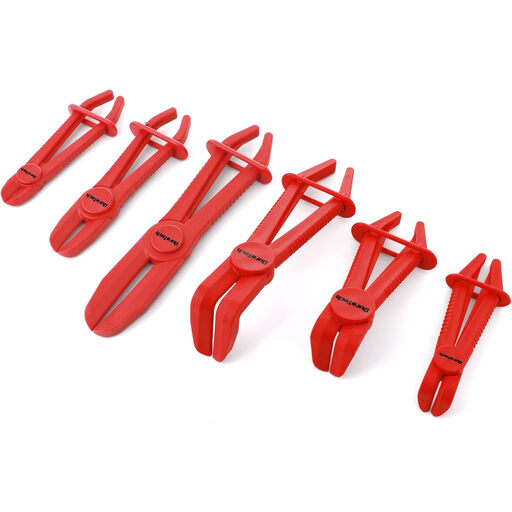
Why This Fits Their Persona: A focused option for flexible brake, fuel, coolant, radiator and lawnmower hoses during automotive or maintenance work.
The description clearly states that it is not for hard, reinforced or high-pressure lines, helping buyers avoid an unsuitable application.
Six straight and 90-degree tools, PA6 heat-resistant non-conductive construction and locking safety buckles.
A single spanner set rarely covers every repair. Consider adding:
We have compiled a complete, real-time list of products that fully satisfy these strict selection criteria and UK safety regulations.
They can cover many routine tasks, including battery-area fasteners, brackets and hose maintenance. For wheel bolts or seized fasteners, use the correct socket and a breaker bar. Never substitute pliers for a correctly sized spanner when the fastener may be damaged.
Wipe tools dry after use, remove oil and dirt, and store them in a dry pouch, case or toolbox. Occasional light lubrication can help moving ratchet or adjustment mechanisms. Avoid leaving tools exposed in a damp shed or vehicle boot.
A ratcheting spanner set saves handle movement when access is restricted, while a standard combination spanner may offer a simpler option for higher-load work. Many workshop users keep both, using the ratcheting tool for speed and a conventional spanner or breaker bar when greater leverage is required.