
24/7 Customer Support

Free returns

Same-day & Next-day Delivery

Quality Guaranteed

Unlock Your Welcome Offers: FREE Delivery | Up to 80% OFF | Free 30-day JoyPlus trial
Download the APP
Buying a set of spanners can appear straightforward until a missing size, awkward handle or poorly matched drive leaves a job unfinished. Marketing descriptions often focus on piece counts and polished finishes, while the details that affect real use—size coverage, access, fastener contact and storage—receive less attention.
The right choice depends on the work you actually carry out. A home DIY user may need a versatile combination spanner set, while a bicycle mechanic may require a calibrated torque wrench set. Before buying, watch for these common traps.
A large number of tools does not necessarily mean better coverage. Some extensive mechanic tools sets include duplicate bits, unusual sizes or accessories that rarely suit your repairs. Check the actual size list rather than relying on the headline number.
For general UK household and vehicle work, a metric spanner set covering frequently used sizes such as 8–19 mm is often a practical starting point. Imperial sizes remain useful for some older vehicles, machinery and imported equipment.
A standard straight spanner may fit the fastener but still be unusable if there is little room to swing it. Conversely, a deeply offset ring spanner may not be suitable where a quick open-end adjustment is needed.
Look for the design that matches the space:
A polished or chrome-plated surface can make a tool easier to wipe clean and may help resist corrosion, but appearance alone does not indicate strength. Check the construction material and manufacturing description.
Chrome vanadium steel spanners are commonly selected for general fastening because the alloy is suited to strong hand tools. Heat treatment, drop forging and accurate sizing also matter. These features should be considered alongside the tool’s stated limitations and intended use.
Confirm whether the set is metric, imperial or mixed. Metric sizes are commonly used on modern UK cars, bicycles, motorcycles and household fittings, but an imperial range can be valuable for classic vehicles and older machinery.
Also check whether the set includes every size in the stated range. Some sets cover a broad span but omit sizes between the smallest and largest tools.
A 12-point ring end can engage a fastener at more angles than a six-point design, which can be helpful in restricted spaces. However, the fastener must still be in good condition and the spanner must fit correctly.
A 15-degree offset can provide knuckle clearance and improve access around obstructions. A 75-degree offset, as found on some double ring designs, is more suited to recessed fasteners. A flex-head ratcheting spanner can offer additional positioning, but the moving head should be used carefully and not treated as a substitute for a fixed tool in every high-load situation.
A hand spanner is not a replacement for a torque wrench where a manufacturer specifies a tightening value. A torque wrench set should clearly state its torque range, drive size, adjustment method and accuracy.
For bicycles and smaller motorcycle components, a 1/4-inch drive torque wrench covering a low range such as 2–26 N·m may be appropriate. Automotive and industrial work can require a wider range and larger drives. Always match the socket to the drive and follow the fastener or equipment manufacturer’s torque instructions.
After use, adjustable mechanical torque wrenches should generally be returned to their minimum setting if the product instructions require it. Do not use a torque wrench as a general breaker bar unless the manufacturer specifically permits this.
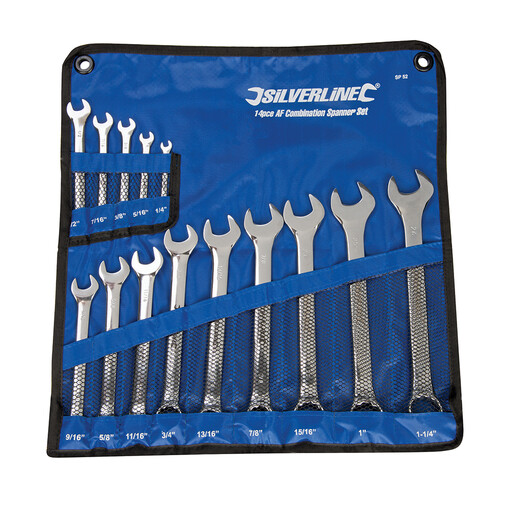
Why This Fits Their Persona: A broad imperial range from 1/4 to 1-1/4 inches suits home users working on mixed household, workshop and older vehicle fasteners.
The listing specifies all 14 sizes, rather than relying only on the piece count. The 15-degree offset also addresses clearance issues around some fasteners.
Drop-forged chrome vanadium steel; includes a ballistic nylon storage roll for transport and organisation.
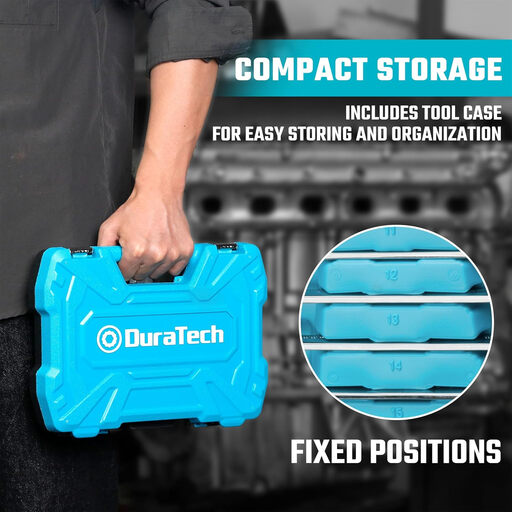
Why This Fits Their Persona: This metric ratcheting spanner set is suited to regular workshop users who value access and reduced hand movement during repeated fastening.
The listing provides the 8–19 mm size list, 72-tooth mechanism and 5-degree working arc, making the access claims specific rather than vague.
Flex head tilts up to 180 degrees; chrome vanadium steel construction with a storage case.
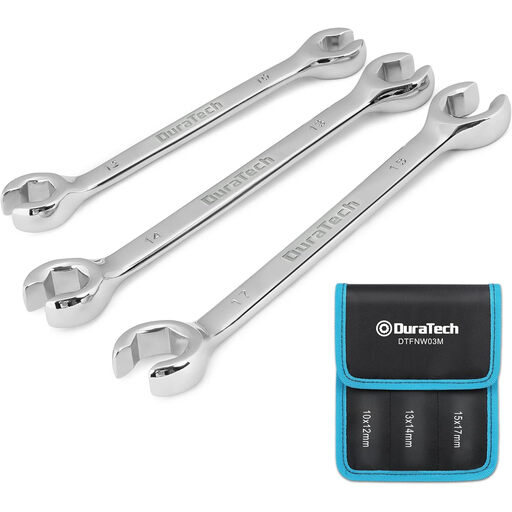
Why This Fits Their Persona: Designed for mechanics, automotive repairers and tradespeople handling brake-line or plumbing-tube connections.
The flare profile gives more surrounding contact than a conventional open end for compatible line fittings. The three double-size tools also avoid carrying six separate spanners.
Includes 10x12, 13x14 and 15x17 mm sizes; 15-degree offset and roll-up storage pouch.
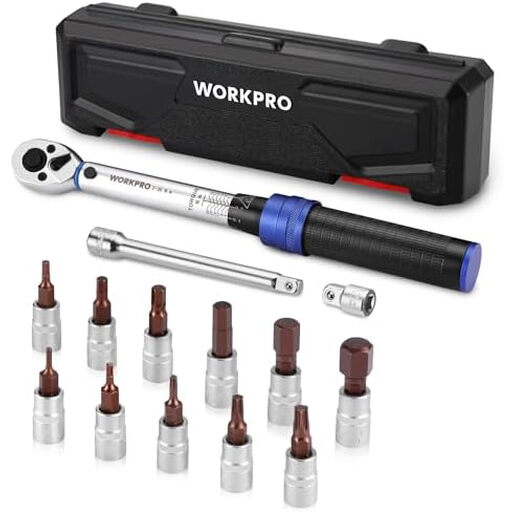
Why This Fits Their Persona: The low torque range and included hex and Torx bits are aligned with bicycle servicing and lighter motorcycle or vehicle work.
The stated 2–26 N·m range and ±3% accuracy provide measurable information, unlike descriptions that simply use the word “precision”.
72-tooth dual-direction mechanism; includes S2 steel hex and Torx bits, an extension bar and socket adapter.
A socket set is often more efficient when fasteners are recessed or require a ratchet handle. A spanner remains more convenient where access from the side is necessary or where a socket cannot slide over the surrounding component.
For a home workshop, combining a metric combination spanner set with a socket set can cover more fastening situations than buying an oversized single kit. Large multi-piece kits may offer convenience, but check the case size, weight and whether the included accessories match your projects.
Before purchase, confirm:
We have compiled a complete, real-time list of products that fully satisfy these strict selection criteria and UK safety regulations.
Many modern vehicles use metric fasteners, so a metric range is a sensible choice for common car maintenance. Older vehicles, imported models and certain machinery may use imperial sizes, making a mixed set or an additional imperial set useful.
Service life depends on material, load, storage and correct use. Chrome vanadium construction, appropriate heat treatment and corrosion-resistant finishes can support regular use, but tools should not be forced onto incorrect fasteners or extended with unauthorised pipes. Clean and dry them after use, inspect for deformation and replace damaged tools.