Commuters looking for a 150ml juice serving
A single 150ml can is straightforward to take with breakfast if you want 100% sparkling apple juice. The NHS advises limiting combined fruit juice and smoothies to 150ml a day.


For a portion-sized 100% juice with breakfast, a 150ml sparkling apple juice fits the NHS advice to limit combined juice and smoothies to 150ml a day; Sainsbury’s lists its 150ml Appletiser can as 100% apple juice. A larger can may be convenient on the go, but sparkling apple drinks vary in juice content and ingredients, so compare the label rather than treating every fizzy apple drink as equivalent.
A single 150ml can is straightforward to take with breakfast if you want 100% sparkling apple juice. The NHS advises limiting combined fruit juice and smoothies to 150ml a day.
Read the juice percentage and ingredient list if you want to distinguish 100% apple juice from a drink made with juice and sparkling water, or from an apple-flavoured sparkling-water drink.
Individually canned multipacks offer several drinks to take out. Check the amount in each can as well as the number of cans: a 250ml juice can is larger than the NHS’s 150ml daily juice-and-smoothie amount.
Decide whether you want 100% juice or an apple-containing sparkling drink, then compare the can size and label details.
| Priority | What to check | Your needs |
|---|---|---|
| Juice content | Read the stated juice percentage and first ingredients. Sainsbury’s lists Appletiser as 100% apple juice and Cawston Press Cloudy Apple as 49% pressed apple juice with sparkling water; Marks & Spencer lists 16% apple juice in its sparkling spring-water drink. | I want to know whether I’m picking up apple juice, a drink blended with water or a flavoured sparkling drink. |
| Serving size | Compare the volume of one can with the NHS advice to limit combined fruit juice and smoothies to 150ml a day. A 250ml can contains more than that amount. | A 150ml juice serving suits me when I want one small drink with breakfast; a larger can is a separate choice about how much to drink. |
| Sugars and ingredients | Compare sugars per 100ml and per can, alongside the ingredient list. Sainsbury’s lists 10.5g sugars per 100ml and 26g per 250ml can for Appletiser; its Cawston Press listing says no added sugar or sweeteners, while Marks & Spencer lists sugar in its sparkling apple spring-water drink. | If I’m avoiding added sugar, I need the ingredients as well as the total sugars figure. Different can sizes also make per-can figures harder to compare directly. |
| Pack format | Check the volume of each can and the number in the pack. Sainsbury’s lists a single 150ml Appletiser can and a six-pack of 250ml cans. | One can works for an immediate breakfast; a multipack makes more sense when I’m buying drinks for several mornings or people. |
The named products have different formulations: Sainsbury’s lists Appletiser as 100% apple juice and Cawston Press Cloudy Apple as 49% pressed apple juice, while Marks & Spencer lists 16% apple juice in its sparkling spring-water drink.
Check the product description, juice percentage and ingredients before choosing a drink for its juice content.
The NHS advises limiting combined juice and smoothies to 150ml a day. A full 250ml can is larger than that amount; Sainsbury’s also lists 26g sugars per can for its 250ml Appletiser.
If a 150ml serving is what you want, check the can size rather than assuming an individual can matches it.
Sainsbury’s describes Cawston Press Cloudy Apple as having no added sugar or sweeteners, but that statement is about ingredients, not a zero-sugars nutrition figure.
Read both the ingredient list and total sugars per 100ml; use the per-can figure too when deciding how much you plan to drink.
The can you buy is the practical place to confirm the product’s current ingredients and nutrition information.
Check the physical label for ingredients, allergens, nutrition information and storage instructions before consuming the drink.
Sainsbury’s lists 150ml single cans and 6 × 250ml packs of sparkling 100% apple juice.
Sainsbury’s lists Cloudy Apple as a sparkling drink made with 49% pressed apple juice and sparkling water.
Marks & Spencer lists a 330ml Sparkling British Apple Spring Water drink containing 16% apple juice from concentrate.
These options cover a 100% sparkling apple-juice multipack and a sparkling apple-and-raspberry drink. Check the pack and ingredients against the kind of breakfast drink you want.
 No image available
Six separate 250ml cans provide a sparkling apple-juice option for several breakfasts. Joybuy lists 26g sugars per 250ml serving; a full can is larger than the NHS’s advised 150ml daily amount for combined juice and smoothies.
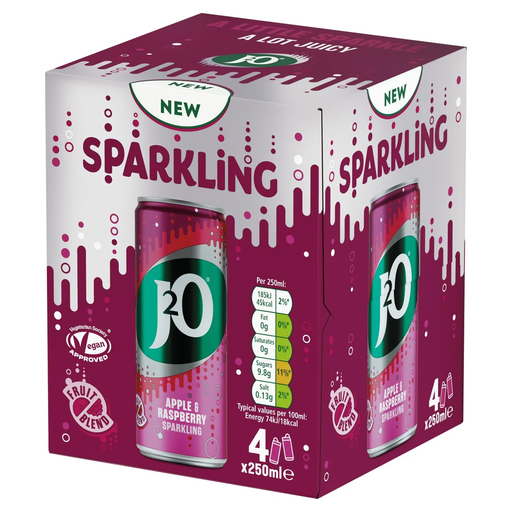 No image available
Four 250ml cans offer an apple-and-raspberry sparkling drink to take with breakfast rather than an apple-only choice. Check the ingredient list and stated juice content if 100% apple juice or particular sweeteners matter to you.
A 150ml serving of unsweetened fruit juice counts as one portion under NHS guidance, and juice or smoothies count only once a day. Sainsbury’s describes its 150ml Appletiser 100% apple-juice can as one portion; do not assume the same applies to a sparkling drink with a lower juice percentage.
A 250ml can is larger than the NHS-advised daily limit of 150ml for juice and smoothies combined. If you want a portion-sized 100% juice with breakfast, check for a 150ml format rather than treating every individual can as one such serving.
Check the stated juice percentage and ingredients. Sainsbury’s lists Appletiser as 100% apple juice and Cawston Press Cloudy Apple as 49% pressed apple juice with sparkling water; Marks & Spencer lists 16% apple juice and sugar in its Sparkling British Apple Spring Water.
Read the current ingredients, allergen information, nutrition panel and storage instructions on the physical can. The juice percentage, sugars per 100ml and can size are especially useful when comparing sparkling apple drinks for breakfast.