Sparkling apple juice can contribute to a practised long-run carbohydrate plan if you tolerate the fizz, but it should not be your entire fluid and electrolyte plan. ASDA Groceries lists 28 g carbohydrate and negligible salt in a 250 ml Appletiser serving; World Athletics cites 30–60 g carbohydrate per hour for endurance exercise lasting 1–2.5 hours. If carbonation causes bloating, consider still juice, while prolonged or sweat-heavy sessions call for separate attention to sodium-containing fluid.
Who might consider sparkling apple juice?
The useful question is not simply whether a drink contains apple juice, but whether its portion, carbonation and salt content fit a plan you have practised while running.
Runners testing fuel on long training runs
A labelled single serving makes it easier to account for carbohydrate alongside other food and drinks. World Athletics advises practising a race nutrition plan that balances carbohydrate and fluid with the risk of gut discomfort.
Runners who prefer an apple-juice flavour
Apple juice can provide a measurable carbohydrate contribution. Check the salt or sodium label separately: the reviewed Appletiser and Tropicana juices do not have the same labelled profile as a carbohydrate-electrolyte drink.
Runners who find fizzy drinks uncomfortable
If carbonation brings on bloating during exercise, a still drink is an alternative to trial. NHS bloating advice cautions against drinking lots of fizzy drinks, and a drink that feels comfortable at rest may need a separate test on a run.
How should you choose a long-run drink?
Choose the type of drink first, then check the carbohydrate in the portion you will actually carry, your tolerance of fizz and whether the rest of your plan provides sodium-containing fluid.
Sparkling apple juice
Consider it: You want a measured apple-juice serving and have tolerated carbonation on training runs.
Trade-off: The reviewed Appletiser provides carbohydrate but negligible salt, so it does not cover every part of a long-run drink plan.
Still apple juice
Consider it: You want apple juice without fizz and prefer to test a non-carbonated portion while running.
Trade-off: ASDA Groceries lists 0 g salt for Tropicana Pressed Apple Juice, so avoiding fizz does not resolve the electrolyte question.
Carbohydrate-electrolyte drink
Consider it: Your prolonged or sweat-heavy session calls for a plan covering both carbohydrate and sodium-containing fluid.
Trade-off: If you want apple flavour as well, account for any separate juice or food within the same practised plan.
| Priority | What to check | Your needs |
|---|
| Carbohydrate |
Read grams per serving, not just the juice percentage. ASDA Groceries lists 28 g per 250 ml of Appletiser; World Athletics cites 30–60 g per hour for 1–2.5-hour endurance exercise and up to 90 g per hour for events over 2.5 hours. |
I want to know how this portion fits with the food and drinks I have planned for the whole session. |
| Comfort with fizz |
Trial the portion, temperature and timing while running. If fizzy drinks cause bloating for you, compare a still option rather than waiting until race day. |
A drink I enjoy at rest might not feel comfortable on a run, so I would rather test it in training. |
| Salt and sodium |
Check the nutrition label separately from carbohydrate. ASDA Groceries lists negligible salt for Appletiser and 0 g salt per 100 ml for Tropicana Pressed Apple Juice; endurance-hydration guidance in Nutrition discusses drinks containing carbohydrate and electrolytes. |
For a prolonged or sweat-heavy run, I need to plan sodium-containing fluid as well as carbohydrate. |
| Drink and portion |
Compare like-sized portions: Sainsbury's lists 4.5 g carbohydrate per 100 ml for Cawston Press Cloudy Apple, versus ASDA Groceries’ 11 g per 100 ml for Appletiser. An ASDA apple-and-elderflower flavoured water lists 0 g per 100 ml. |
I want to distinguish a drink that contributes carbohydrate from one I am carrying mainly for its flavour, and measure any larger bottle into the portion I intend to use. |
Mistakes to avoid with long-run drinks
-
Assuming 100% juice is a complete endurance drink
Appletiser’s reviewed label shows carbohydrate but negligible salt. Endurance-hydration guidance published in Nutrition also discusses electrolytes and the role of sodium in water retention.
Read carbohydrate and salt or sodium values separately, then plan the rest of your fluid intake for the session.
-
Trying a fizzy drink for the first time on race day
Carbonation may be uncomfortable if fizzy drinks trigger bloating for you. World Athletics recommends a personalised nutrition plan practised before competition.
Test the same portion and timing on training runs; if fizz causes problems, trial a still alternative.
-
Counting every fizzy apple-flavoured drink as fuel
Reviewed labels differ: ASDA Groceries lists 11 g carbohydrate per 100 ml for Appletiser and 0 g for its sparkling apple-and-elderflower flavoured water; Sainsbury's lists 4.5 g for Cawston Press Cloudy Apple.
Use the carbohydrate figure and your intended serving size, rather than the flavour name, when planning intake.
-
Using everyday juice guidance as a training target
The UK Government’s Eatwell Guide recommends limiting fruit juice and smoothies to a combined 150 ml per day in the general diet because they contain free sugars. That figure is not a session-specific carbohydrate target for endurance exercise.
Keep routine dietary guidance distinct from a practised training or race plan.
Apple drink brands and labelled options
These examples illustrate different labelled drinks and formats; a brand name alone does not establish the carbohydrate or salt content of every product it sells.
Appletiser
The reviewed sparkling apple juice is 100% carbonated apple juice from concentrate, offered in a 250 ml can within a six-pack.
- ASDA Groceries lists 28 g carbohydrate per 250 ml serving.
- The same listing describes salt as negligible; carbonation may not suit someone who gets bloating from fizzy drinks.
Cawston Press
The reviewed Cloudy Apple sparkling drink contains sparkling water and 49% pressed apple juice.
- Sainsbury's lists 4.5 g carbohydrate per 100 ml, making the contribution straightforward to calculate for a chosen portion.
- That is less carbohydrate per 100 ml than the reviewed Appletiser juice, so check the portion if carbohydrate is the reason for carrying it.
Belvoir Farm
The reviewed Pink Lady sparkling apple-juice drink comes in a 750 ml bottle.
- Tesco Groceries lists 25 g carbohydrate per 250 ml serving.
- The reviewed label lists 0 g salt per 250 ml; measure a portion from the larger bottle if using it in a run plan.
Tropicana
The reviewed Pressed Apple Fruit Juice is a still, 100% pressed juice rather than a sparkling option.
- ASDA Groceries lists 11 g carbohydrate per 100 ml, providing a labelled still-juice option to portion and trial.
- Its label lists 0 g salt per 100 ml, so removing fizz does not add sodium.
Joybuy sparkling apple juice options
This Appletiser option represents the measured, sparkling apple-juice route. Compare it with a still drink or a carbohydrate-electrolyte drink according to your tolerance and the rest of your long-run plan.
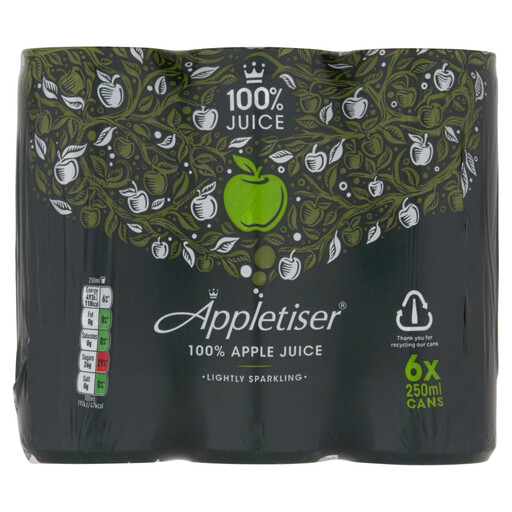 Image unavailable
Appletiser 100% Apple Juice Lightly Sparkling 6 × 250 ml
The 250 ml cans provide defined portions to trial on training runs. Joybuy lists 28 g carbohydrate per 250 ml serving; ASDA Groceries describes salt in the same sparkling juice as negligible. If fizz causes bloating for you, trial a still alternative, and plan sodium-containing fluid separately where the session calls for it.
View on Joybuy
Questions about apple juice on training runs
Can a 250 ml can of sparkling apple juice contribute to a long-run fuel plan?
Yes, if you tolerate it and count its carbohydrate alongside the rest of your intake. ASDA Groceries lists 28 g carbohydrate in a 250 ml Appletiser serving, while World Athletics cites 30–60 g per hour for endurance exercise lasting 1–2.5 hours and up to 90 g per hour for events over 2.5 hours. Practise the complete food and fluid plan in training.
What if fizzy drinks make me feel bloated while running?
Trial a still alternative rather than relying on a sparkling drink for race day. NHS bloating advice cautions against drinking lots of fizzy drinks, and World Athletics recommends practising your nutrition plan before competition.
Can sparkling apple juice take the place of a carbohydrate-electrolyte drink?
Do not assume it can: ASDA Groceries lists negligible salt for the reviewed Appletiser, whereas endurance-hydration guidance published in Nutrition discusses drinks containing both carbohydrate and electrolytes. For prolonged or sweat-heavy sessions, assess sodium-containing fluid separately from the juice’s carbohydrate contribution.
Does the 150 ml fruit-juice advice set a long-run fuelling target?
No. The UK Government’s Eatwell Guide recommends limiting fruit juice and smoothies to a combined 150 ml per day as general dietary guidance because they contain free sugars; it is not a marathon fuelling prescription. Plan and practise what you consume during a session in the context of its duration and your tolerance.


