Small-table workshop hosts
You gather several writers around one table and want a laptop-connected speakerphone without setting up a permanent room system. The seating distance still needs to fit the device’s placement guidance.


Choose a speakerphone by the distance to the furthest participant and the need for free-flowing discussion, not speaker volume alone. A compact USB model can suit a small table when everyone sits within its stated pickup area; a more widely spaced group may need greater coverage or linked units. Check the host device’s connection and the meeting app’s audio settings before the workshop.
You gather several writers around one table and want a laptop-connected speakerphone without setting up a permanent room system. The seating distance still needs to fit the device’s placement guidance.
Participants read aloud, respond quickly and sometimes speak over one another. Full-duplex audio and echo control are relevant features to check, alongside how clearly the furthest seats can be heard.
You move between workshop rooms or sometimes seat people beyond one small table. Connection options, published pickup coverage and any model-specific expansion route become important.
Start with the seating plan, then decide how the host will connect the speakerphone and whether a larger venue calls for an expandable setup.
| Concern | What to check | Who this matters to |
|---|---|---|
| Discussion flow | Look for stated full-duplex audio and echo control; test turn-taking in the intended room. | If people read aloud and respond before the previous speaker has finished, I want the conversation to remain intelligible. Around 33% of consumers put discussion flow first. |
| Table coverage | Compare the furthest seat with the exact model’s pickup or placement guidance. | I need quieter readers at the far end of the table to be heard without moving towards the device. For around 27% of consumers, coverage is the primary concern. |
| Connection and setup | Check the host device’s connector or Bluetooth support, then select the speakerphone for both input and output in the meeting app. | When I am hosting from a laptop or phone, I want to avoid sorting out audio settings after everyone joins. Setup comes first for around 20% of consumers. |
| Changing venues | Check connection and power needs, plus model-specific support for linked units or expansion microphones. | My workshop may move to a room where one centrally placed device cannot reach everyone. Around 20% of consumers primarily need a setup that can adapt to changing venues. |
The furthest seat matters more than a general meeting-room description. Jabra advises placing the Speak2 40 centrally, within 2.3 m of each participant; HP specifies up to 2.5 m microphone pickup for the Poly Sync 40, while Yealink specifies 5 m all-round pickup for the SP96. These are model-specific statements, not interchangeable measures of workshop performance.
Sketch the seating plan and compare it with the exact model’s guidance before buying.
The app or computer may continue using its built-in microphone and speakers. Jabra’s Speak2 40 instructions note that users may need to select the speakerphone as both the recording and playback device.
Connect it before the session and make a test call in the app the workshop will use.
Stated full-duplex, echo-control and noise-processing features do not remove the need to keep speakers within the device’s published pickup area.
Test a live exchange with people speaking from the furthest seats in the intended room.
A replaced speakerphone is electrical waste and needs an appropriate collection route.
Check local electrical-waste collection or the retailer’s applicable take-back arrangements.
The Speak2 range includes laptop-oriented speakerphones for shared-table calls.
The Sync 40 range is aimed at shared calls in flexible workspaces.
The SP96 offers a portable speakerphone route with a two-unit expansion option.
The GAC2570 is conference hardware to consider for a more permanent workshop room.
The Pro Desktop Speakerphone SP3022 is a wired option for computer-led calls.
These choices offer a Bluetooth conference speaker and a wired speakerphone for a shared workshop call. Match either one to the host device and the distance between the unit and the furthest reader.
 No image available
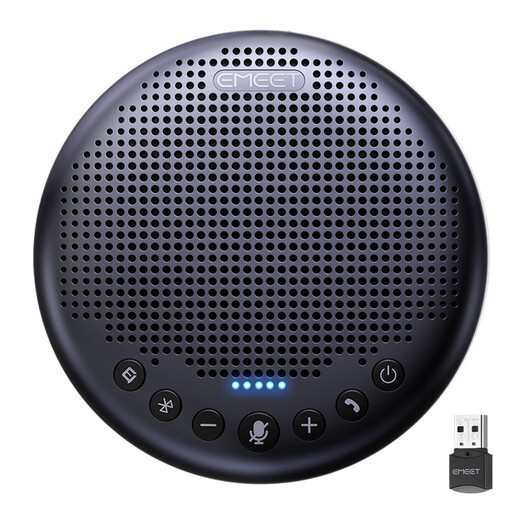
Consider this model when the workshop host wants a Bluetooth connection. Its name lists 360° voice pickup and a 5 W speaker; check the usable microphone distance against the furthest seat rather than treating 360° as a distance rating.
 No image available
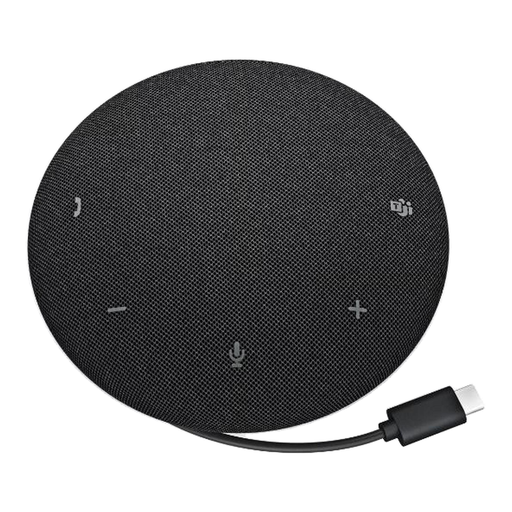
Consider this wired model when the host computer can remain connected throughout the workshop. Check cable reach and microphone coverage for the seating plan, and confirm the discussion and echo-control features you need for the SP325 specifically.
Place it near the centre of the group, with every participant inside the exact model’s placement or pickup guidance. Jabra advises positioning the Speak2 40 in the centre of a table, up to 2.3 m from each participant; check a different model’s own guidance rather than applying that distance to it.
You may still need to select it for both microphone input and speaker output. Jabra gives that advice for the Speak2 40; use the workshop’s meeting app for a short test call before participants join.
Consider a supported two-unit setup when the seating extends beyond one device’s published pickup boundary or people sit at opposite ends of the room. Yealink says two SP96 units can be daisy-chained and recommends about 2–3 m between them; confirm the instructions for the particular model you choose.
Use an electrical-waste collection route rather than general household rubbish. Check your local collection options or the retailer’s applicable take-back arrangements before disposing of the old device.