Active table-side review groups
Several colleagues comment on wording and sometimes speak at once. They need to assess full-duplex support and whether microphones can pick up voices from their usual seats, rather than choosing by speaker size alone.


For a draft review with colleagues seated on different sides of a kitchen table, favour a speakerphone that explicitly supports full-duplex conversation and has microphone coverage suited to the seating arrangement. A compact model may suit a nearby pair or small group; for a more spread-out group or a setup that moves to a meeting room, compare stated pickup or room coverage and check the connection and meeting app before choosing.
Several colleagues comment on wording and sometimes speak at once. They need to assess full-duplex support and whether microphones can pick up voices from their usual seats, rather than choosing by speaker size alone.
One or two colleagues sit close to the host laptop and want a straightforward connection and a unit that is easy to put away after the call. Their seating distance matters more than a model’s stated capacity for a larger room.
These colleagues review drafts at home but may take the same unit to a small office room. Portability, the devices they connect and compatibility with their usual meeting platform all affect the choice.
Start with how many people speak locally and where they sit. Then check how the speakerphone connects to the person hosting the call and whether any platform-specific feature works in that setup.
| Concern | What to check | Who this matters to |
|---|---|---|
| Natural discussion | Look for explicitly stated full-duplex operation and microphone coverage suited to voices around the table. | If several of us are commenting on a draft, brief interruptions should not stop the remote side hearing the discussion. Around 36% of consumers put natural multi-person conversation first. |
| Connection to the host | Check the host’s port, the model’s USB or Bluetooth options and whether a required adapter is included. | When a colleague opens the draft on a laptop or phone, I want to start the call without sorting out a connection mid-meeting. For around 29% of consumers, straightforward setup is the primary need. |
| Table coverage | Compare the usual seating distance and group size with the exact model’s stated pickup range or recommended meeting size. | For a close-seated group, I want coverage that fits our table without choosing capacity for a room we do not use. That fit comes first for around 21% of consumers. |
| Platform flexibility | Check the exact meeting-platform compatibility, model variant and any conditions attached to advertised audio modes. | If our draft reviews may move into managed office calls, I need the unit to work with the service and devices we actually use. Around 14% of consumers make platform and future-room needs their main priority. |
A compact speakerphone’s stated coverage may suit people near the device without answering whether it reaches every seat. HP specifies up to 2 m microphone pickup for the Poly Sync 20 M USB-C, while Yealink positions the CP700 for meetings of up to four people.
Count the regular speakers and check their distance from the proposed position of the unit against the exact model’s stated coverage.
Draft reviews often involve quick replies and overlapping comments. Jabra and AnkerWork describe full-duplex operation on their respective Speak2 75 and PowerConf S500 models as allowing both sides of a call to speak and be heard at the same time.
If the group regularly talks back and forth with remote colleagues, check that the exact model explicitly supports full-duplex conversation.
Jabra says the Speak2 75’s super-wideband audio requires support from both the unified communications client and the connected device.
Check the meeting service, host device and product variant before making that mode part of your decision.
A speakerphone is electrical equipment. UK government guidance on waste electrical and electronic equipment addresses its recovery, reuse and recycling.
When replacing a unit, use an appropriate electrical-waste collection or retailer take-back route where available.
Jabra positions the Speak2 75 as a portable speakerphone for meetings in flexible locations.
AnkerWork positions the PowerConf S500 for small-to-medium meeting rooms, stating a capacity of up to 12 people for one unit.
The Poly Sync 20 line offers a compact approach to calls hosted from a nearby computer or smartphone.
Yealink positions the portable CP700 for personal calls and meetings of up to four people.
These options address two ways of setting up a kitchen-table review: a Bluetooth speakerphone advertised with 360° voice pickup and a wired speakerphone for a laptop-led group. Check seating, connection and conversation requirements against the exact product before choosing.
 No image available
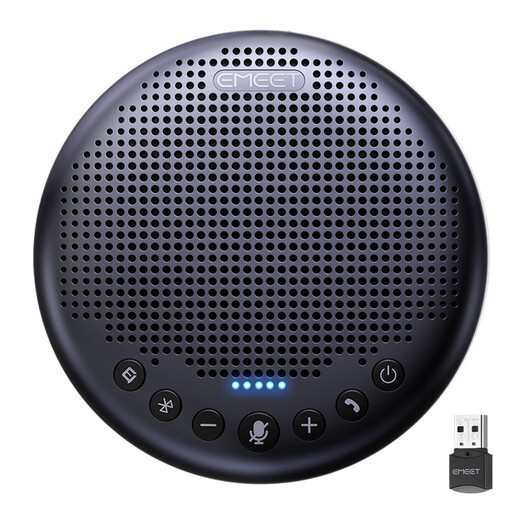
For colleagues seated on different sides of the table, compare its advertised 360° voice pickup with your usual arrangement. The title specifies eight microphones and a 5 W speaker. Check compatibility with the host device and meeting app, and keep the unit clear of kitchen-table spills: the listing says it is not waterproof.
 No image available
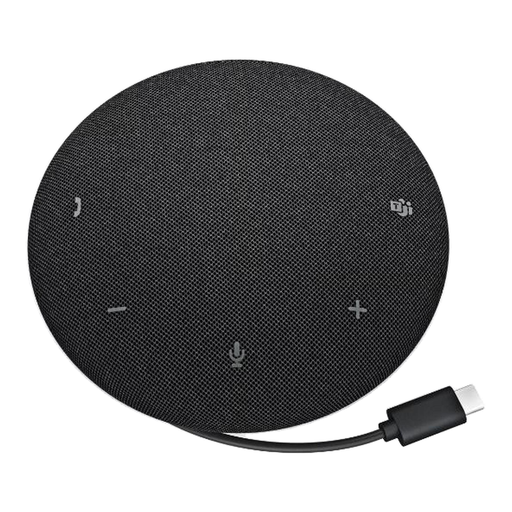
Consider this wired model for a review hosted from a nearby laptop. Check that the connector suits the host and the cable reaches the intended position on the table. If colleagues often speak over one another, confirm full-duplex operation for this model before choosing it.
Use the exact model’s stated coverage and your usual seating arrangement, not a single capacity figure for all speakerphones. Yealink positions the CP700 for meetings of up to four people; HP specifies up to 2 m pickup for the Poly Sync 20 M USB-C; and AnkerWork states up to 12 people for one PowerConf S500. Distance, background noise and room acoustics still matter.
USB may be the simpler choice when one laptop regularly hosts the call, while Bluetooth offers more placement flexibility when the host device changes. Check the exact connector, pairing requirements and included accessories rather than assuming every variant offers the same connection options.
A named certification matters most when the team uses that platform in the stated type of setup. AnkerWork lists Zoom Rooms and Google Meet certification for the PowerConf S500; check the exact app, operating system, connection and model variant used for your calls.
Connect the speakerphone using the chosen method and select it as both the microphone and speaker in the call settings. AnkerWork’s PowerConf S500 user guide specifically calls for those software selections after connecting; for a battery-powered unit, also check its charge before the meeting.
Use an appropriate electrical-waste collection or retailer take-back route where available rather than putting it in general waste. UK government guidance on waste electrical and electronic equipment is intended to support recovery, reuse and recycling.