One-to-one conversation tutors
For paired speaking exercises at a desk or kitchen table, check that both people can sit within the microphone’s stated pickup range. Full-duplex audio matters when a learner responds before a prompt has finished.


Choose a speakerphone with stated full-duplex audio if lessons involve quick replies or overlapping speech. A compact model can suit two people at a table when both sit within its stated microphone pickup range; consider wider coverage for a more dispersed group, while checking noise handling and connections against the room and devices you actually use.
For paired speaking exercises at a desk or kitchen table, check that both people can sit within the microphone’s stated pickup range. Full-duplex audio matters when a learner responds before a prompt has finished.
Flatmates, appliances and room echo can interrupt a remote lesson. Look for model-specific noise and echo handling, but plan the teaching space as well: those features cannot make a shared room silent or private.
If lessons move between a laptop and a phone or tablet, check the connections supported for each device. A USB connection can provide a wired option alongside Bluetooth where both are offered.
Start with how people take turns speaking, then measure where they sit. Check household noise and device connections against the way lessons run.
| Concern | What to check | Who this matters to |
|---|---|---|
| Natural dialogue | Confirm full-duplex audio on the exact variant; check echo handling separately. | When teaching involves quick corrections and overlapping replies, I need both ends of the call to remain audible. Around 36% of consumers put natural dialogue first. |
| Flat noise and echo | Check the model’s stated noise and echo features, then position it away from household noise. | In an occupied flat, I want remote learners to hear speech without as much distraction from nearby activity. Roughly 29% of consumers make noise and echo control their primary concern. |
| Device switching | Check connections for the intended laptop, phone or tablet, including any adapters needed. | If I alternate teaching devices, I need a setup I can change without disrupting a lesson. About 21% of consumers prioritise connection flexibility. |
| Seating coverage | Compare the distance from the unit to each speaker with its stated microphone pickup range. | When learners sit around a larger table, I need their seats to remain within microphone reach without choosing a larger unit unnecessarily. Around 14% of consumers put seating coverage first. |
Bluetooth describes a connection, not whether a call can carry speech in both directions at once. Frequent interruptions can feel awkward if simultaneous speech is not supported.
Check that the exact speakerphone variant explicitly states full-duplex audio.
A distant learner may be difficult for remote participants to hear even when playback is loud. HP lists up to 2 m microphone pickup for Poly Sync 20, while Jabra lists up to 2.5 m for Speak2 75; those figures are manufacturer specifications, not guarantees for every room.
Measure the usual seating layout and compare the distance to each speaker with the model’s stated pickup range.
Noise and echo handling may help a call, but it cannot ensure that flatmate conversations are inaudible or that a lesson is private.
Check the device’s documented features and reduce noise at source where possible, such as by moving away from appliances or choosing a quieter room.
Jabra’s Speak2 75 is a portable speakerphone to consider when several local voices or a larger shared-flat table need coverage.
HP Poly’s Sync 20 is relevant to a compact tutor-and-learner table arrangement.
AnkerWork’s PowerConf S500 is aimed at small-to-medium rooms and may be relevant when lessons involve more than two local participants.
For lessons at a shared table, these choices include a Bluetooth speakerphone and a wired speakerphone. Check full-duplex operation, microphone reach and device connections on the exact variant before deciding which fits your setup.
 No image available
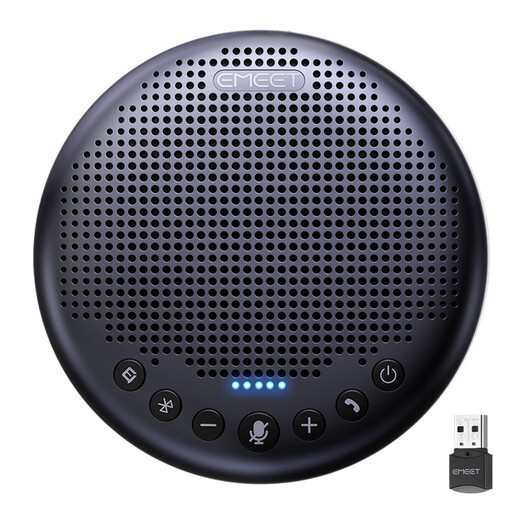
For a lesson where Bluetooth connectivity matters, check that the connection works with your teaching device and that the stated microphone reach covers everyone at the table.
The product name describes eight microphones, 360° voice pickup, AI noise reduction and a 5W speaker. Noise reduction should not be treated as a promise that flatmate sounds will be inaudible.
 No image available
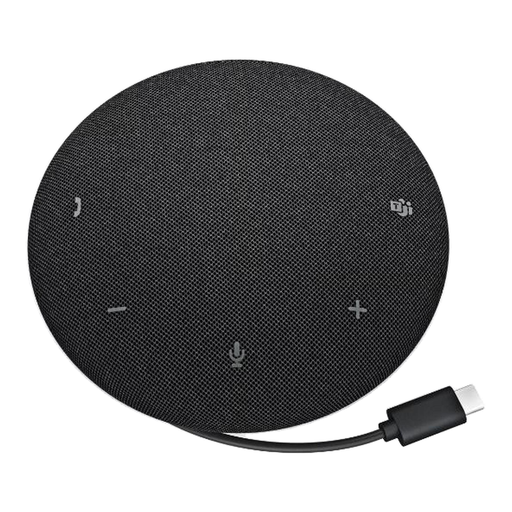
For lessons where a wired speakerphone suits the teaching setup, check that its connection fits your device and that the cable reaches the intended table position.
Before relying on the SP325 for overlapping speech, confirm full-duplex operation on the exact variant. Compare its stated microphone pickup range with where the tutor and learners will sit.
Full-duplex audio is worth prioritising when lessons include interruptions, role-play or quick corrections, because it allows speech in both directions at once. Check the specification for the exact model rather than assuming every Bluetooth speakerphone provides it.
Place it on a stable table where the usual speakers are within its stated microphone pickup range. Keep it away from obvious noise sources where possible; a manufacturer’s room-size guidance does not guarantee clear calls in a noisy room.
Bluetooth may suit a particular setup, but check laptop compatibility and consider a model with a USB option if you want a wired connection available. AnkerWork’s PowerConf S500 user guide also notes that the speakerphone may need to be selected manually as the audio device in computer or conferencing settings.
Use an appropriate electrical-equipment collection or retailer take-back route where available rather than putting it in ordinary household rubbish. UK guidance from the Office for Product Safety and Standards and the Department for Environment, Food & Rural Affairs describes waste electrical and electronic equipment rules as supporting recovery and recycling.