Noisy open-office planning teams
If nearby conversations and keyboard noise compete with the meeting, look for model-specific call-noise reduction, echo cancellation and full-duplex audio. Keep in-room speakers within the stated microphone coverage.


Choose a speakerphone whose stated microphone coverage includes every usual seat, then check full-duplex audio, echo control and call-noise reduction for the exact model. A compact personal unit may suit one or two nearby speakers; a larger planning group needs broader stated coverage and a connection that works with its meeting computer. Noise processing does not make an open office private.
If nearby conversations and keyboard noise compete with the meeting, look for model-specific call-noise reduction, echo cancellation and full-duplex audio. Keep in-room speakers within the stated microphone coverage.
For a recurring group meeting, start with the room and seating layout. Check pickup range, the computer connection and the conferencing controls on the exact variant rather than choosing by portability alone.
A compact unit may be practical between desks and small meeting spaces. Compare its stated pickup range with the largest group you expect to seat around it before using it for a shared planning table.
For a noisy-office planning meeting, identify the constraint that would most disrupt your call: speech clarity, coverage of the table, setup or carrying the device between spaces.
| Concern | What to check | Who this matters to |
|---|---|---|
| Speech over office noise | Look for full duplex, acoustic echo cancellation and call-noise reduction specified for the exact model. | If background conversation competes with our discussion, I need remote colleagues to follow the speakers without constant repetition. Around 36% of consumers put speech clarity first. |
| Meeting-table coverage | Compare the farthest usual seat with the stated microphone pickup range and room guidance. | When several colleagues share a table, I need the farthest person heard as well as those beside the device. Coverage is the main concern for roughly 29% of consumers. |
| Connection and meeting workflow | Confirm the host-device connection and any adapter supplied with the exact variant; select it as both microphone and speaker before the call. | If different colleagues start meetings from their laptops, I need a setup that does not delay the discussion. For about 21% of consumers, straightforward connection takes priority. |
| Portability | Check carrying needs alongside battery expectations and pickup coverage for the largest intended group. | I move the unit between desks and small meeting spaces, so carrying it matters provided the group fits within its coverage. Portability comes first for around 14% of consumers. |
Noise processing cannot make up for seats beyond the microphone’s stated range. Yealink specifies a 1.5 m pickup range for the CP700, while Jabra lists up to 2.5 m for the Speak2 75.
Mark the usual seating positions and compare the farthest speaker’s distance with the exact model’s coverage.
Manufacturer descriptions of noise reduction and echo control concern call audio; they do not establish confidentiality from colleagues nearby.
For sensitive planning discussions, use an appropriately quiet space or another suitable privacy measure.
Connection routes differ. Jabra specifies Bluetooth use with smartphones and tablets for the Speak2 75, while AnkerWork documents USB-C, dongle and Bluetooth routes for the PowerConf S500.
Check the connection documented for your meeting computer and select the device as both input and output before the call.
The Speak2 75 is a portable speakerphone that Jabra specifies for rooms up to 4.5 m × 4.5 m, with microphone pickup up to 2.5 m.
The Sync 40 range is positioned for flexible huddle spaces; HP’s room guidance varies by page and variant.
AnkerWork positions the PowerConf S500 for small-to-medium meeting rooms and states coverage for up to 12 people with one unit.
Yealink positions the portable CP700 for personal calls and meetings of up to four people.
These wired and Bluetooth speakerphones are options to assess for a shared planning meeting. Compare their connection methods and stated microphone coverage with your own table layout before choosing.
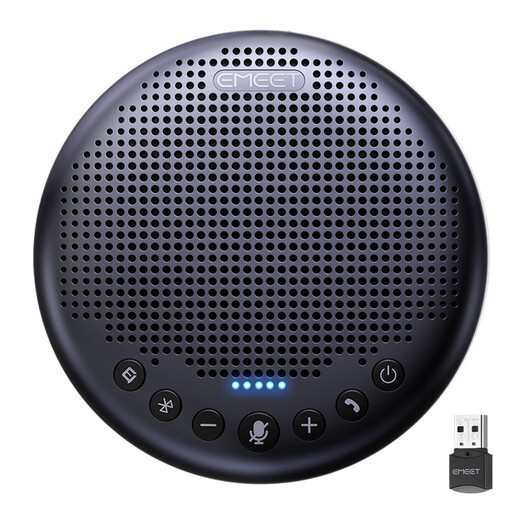 Image unavailable
For a group seated around one table, compare the advertised 360° voice pickup with where participants will sit.
The product name specifies eight microphones, Bluetooth, AI noise reduction, dual connection and a 5W speaker. Confirm the computer connection and pickup distance needed for your room; the noise-reduction wording does not establish call clarity in every office.
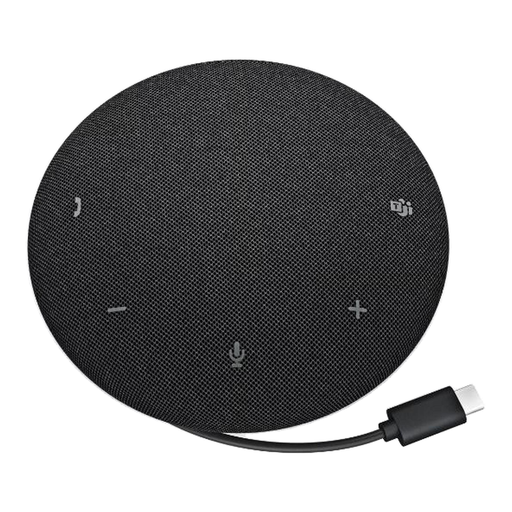 Image unavailable
A wired speakerphone may suit a planning table with a nearby meeting computer, provided its connector matches the host.
Check microphone coverage against the farthest seat, and confirm full-duplex audio and echo control if overlapping discussion makes those features important to your meeting.
Start with microphone pickup range and room guidance for the exact speakerphone, then check full duplex, echo cancellation and call-noise reduction. Place the unit so the farthest usual speaker falls within its stated coverage; processing features alone cannot resolve poor placement.
Use a connection that the exact model documents for your meeting computer. Jabra specifies USB connectivity for the Speak2 75 and describes its Bluetooth use for smartphones and tablets; AnkerWork documents USB-C, dongle and Bluetooth routes for the PowerConf S500. Select the device as both microphone and speaker in the computer and conferencing app.
No: a manufacturer’s group-capacity figure does not replace checking seating positions, microphone coverage and room layout. If a longer table calls for linked units, confirm that the exact model supports linking and check the setup requirements.
Check the documentation and applicable conformity marking for the exact electrical product. GOV.UK’s guidance on the Electrical Equipment (Safety) Regulations 2016 concerns equipment within those regulations supplied in or into Great Britain; Northern Ireland has different provisions, so confirm the requirements for that destination separately.
Check the warranty and support terms for the exact model and seller rather than assuming they apply across a brand. HP lists a standard two-year limited warranty for the Poly Sync 40 series; terms for other models or sellers may differ.