Solo listener in a noisy office
You join the talk from a laptop or phone and want your occasional questions to be understandable despite nearby conversation. Microphone noise handling matters, but it will not make the office quiet.


If you expect to ask questions during the talk, look for documented microphone noise reduction, echo control and full-duplex calling. A personal desk speakerphone may suit one nearby participant; if colleagues will join in, check the stated pickup range and room guidance. Use a headset instead if playing the talk aloud would disturb colleagues or compromise privacy.
You join the talk from a laptop or phone and want your occasional questions to be understandable despite nearby conversation. Microphone noise handling matters, but it will not make the office quiet.
One or more colleagues may listen or contribute with you. Check whether the stated pickup range fits where everyone will sit, and whether the speakerphone supports simultaneous conversation and echo control.
You use different desks or work locations. The USB connector, Bluetooth option and any supplied adapter need to fit the devices and workplace rules you actually use.
Check first whether playing the talk aloud is acceptable in your office. If it is, consider how you will be heard and how the device will connect before deciding how much pickup range or portability you need.
| Concern | What to check | Who this matters to |
|---|---|---|
| Being heard over office noise | Look for documented microphone noise reduction and echo control. Check for full-duplex calling if you expect a live discussion. | If office conversations overlap my questions, I need the remote audience to understand me; around 36% of consumers put clear outgoing speech first. |
| Work-device compatibility | Confirm the USB connector, Bluetooth permissions and the exact meeting-platform variant or supplied adapter. | With a managed work laptop, I need the device and meeting service to work together; roughly 29% of consumers place compatibility first. |
| Occasional group discussion | Compare the stated microphone pickup range with where colleagues will sit, and check the maker’s room guidance. | When colleagues join my questions, I need their voices to reach the call too; around 21% of consumers put shared participation first. |
| Moving between locations | Check the connection options, stated battery life where relevant, and what is included for carrying the device. | Moving between desks and home makes a device I can carry and connect important to me; roughly 14% of consumers put portability first. |
A speakerphone still plays the history talk aloud, and people nearby can hear you speak. Microphone noise reduction does not address either issue.
Use a headset if discretion or avoiding disturbance is decisive. Otherwise, keep the volume modest and mute while listening.
The number of microphones does not establish how well a device will handle your office noise or where other participants can sit.
Read the stated noise-handling features, pickup range, room guidance and full-duplex information alongside the microphone count.
USB-A, USB-C and meeting-platform variants can differ within a product family. An unsuitable connector or restricted Bluetooth connection could prevent use with a work laptop.
Confirm the part number, connector, supplied adapter and workplace IT requirements before ordering.
The Speak2 75 is a portable speakerphone positioned for personal and small-room calls.
The Sync 20 range is aimed at portable, close-range desk use.
The EXPAND 40 is a portable Bluetooth and USB-C speakerphone for office calls.
The PowerConf S500 is presented as a portable speakerphone for shared calls, with USB-C, Bluetooth and dongle connection options.
The SP92 is a portable speakerphone positioned for desk or home-workspace calls.
These choices cover a Bluetooth conference speakerphone for possible shared participation and a wired speakerphone for a laptop-based talk. Check each connection against your work setup before choosing.
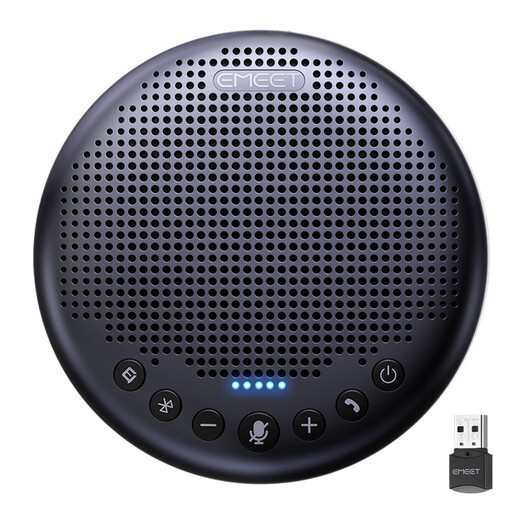 Image unavailable
Consider this for a talk where colleagues might occasionally join the discussion.
The product name lists eight microphones, Bluetooth, 360° voice pickup and a 5W speaker. Its AI noise reduction is an advertised feature, not a guarantee against nearby voices; confirm the exact connection modes and device compatibility before buying.
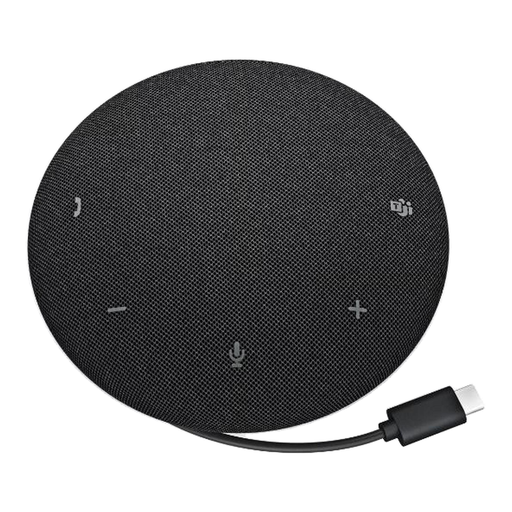 Image unavailable
Consider this for joining from a work laptop when a wired speakerphone suits your desk.
Check the connector against your laptop and workplace requirements. If you expect people to speak over one another during questions, confirm whether this exact model provides the echo control and full-duplex operation you need.
No speakerphone can guarantee that nearby speech or sudden sounds will disappear from your call. Look for documented microphone noise reduction and echo control, place the unit within its stated pickup range and mute while you are only listening. Use a headset if privacy or disturbance to colleagues is the deciding concern.
Confirm the laptop’s available USB connector, workplace Bluetooth rules and the meeting service you will use. Check the exact product variant and whether any adapter you need is included; connection options and certifications can vary within a speakerphone range.
Check small-room guidance when colleagues will speak from different positions rather than sitting close to one desk unit. HP states microphone pickup up to 2 m for Poly Sync 20 variants, while Jabra specifies up to 2.5 m for Speak2 75; treat those distances as product specifications, not guarantees of intelligibility in a noisy office.