Solo listener who may ask a question
You listen on your own, normally stay muted during the presentation and need to hear speech clearly before briefly unmuting for Q&A.


If you join alone and can already hear clearly, you may not need a speakerphone: Gloucestershire Family History Society advises that most attendees stay muted during a large talk. Consider a compact model if your existing audio makes listening or occasional Q&A difficult; look at shared-room microphone coverage when several people will use one device, and keep other nearby devices disconnected from meeting audio to avoid echo.
You listen on your own, normally stay muted during the presentation and need to hear speech clearly before briefly unmuting for Q&A.
Several people listen around one computer and may contribute aloud. Microphone reach and avoiding echo matter more here than pocket portability.
You join from different rooms or devices and want to check connection options and battery use rather than set up a fixed meeting-room system.
Start by checking whether your current device is comfortable to listen to; then decide whether brief Q&A or several people speaking around one device changes what you need.
Choose this when: You join alone and can already hear the talk clearly through your laptop, tablet or phone.
Bear in mind: Test the microphone too if you intend to ask a spoken question.
Choose this when: You listen alone but want a separate sound source or a convenient way to take part in Q&A.
Bear in mind: Check the connection with your device and test the selected speaker and microphone in the meeting app.
Choose this when: Several people will listen or speak around the same device.
Bear in mind: Room-coverage features add little to a mostly muted solo session, while other nearby devices with active meeting audio can cause echo.
| Concern | What to check | Who this matters to |
|---|---|---|
| Clear solo listening | Check connection compatibility and run the meeting app’s speaker test from your usual seat. | If I mainly listen, I want to follow spoken details without struggling with my device’s output. Around 50% of consumers put clear solo listening first. |
| Occasional Q&A | Check the exact model’s microphone and mute controls, then test its input in the meeting app. | When I unmute for a question, I need the host to hear me without leaving my microphone on throughout the talk. For around 33% of consumers, brief spoken participation is the primary concern. |
| Shared-room use | Compare stated room and microphone-pickup guidance; use only one active meeting-audio device nearby. | If several of us gather around one computer, we need voices at our seats to reach the call. That shared-room need comes first for around 17% of consumers. |
Gloucestershire Family History Society advises that almost everyone stay muted in large meetings. If you listen alone, the ability to hear clearly and select the right audio device may matter more than wider microphone coverage.
Test your built-in speaker first. Consider broader pickup when other people will share the device or join the discussion.
Zoom identifies multiple devices with active audio in one room as a cause of echo, which can interrupt the talk or Q&A.
Use one device for the room’s meeting audio and disconnect audio on the others; muting their microphones alone does not silence their speakers.
A connected speakerphone will not help if the meeting app is still using another speaker or microphone.
Before the talk, select the intended output and input in the app and run both audio tests. Zoom provides separate speaker and microphone tests.
GOV.UK says electrical products and batteries should display the crossed-out wheelie-bin symbol, indicating that they should not be disposed of with ordinary household waste.
Use an appropriate electrical-waste collection route and follow the product instructions for its battery.
Its portable Speak2 55 offers USB-A and USB-C connectors on one cable, alongside Bluetooth use.
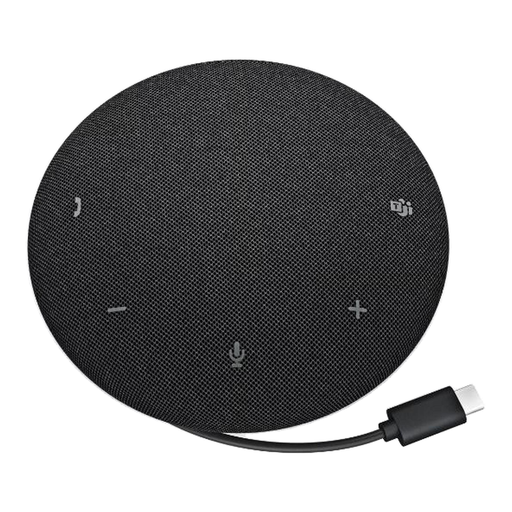
The Sync 20+ USB-C model listed by HP Store UK is positioned for personal and small-room calls.
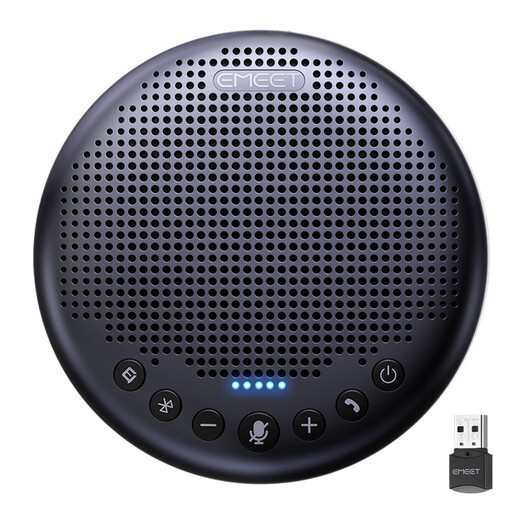
The EXPAND 40 offers Bluetooth and USB-C connection options for shared calls.
These choices cover a wired speakerphone for joining from a computer and a Bluetooth conference speaker for considering shared listening. Decide whether you need a separate device at all before comparing them.
 No image available
Consider this wired model if you join the talk from a computer and prefer not to rely on Bluetooth pairing. Check that its connection suits your computer and that the cable reaches where you normally sit.
 No image available
Consider this model if several people may speak around one device; its title advertises eight microphones and 360° voice pickup. Check the connection and pairing behaviour you need, and confirm that its pickup suits the room and seating arrangement.
Not if your existing device lets you hear comfortably. Essex Society for Family History notes that laptops, tablets and smartphones have built-in speakers and microphones; try your usual listening position before buying separate equipment.
Test both the speaker and microphone you intend to use. Zoom lets you play a speaker test tone and record a microphone test; select the speakerphone explicitly in the meeting app if either test uses another device.
Keep only one nearby device connected to meeting audio. Zoom identifies multiple active audio connections in a room as an echo cause, so disconnect the others from meeting audio rather than only muting their microphones.
Usually not in a large talk: Gloucestershire Family History Society advises that almost everyone stay muted. Follow your organiser’s instructions for when to unmute or ask a question.
Use an appropriate electrical-waste collection route rather than household rubbish. GOV.UK says electrical products and batteries should display the crossed-out wheelie-bin symbol; follow the device’s instructions when handling its battery.