One person at a fixed kitchen table
If you normally join from a laptop, focus on a connection that suits its ports and a stated pickup range that reaches your usual seat without moving the computer closer.


For one person joining a writing workshop from a laptop, start with a compact USB speakerphone whose stated microphone range reaches the usual seat, and check for full-duplex audio and echo reduction. If several writers regularly share the table, assess the farthest seat before choosing wider pickup or expansion; manufacturer-stated coverage does not guarantee the same result in every room.
If you normally join from a laptop, focus on a connection that suits its ports and a stated pickup range that reaches your usual seat without moving the computer closer.
If people speak from different sides of the table, compare the farthest seat with the model’s pickup range. Multi-microphone coverage and full-duplex audio are relevant to group discussion, but stated ranges are not a promise of equal clarity at every seat.
If the speakerphone will move between a laptop, phone and other locations, check its connection options and whether its battery operation suits those sessions.
Start with the number of people who usually speak from the table and their distance from the device; then choose a connection that works with the laptop used for the workshop.
| Concern | What to check | Who this matters to |
|---|---|---|
| Voice coverage | Measure from a central position to the farthest usual speaker. Compare that distance with the exact model’s stated pickup range, and check for full-duplex audio and echo reduction. | If I read aloud or discuss drafts with someone across the table, I need their voice to reach the device as well as mine; around 36% of consumers put voice coverage first. |
| Laptop connection | Match the supplied connector to the laptop’s ports. If a named meeting-platform certification matters, check which connection method and variant it covers. | When a workshop begins at a set time, I want to connect to my usual laptop without sorting out Bluetooth pairing; roughly 29% of consumers prioritise a straightforward laptop connection. |
| Use away from the table | Check battery talk time and whether the exact device supports the connections you need for both laptop and phone use. | If I also take calls in another room or while travelling, I need one device that can move with me; around 21% of consumers make that flexibility their primary concern. |
| Shared-group capacity | Count regular in-room participants and check whether claimed group coverage depends on a second compatible unit. | When several writers routinely share one call, I need the setup to reach people beyond the nearest seats; about 14% of consumers put shared-group capacity first. |
Pickup range varies by model, and kitchen noise or reflective surfaces can affect how a call sounds.
Measure the distance to the farthest regular speaker from the planned central position, then compare it with the exact model’s stated range. Try the setup before an important workshop if possible.
Connection method can change both setup and certification conditions. Jabra specifies that Speak2 55 platform certifications apply to USB connections, not ordinary Bluetooth connections.
If certification matters for your meeting platform, check the exact model, variant and connection you intend to use.
Daisy-chaining serves a larger shared setup; it does not help determine whether one unit reaches your usual seat.
Assess the regular number of speakers and the farthest seat before deciding whether a second compatible unit is useful.
Daisy-chaining also means placing and connecting another device before the call.
GOV.UK advises that waste electrical products should go to an appropriate recycling collection point rather than household rubbish.
When replacing a speakerphone, check the available electrical-waste collection or retailer take-back options and follow local battery instructions where applicable.
The Speak2 55 is a portable option for a small table or a setup that moves between locations.
The Sync range includes devices for personal and shared workspaces; the exact variant matters when comparing connections.
The M0 Plus is worth examining when several people regularly share the workshop or the setup may expand.
The EXPAND 20 is a compact option to consider for personal or small-group calls where a wired connection suits the setup.
These choices cover an expandable Bluetooth speakerphone for a shared table and a wired speakerphone to consider for a fixed laptop setup. Check the connection and coverage of the exact product against your workshop arrangement.
 No image available
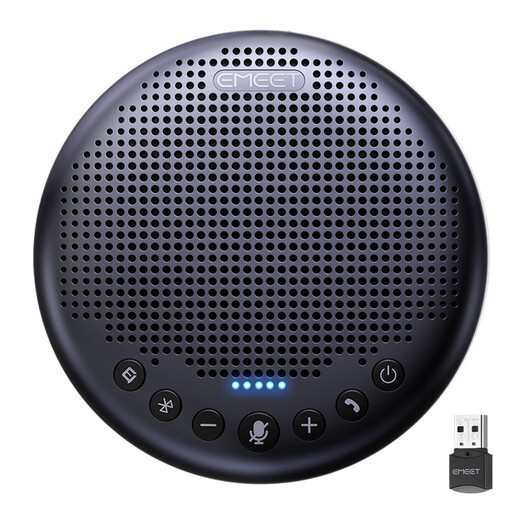
Consider this model if several writers share one workshop connection and you want to assess an expandable setup. Its product name specifies eight microphones, 360° voice pickup, AI noise reduction, dual connection and a 5W speaker. Confirm the pickup distance to the farthest seat, the available connection methods and any supplied cable before purchase.
 No image available
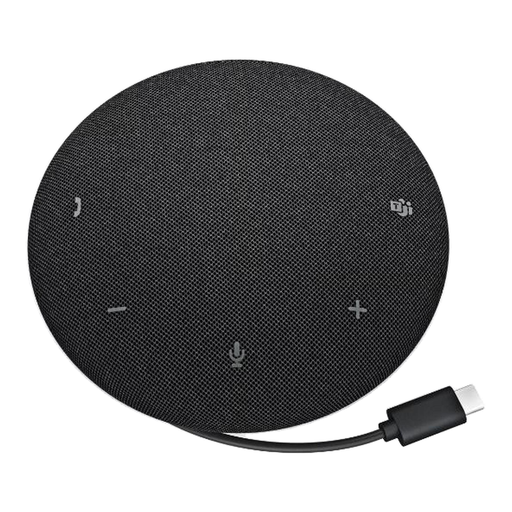
Consider this wired model if the workshop normally runs from the same laptop. Check its connector and cable reach against the position you want on the table, and confirm full-duplex audio and echo cancellation if simultaneous conversation is important to you.
USB is the more direct choice when you normally join from the same laptop and want to avoid pairing before a session. Bluetooth can be useful for another device, but check the exact connection and platform requirements: Jabra says Speak2 55 platform certifications apply to USB, not ordinary Bluetooth.
Place it as centrally as practical for the people who regularly speak, then measure to the farthest seat. Jabra specifies up to 2.3 m pickup for the Speak2 55, HP specifies up to 2 m for the Poly Sync 20+, and EMEET states up to 9.8 ft for the M0 Plus; each figure applies to its named model, not every kitchen arrangement.
Expansion is worth considering when several people routinely share one connection and a single unit’s stated coverage does not reach the regular seats. EMEET says compatible M0 Plus units can be daisy-chained, which also means placing and connecting another device.
Check the exact seller’s warranty and return terms, the connection accessories supplied, and whether the model suits your laptop and table. When an electrical speakerphone reaches the end of its life, GOV.UK advises taking it to an appropriate recycling collection point rather than putting it in household rubbish.