Collaborative design-call hosts
When colleagues or clients discuss a brief from the same desk, check full-duplex audio for overlapping conversation, echo cancellation and a microphone pickup distance that reaches each seat.


Choose a speakerphone with full-duplex audio, acoustic echo cancellation and a stated microphone pickup range that reaches the people around your desk. For a fixed computer, check the USB connection first; Bluetooth adds flexibility for phone or tablet calls, but computer compatibility and meeting-platform controls depend on the exact device and setup.
When colleagues or clients discuss a brief from the same desk, check full-duplex audio for overlapping conversation, echo cancellation and a microphone pickup distance that reaches each seat.
If most calls start on one laptop or desktop, the right USB connector and the call controls you use may matter more than wireless mobility. Check the exact device variant for your meeting platform.
If you move between computer and mobile calls, look at USB and Bluetooth connectivity, portability and quoted talk time. Confirm how the speakerphone connects to each device rather than assuming its Bluetooth features work identically on both.
For a home-office design discussion, start with the seating layout and whether people need to interrupt one another. Then consider the computer connection, the sound audible in your room and how often you move the device.
| Concern | What to check | Who this matters to |
|---|---|---|
| Two-way discussion | Look for stated full-duplex audio and acoustic echo cancellation; compare microphone pickup distance with the farthest seat. | If several of us discuss a sketch, I want interruptions to be heard rather than cut off; around 36% of consumers put natural two-way discussion first. |
| Computer connection | Check the computer's USB port against the speakerphone connector and, if needed, the exact Teams-certified variant. | I join calls from the same work computer and want a straightforward connection; roughly 29% of consumers put dependable computer connection first. |
| Shared-space control | Consider room noise and device placement, and whether an open speakerphone is appropriate for sensitive conversation. | In a shared room, I need to manage household sound and consider who else can hear the brief; about 21% of consumers put shared-space control first. |
| Portable use | Confirm connectivity with the intended phone or tablet, alongside the computer connection and quoted talk time. | When I move a call between my desk and a phone or tablet, I need connection flexibility; approximately 14% of consumers put portable, multi-device use first. |
A larger speaker does not establish whether local and remote participants can speak over one another or whether people farther from the unit will be picked up.
Check the exact model for full-duplex audio, acoustic echo cancellation and a stated pickup distance before relying on music or output claims.
Wireless convenience does not establish how a particular speakerphone will behave with your computer or meeting software.
For a fixed desk, check the USB connector and try the intended computer connection. If Teams controls matter, confirm the exact variant and its supported connection method.
Jabra states up to 2.3 m for Speak2 55, HP up to 2 m for Poly Sync 20, and Yealink 1.5 m for CP700. Those distances do not account for every seating position or noisy room.
Map where people will sit, place the unit near the group and compare the farthest speaker with the exact model's stated range.
A rechargeable speakerphone is electrical waste, whether or not its battery can be removed.
GOV.UK advises taking electrical products and batteries marked with the crossed-out wheelie bin to an appropriate recycling collection point.
The Speak2 55 is relevant when a home-office discussion needs both desk connectivity and a stated pickup range for people seated nearby.
The Sync 20 is a desk or compact shared-space option when its stated coverage fits the seating arrangement.
The CP700 is a compact USB/Bluetooth option for a close desk or small table.
The P710e may interest callers who want a mobile-device stand or a headphone socket as part of their speakerphone setup.
These choices cover a Bluetooth speakerphone for flexible calling and a wired model for a computer-based desk setup. Compare their stated features with your seating layout and the way people will join the discussion.
 No image available
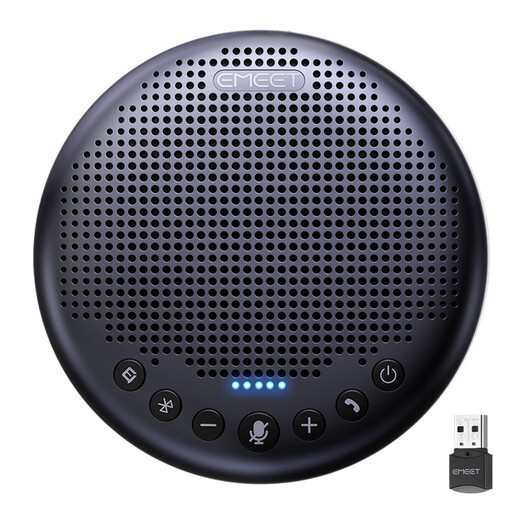
For a discussion with people seated around the unit, consider its stated 360° voice pickup and check whether the microphone reach fits the farthest seat.
The product name also specifies dual connection. Confirm the connection options you need and how the device handles overlapping speech in your intended setup.
 No image available
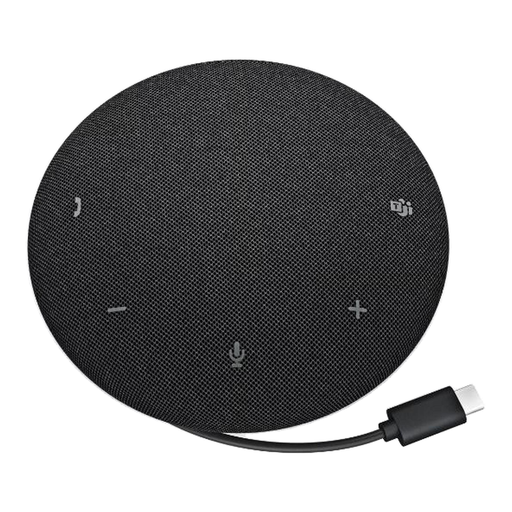
For calls from a computer that stays at one desk, a wired speakerphone avoids making wireless mobility part of the setup.
Check the required computer port and cable reach for its planned position. If people regularly interrupt one another, confirm full-duplex audio and acoustic echo cancellation for this exact model.
Full-duplex audio allows speech to travel in both directions at the same time, which matters when people ask questions or interrupt during a brief. Check that the exact speakerphone explicitly specifies it rather than assuming it from other audio features.
USB is a practical starting point when the speakerphone normally stays with one computer; check that the connector and cable suit your desk. Bluetooth is useful if you also take calls on a phone or tablet, but confirm compatibility and call controls with each device you intend to use.
Teams certification matters if you want the integration and call controls offered by a certified device. Microsoft says certified devices provide plug-and-play operation and Teams call control; check the exact model and variant rather than assuming a UC edition has the same controls.
Take it to an appropriate electrical-waste collection point rather than putting it in household rubbish. GOV.UK gives this advice for electrical products and batteries displaying the crossed-out-wheelie-bin symbol.