What matters when choosing
Decide whether a separated stereo image or simpler placement takes priority, then check how the speakers and their bass will work in your room.
Compact active stereo pair
Consider it when: You have space to separate two speakers but want to avoid a separate amplifier and large floor-standing cabinets.
Trade-off: The pair still needs two suitable positions; compact size alone does not establish how it will reproduce bass or fill your room.
Powered micro-tower stereo pair
Consider it when: You can give a taller pair floor space while keeping amplification within the speaker system, as with the Q Acoustics M40.
Trade-off: The floor footprint and proximity to walls need particular attention in a flat; the format does not guarantee controlled bass.
Single wireless speaker
Consider it when: Streaming and finding one convenient position matter more to you than a physically separated stereo layout.
Trade-off: One speaker cannot occupy separate left and right positions; check any adapter required for a wired source.
| Concern |
What to check |
Who this matters to |
| Controlled bass |
Allow for changes in wall distance and listening level. Judge the main speakers in your room before deciding whether to add a subwoofer. |
If low brass or bass drum becomes too prominent, I need to adjust the sound without disturbing neighbours. Roughly 42% of consumers would put bass control first. |
| Stereo separation |
Check that two speakers can be placed apart and that your usual seat gives you a workable left-right listening position. |
When the full band plays, I want to follow separate instrumental lines and can make room for two speakers. For around 33% of consumers, stereo detail would be the primary concern. |
| Easy connections |
Match the listed inputs to your phone, TV, computer or other source, including any required adapter. |
I want everyday playback without managing extra boxes, even if that makes a separated stereo layout less important. About 25% of consumers would prioritise simple connections. |
Joybuy products for this setup
These products cover compact desktop playback, passive bookshelf speakers and a wireless tabletop option. Check the supplied speaker count and any amplifier requirements before planning a separated stereo layout.
 Image unavailable
Edifier M60 multimedia speakers
Consider this compact desktop model if your music sources need a choice of wired and wireless connections. Its title lists Bluetooth 5.3, USB-C and AUX inputs, 66 W RMS, a 3-inch mid-bass driver and a 1-inch tweeter. Confirm the supplied speaker count and stereo layout before relying on separated left-right playback.
View on Joybuy
 Image unavailable
HiVi-Swans DIY3.1 passive bookshelf speakers, pair
This specified pair is an option if you can position two bookshelf speakers apart for stereo listening. The title lists a 6.5-inch size. Because the speakers are passive, plan for a compatible amplifier and check placement in the flat rather than assuming the cabinet size determines bass control.
View on Joybuy
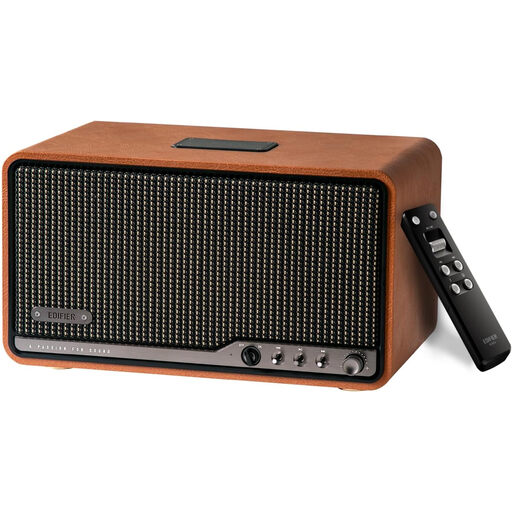 Image unavailable
Edifier S300 wireless multi-room tabletop speaker, Brown
Consider this tabletop model if convenient placement is more important than starting with a separated stereo pair. Check which connections suit your sources and how many speakers the package contains. If you want physical left-right separation, confirm the requirements for a two-speaker S300 setup before buying.
View on Joybuy
 Image unavailable
HiVi-Swans D3.1MKII passive bookshelf speaker
Consider this model if you are planning a bookshelf-based stereo system and can provide suitable amplification. Its title specifies a 6.5-inch mid-bass driver, 28 mm tweeter, rear bass-reflex design, 8 Ω impedance and 10–120 W power handling. Confirm the supplied quantity, amplifier compatibility and available wall clearance before planning the setup.
View on Joybuy
Common questions
Should I choose one speaker or a stereo pair for brass band recordings?
Choose a stereo pair if you can place its speakers apart and listen from a workable position between them. That physical layout gives you conventional left-right imaging; a single speaker is the simpler placement choice when streaming convenience matters more. Cambridge Audio’s placement guidance also makes clear that the listening position affects the stereo image.
Do active speakers need a separate amplifier?
No separate amplifier is needed for the active KEF LSX II LT or powered Q Acoustics M40 systems described here; both have built-in amplification according to their manufacturers. Passive speakers are different, so check amplifier compatibility as well as the inputs required by your music sources.
Will a subwoofer help with brass band music in a flat?
A subwoofer is not automatically necessary. First assess the main speakers at your normal listening level and try practical placement changes: Bowers & Wilkins notes that a nearby rear wall can increase bass while reducing openness and stereo imaging. Add a subwoofer only if you can accommodate and control its output in your room.
Can loud daytime listening cause a noise complaint?
Yes, a complaint is possible during the day. GOV.UK says councils in England must look into noise complaints that could be a statutory nuisance. Keep playback considerate and consult your local council’s guidance; do not assume England’s guidance states the rules for every part of the UK.
Which accessories should I check before buying?
Check the complete setup against your sources and intended speaker positions. Sonos specifies a Line-In Adapter for the Era 300, while passive speakers require compatible amplification; depending on placement and connections, you may also need suitable cables or stands.


