Who is this setup for?

Listeners with a main listening seat

If you usually listen from a sofa, desk or dining chair, a separately positioned pair lets you aim both speakers towards that position. Genelec’s placement guidance uses this arrangement for stereo listening; it is worth considering if the positions of choir sections and recorded ambience matter to you.

Neighbour-conscious flat dwellers

If music needs to remain clear at moderate levels, consider how much bass reaches adjoining rooms as well as what you hear at your seat. Westmorland and Furness Council advises keeping speakers away from neighbouring walls, floors and ceilings and using insulating material to reduce sound transmission.

Streamers with limited furniture space

If you play music from a phone, computer or television, match the speaker’s connections to those sources before choosing a cabinet size. A compact system still needs suitable surfaces and, for a separate stereo pair, room for both speakers.

What matters when choosing?

For choral listening in an open-plan flat, decide which constraint will shape your setup most: stereo placement, restrained bass, source connections or the space available for speakers.

Concern What to check Who this matters to
Stereo placement Check whether you are buying a left/right pair, two speakers that can form one, or a single enclosure. Make sure both positions can face your usual seat. When I listen from the sofa, I want room to position the left and right voices distinctly. Around 36% of consumers would put stereo placement first.
Bass and neighbours Look for bass adjustment and plan positions away from shared surfaces where possible. A subwoofer output does not mean you need to add a subwoofer. If bass carries into adjoining rooms, I want control at ordinary listening levels. Roughly 36% of consumers would prioritise limiting neighbour disturbance.
Source connections Check the input path for each source you use, including any required adapter and whether preferred features need Wi-Fi or an app. I switch between a TV and a computer, so both need a workable connection. About 18% of consumers would make source compatibility their main concern.
Space and daily use Check cabinet dimensions with cable clearance, space for a second speaker and how you will control the system. With little room on my sideboard, I want a setup that fits and is straightforward to use. Around 10% of consumers would put footprint and daily operation first.

Buying pitfalls

  • Choosing maximum bass output for a shared flat

    More low bass is not automatically useful for moderate-level choral listening, particularly if speaker positions are close to shared surfaces. Genelec describes bass controls for adjusting response near room boundaries, while Westmorland and Furness Council advises restraint with bass to reduce disturbance.

    Check what bass adjustment is available, leave distance from neighbouring surfaces where practical and listen at the levels you expect to use before deciding whether you want additional low bass.

    Suitable positions may require insulating pads or stands rather than placing the speakers directly on shared surfaces.

  • Assuming one compact speaker provides a spaced stereo pair

    A single enclosure cannot occupy two separate left/right positions. Genelec’s stereo placement guidance aims two speakers towards the listening position with a 60-degree angle between them; that is a setup target, not a guarantee of how a system will sound in every room.

    If the choir’s layout is a priority, check whether the purchase includes two speakers or whether a second compatible unit is needed, then identify two positions before ordering.

    A second speaker, stands or a longer interspeaker cable may be needed for the layout you want.

  • Overlooking the input needed by your music source

    Connection paths differ: Sonos specifies a separate Line-In Adapter for analogue input to Era 100, while Genelec 8020D is an individual active monitor with an analogue XLR input.

    List the phone, computer, TV or turntable you intend to use, then check each connection and the accessories required for that exact speaker setup.

    Depending on the source and speaker, the setup may need an adapter, interface or additional cables.

Brands to consider

KEF

KEF’s LSX II LT is an integrated wireless stereo-pair option for listeners who want separate left and right speakers without a separate amplifier.

  • KEF lists streaming support, HDMI ARC, Bluetooth 5.0 and USB-C input for the LSX II LT, covering several common music, computer and TV connection paths.
  • Allow for two speaker positions and the connection between them. Its subwoofer output offers an option, not a requirement for listening in a flat.

Ruark

Ruark’s MR1 Mk3 is a compact powered stereo pair suited to buyers checking several consumer-source connections.

  • Ruark specifies Bluetooth, optical, USB-C and a moving-magnet phono input for the MR1 Mk3.
  • Both speakers still need suitable positions and a connecting cable; consider bass and boundary placement in a shared flat.

Sonos

Sonos Era 100 is an option for buyers prioritising Wi-Fi streaming and app control; Sonos says two compatible Era 100 speakers can be configured as a stereo pair.

  • Sonos lists Wi-Fi, Bluetooth and AirPlay 2, and describes Trueplay as room-based EQ tuning.
  • A wider physical left/right layout requires two speakers. Analogue line-in requires the separate Sonos Line-In Adapter.

Genelec

Genelec’s 8020D is a compact active-monitor option for a regular listening position where careful placement and professional-style connections are practical.

  • Genelec provides placement guidance and bass-response controls for adjusting the 8020D setup.
  • Each 8020D is one monitor with an analogue XLR input; a stereo setup needs two units and a suitable source connection.

Joybuy products for this setup

This Edifier tabletop speaker can be considered where two S300 units can be placed as a left/right pair. Plan space for both units if separate stereo positioning is central to your choral listening.
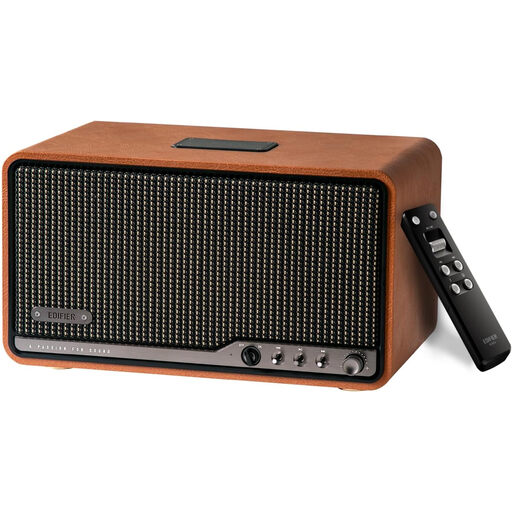
Brown Edifier S300 wireless tabletop speaker

Edifier S300 wireless tabletop speaker, brown

Consider this speaker if you can accommodate a second S300 for separately positioned left and right channels; this SKU is for one speaker. Check the pairing setup and available bass adjustment before buying if either is important for its position in your flat.

Joybuy

Common questions

Should I choose one speaker or two for choral recordings?

Choose two separately positioned speakers if a stable left/right layout from your usual seat is the priority. Genelec’s stereo guidance aims both speakers at the listener with a 60-degree angle between them; one enclosure is simpler to place but cannot provide the same physical spacing.

Where should speakers go in an open-plan flat?

For a left/right pair, start with symmetrical positions aimed at your main seat, then consider the neighbouring rooms around each surface. Westmorland and Furness Council advises placing speakers away from neighbours’ walls, floors and ceilings, using insulating material and keeping bass low to reduce sound transmission.

Is music in a flat automatically illegal after a particular time?

No single time-of-day rule settles whether music in a flat is a nuisance across the UK. In England, GOV.UK says councils must investigate complaints about noise that could be a statutory nuisance; also check your tenancy terms and the local rules where you live.

What if a new speaker is faulty or differs from its listing?

Contact the selling trader and keep the listing, order details and evidence of the problem. For goods bought from a UK trader, GOV.UK describes statutory standards requiring products to be as described, of satisfactory quality and fit for purpose; a fault or misdescription is distinct from a voluntary change-of-mind return.