What matters when choosing
Work out where you will listen and how much space the speakers can occupy before comparing bass figures. Then check the connections and everything needed to make a complete system.
| Concern |
What to check |
Who this matters to |
| Bass and room effects |
Compare low-frequency limits only on a stated measurement basis. Check cabinet space, wall placement and any room-adjustment controls. |
If kick and bass are central to my listening, I want depth without the room making notes disappear or boom. Around 40% of consumers put bass and room effects first. |
| Nearfield stereo setup |
Plan space for two matching speakers aimed symmetrically at the listening position, with their acoustic axes near ear height. |
At a regular desk position, I want synth layers to hold their place across the stereo image. Roughly 30% of consumers make nearfield clarity their primary concern. |
| Connections and completeness |
Match the speaker inputs to your source outputs. Confirm the number of units, required cables and supplied power arrangement. |
If I want to start playing music without assembling extra hardware, I need to know what connects and what comes in the box. Around 30% of consumers prioritise a straightforward, complete setup. |
Brands to consider
These monitor ranges illustrate different sizes, connections and setup controls; check the exact model and package rather than assuming every product from a brand is alike.
Yamaha
Yamaha’s UK HS powered-monitor range offers the 5-inch HS5, 6.5-inch HS7 and 8-inch HS8 for different cabinet-space and stated bass-extension needs.
- Yamaha specifies low-frequency limits of 54 Hz, 43 Hz and 38 Hz respectively at −10 dB, making those figures comparable within this range.
- The HS models are packaged singly and list XLR and phone-jack inputs; check what your source needs to connect and order two units for a stereo pair.
KRK
KRK’s ROKIT Generation Five range includes the 5-inch ROKIT 5 Generation Five powered monitor for buyers considering selectable voicing.
- KRK lists Mix, Create and Focus voicing modes, alongside onboard room-tuning options, for the ROKIT 5 Generation Five.
- Those controls do not replace careful placement; check the exact seller’s package contents and the connections your source requires.
Genelec
Genelec’s 8030C is a compact active monitor for a deliberately arranged nearfield listening position.
- Genelec specifies the 8030C at 47 Hz–25 kHz at −6 dB and lists rear-panel room-compensation switches.
- Plan its analogue connection to your source and check the quantity: the 8030C package contains one monitor, not a stereo pair.
Joybuy product choices
For a tabletop listening setup where wireless and wired connections are useful, this active speaker is an option to examine alongside a separately positioned monitor pair. Check its bass response and stereo arrangement against your own priorities.
 No image available
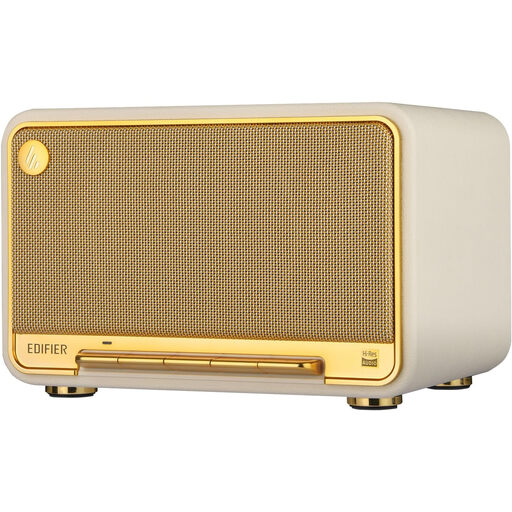
Edifier D32 tabletop wireless speaker, 60 W RMS
For tabletop music playback, the D32 offers Bluetooth 5.3, AirPlay 2, USB-C and AUX connection options.
The product name specifies 60 W RMS and a 2.1 acoustic architecture. Before choosing it instead of a monitor pair, check its channel arrangement, stated low-frequency response and supplied power arrangement against your setup.
Joybuy
Common questions
Do I need two monitors for stereo music?
Yes, a separate-monitor stereo setup needs matching left and right units. Yamaha’s UK HS specifications list single-unit packaging, so check the quantity on the exact listing rather than assuming that one order contains a pair.
Where should nearfield monitors go in a hobby room?
Place the left and right monitors symmetrically and aim both towards your listening position. Genelec advises an angle of approximately 60 degrees between the monitors; use the chosen model’s placement instructions to refine their height and distance from walls.
Will larger monitors always give me better bass?
No: deeper stated extension does not guarantee stronger or more even bass at the listening position. Yamaha specifies progressively lower −10 dB limits for the HS5, HS7 and HS8, but Genelec explains that wall reflections can cancel low-frequency output, so assess room placement as well as cabinet size.
What should I check about the power supply when buying powered speakers?
Check the supplied mains cable or plug, the product’s applicable conformity and safety information, and the seller and manufacturer details for the exact item. The Office for Product Safety & Standards states that the Electrical Equipment (Safety) Regulations 2016 set requirements for electrical equipment placed on the Great Britain market; do not assume that a listing intended for another market has the power arrangement you need.


