Quiet-evening orchestral listeners
You play symphonies, concertos or chamber recordings at a neighbour-friendly level and want to follow quiet instrumental lines as well as crescendos.


Choose speakers you can position well and assess at your normal listening level, rather than choosing by maximum output alone. Passive standmount speakers need a compatible amplifier, while active speakers with room-response controls are worth considering if placement is your main difficulty. Listen to familiar quiet passages and crescendos before deciding: a driver layout or power figure cannot establish how a particular system will sound to you at low volume.
You play symphonies, concertos or chamber recordings at a neighbour-friendly level and want to follow quiet instrumental lines as well as crescendos.
You want a compact stereo system but need to account for stands, nearby walls and the space available around each speaker.
Your listening position or speaker placement may be affecting bass balance. You want to assess positioning and room-response controls before changing speakers.
Start with how the system sounds at the level you actually use, then decide whether tonal controls, placement adjustments or a simpler installation would address your main difficulty.
| Concern | What to check | Who this matters to |
|---|---|---|
| Quiet passages and dynamics | Play familiar soft instrumental passages and crescendos at your usual level; compare the exact systems you are considering. | I want to follow quiet strings and woodwinds without turning up every soft passage. Around 40% of consumers would put this need first. |
| Low-level tonal balance | Compare adjustable loudness or tone controls at a consistent volume, and check whether a direct mode bypasses them. | If the music sounds too lean at my preferred level, I want the option to adjust its balance. That would be the primary need for around 30% of consumers. |
| Room and placement | Check the exact model’s positioning guidance and whether it offers room-response controls appropriate to your setup. | When a wall or listening position affects the sound, I would address placement before replacing the speakers; around 20% of consumers would prioritise that concern. |
| System fit | For passive speakers, check amplifier compatibility; for active speakers, check connections, power outlets and space. | I need a system that fits my room and works with my source equipment without unnecessary components. Around 10% of consumers would make that their first priority. |
Neither figure tells you whether quiet orchestral passages will have the balance you prefer. DALI also notes that speaker impedance varies with frequency, so a nominal impedance figure is only part of amplifier matching.
Check the speaker’s published amplifier requirements, then listen to quiet strings, woodwinds and crescendos at your normal volume.
Passive speakers need an external amplifier, and stands may be separate. Bowers & Wilkins, for example, states that stands are not included with its 606 S3.
Account for your source, amplifier, speaker cable, positioning and available space before choosing a passive pair.
On equipment where a direct mode bypasses controls, switching modes changes what you hear. Yamaha’s amplifier manual warns that Pure Direct bypasses loudness control and can cause a sudden increase in output level.
Read the manual for your amplifier and reduce the volume before changing modes; compare tonal settings at a consistent listening level.
Room-response features differ by model and address measured room effects, not every aspect of a speaker’s sound. Genelec documents AutoCal compensation for compatible Smart Active Monitor systems.
Check the exact model’s controls and calibration requirements, position it according to its guidance, and then assess any available adjustment.
A reference point for comparing passive standmount speakers with active alternatives. KEF UK describes the Q Concerto Meta as a three-way passive bookshelf speaker.
A passive two-way standmount option to assess with a separately chosen amplifier. The 606 S3 is listed on the manufacturer’s Great Britain site.
The SUPER DENTON offers a compact, heritage-styled three-way passive standmount to consider for an audition.
An active-speaker route for listeners assessing how room placement affects what they hear.
These choices include desktop and tabletop speakers alongside passive bookshelf pairs. For orchestral listening, compare their setup requirements and, where possible, hear them at your normal volume rather than treating their specifications as a listening test.
 Image unavailable
Consider these for a compact desktop listening position, subject to checking how they sound at your usual level.
The product name specifies 66 W RMS, a 3-inch mid-bass driver, a 1-inch tweeter, LDAC, USB-C and AUX inputs.
 Image unavailable
Consider this pair if you want a passive system and can accommodate a separate amplifier.
Before buying, check amplifier compatibility and the placement requirements for the exact model.
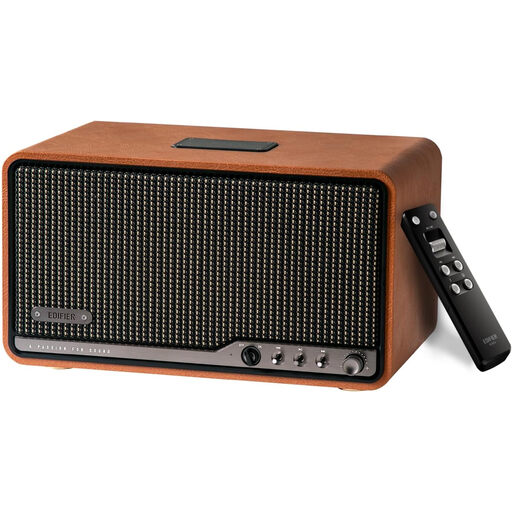 Image unavailable
Consider this for a tabletop position, but check the included quantity before planning a stereo orchestral setup.
The product information describes stereo pairing with two S300 speakers; confirm that the contents and connections suit your intended arrangement.
 Image unavailable
Consider these for a passive stereo system if you can match an amplifier and position the rear-ported speakers appropriately.
The product name specifies a two-way design, 6.5-inch mid-bass driver, 28 mm soft-dome tweeter, rear bass-reflex port, 8 Ohm impedance and 10–120 W range. Check the exact model’s wall-clearance guidance before placing it near a wall.
No: cabinet size alone does not settle how orchestral music will sound at your usual level. Compact standmount speakers are an option if you can position them properly; consider a larger speaker only when you have room for it and prefer its sound after listening at your normal volume.
Treat it as an adjustment to compare, not a setting you must always use. Yamaha documents continuously variable loudness control on the A-S701, while its manual says Pure Direct bypasses loudness control. Compare familiar music at a consistent level and reduce the volume before switching modes.
Place them according to the exact model’s guidance rather than assuming a shelf will suit them. KEF’s setup guide describes stands as a way to position standmount speakers near ear level; check wall clearance and orientation for the speakers you choose.
Check the speaker’s amplifier requirements against the amplifier’s supported load, rather than matching by a single impedance figure. DALI notes that speaker impedance varies with frequency. For a specific example, KEF states a 15–180 W amplifier requirement for the Q Concerto Meta.