For a turntable with a phono-level output, powered speakers with a compatible built-in phono stage offer a direct route to stereo listening. Passive speakers and a separate amplifier give you more freedom to change components, but need more equipment; compact active speakers suit a room shared with other audio sources if you confirm the turntable connection. Whichever route you choose, check where two speakers and your listening seat can actually go.
Who each setup suits
Vinyl-first hobby-room listener
If records are your main source, establish whether your turntable outputs phono or line level before choosing speakers. Klipsch lists a built-in phono stage for The Fives, while Rega documents a line-level output from the Planar 1 Plus.
Small-room stereo listener
If you can place two speakers separately but have limited space, measure the shelves or stands and plan the listening position. KEF recommends starting with roughly equal distances between the speakers and the listener; the final positions still depend on your room.
Flexible multi-source listener
If the speakers will also serve a computer, television or streaming source, list the connections you need alongside the turntable connection. Klipsch, KEF and Rega document different input arrangements for the specific products discussed below.
What matters when choosing
Powered speakers with a phono stage
Choose when: Your turntable outputs phono level and you want a stereo pair without a separate amplifier or phono stage; Klipsch lists these facilities for The Fives.
Trade-off: Speaker and amplification choices are tied together, so changing either later means reconsidering the system.
Compact active speakers
Choose when: The hobby room also needs computer, TV or streaming connections; KEF lists these options for LSX II LT.
Trade-off: Check the chosen model's analogue inputs and phono-stage arrangement before connecting a turntable.
Passive speakers and an amplifier
Choose when: You want to select or change the speakers and amplifier separately; Q Acoustics 3020c and the Rega io illustrate the two components.
Trade-off: Allow space for the amplifier and provide speaker cable and a suitable phono path for your turntable.
| Concern |
What to check |
Who this matters to |
| Turntable connection |
Check whether the turntable outputs phono or line level, then match it to a compatible phono stage or line input. |
If records are my main source, I want a clear connection path before choosing speakers. Around 45% of consumers put turntable connection first. |
| Room placement |
Measure both speaker positions and the listening seat; allow for adjustments to spacing and wall distance. |
In a small hobby room, I need two usable speaker positions rather than a pair that merely fits on a shelf. Around 33% of consumers prioritise placement. |
| Other sources |
Match the computer, TV and streaming sources you intend to use to the chosen system's documented inputs. |
I want the same room to handle albums and other audio without replacing the system later. Other-source flexibility comes first for around 22% of consumers. |
Mistakes to avoid
-
Assuming any turntable will connect directly to active speakers
A phono-level output needs a compatible phono stage before an ordinary line input. Rega documents the built-in stage that gives the Planar 1 Plus a line-level output; Klipsch lists a phono stage in The Fives.
Check your turntable's output setting and the speaker's input labels. For a phono-level output, establish where the compatible phono stage sits in the chain.
A separate phono stage adds another component if neither the turntable nor the receiving equipment provides one.
-
Choosing cabinet size before planning speaker positions
A compact cabinet does not remove the need to position two speakers. KEF recommends an approximately equal-sided listening triangle as a starting point, while Bowers & Wilkins notes that placing speakers close to a back wall can increase bass.
Mark out the available speaker positions and main seat, then check the chosen model's placement guidance and try small adjustments to wall distance.
-
Treating passive speakers as a complete turntable system
Q Acoustics 3020c is a passive speaker, so the route also needs compatible amplification and speaker cable. A turntable's output must have an appropriate path to the amplifier's input.
Plan the speakers, amplifier, cable and any necessary phono stage together before committing to the component route.
The amplifier and speaker cable take additional space and add components to the setup.
Relevant brands to consider
Klipsch
The Fives is relevant if you want a powered stereo pair for a phono-level turntable and other sources.
- Klipsch lists a built-in phono stage, Bluetooth 5, HDMI-ARC, optical, analogue RCA and USB inputs, plus a subwoofer output for The Fives.
- The powered design combines the speaker and amplifier choices in one product; confirm that its phono input suits your cartridge.
KEF
LSX II LT is relevant where a compact active system must also connect to streaming, computer or TV sources.
- KEF lists Bluetooth, USB-C, HDMI ARC, optical input, streaming support and a subwoofer output for LSX II LT.
- For vinyl use, check the exact analogue connection and arrange a suitable phono stage if your turntable outputs phono level.
Q Acoustics
The 3020c is a passive standmount option for a system built from separate components.
- Q Acoustics describes the 3020c as a mid-size standmount speaker and lists cable and stand accessories.
- It needs compatible amplification and is not, by itself, a complete turntable system.
Rega
The io amplifier is relevant to a passive-speaker system using a moving-magnet turntable cartridge.
- Rega documents a moving-magnet phono stage and line-level inputs for the io.
- Rega recommends speakers with a nominal impedance of 6–8 Ω for this amplifier; check the specifications of the particular speakers you choose.
Joybuy product choices
These choices cover compact active or tabletop speakers for a multi-source room and passive speakers for a separate-amplifier system. Check the turntable connection and, where left-right stereo placement matters, what the selected product provides.
 No image available
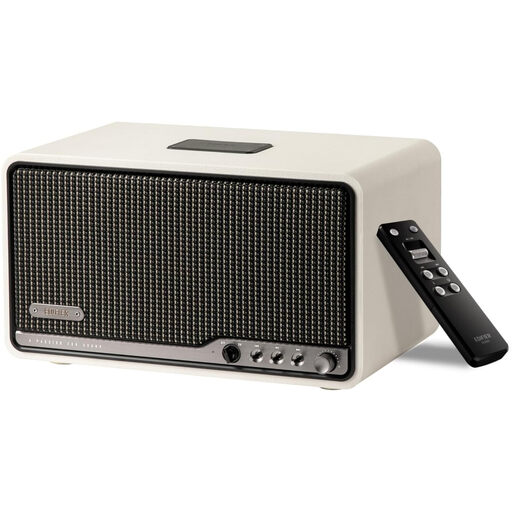
Edifier M60 Bluetooth 5.3 speakers
Consider this compact desktop pair if albums will share the room with computer or wireless audio.
The product name lists 66 W RMS, USB-C and AUX inputs, a 3-inch mid-bass driver and a 1-inch tweeter. For a turntable, check that the AUX connection receives a suitable line-level signal or provide an appropriate phono stage.
View on Joybuy
 No image available
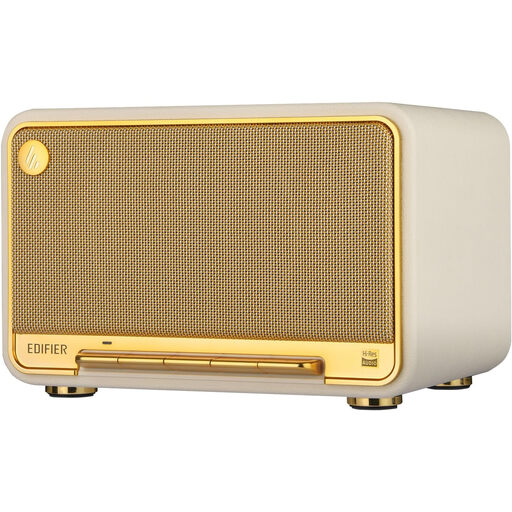
EDIFIER S300 wireless multi-room tabletop speaker, Ivory
Consider this tabletop model if you want to plan a compact multi-source setup, but establish how you will obtain the left-right stereo arrangement needed for your room.
The product information lists Bluetooth, USB-C and AUX. Confirm the package contents and whether a second matching unit is needed for stereo; check the turntable's output and the AUX connection before relying on it for vinyl.
View on Joybuy
 No image available
Edifier D32 tabletop wireless speaker
Consider this tabletop speaker for a room using several audio sources; check its intended arrangement if separately placed left and right speakers are important to you.
The product name lists 60 W RMS, Bluetooth 5.3, AirPlay 2, USB-C and AUX inputs. Confirm a suitable line-level path before connecting a turntable to AUX.
View on Joybuy
 No image available
HiVi-Swans D3.1MKII passive bookshelf speakers
Consider these for a component-based stereo system if you can place two speakers and provide compatible amplification.
The product name lists a 6.5-inch mid-bass driver, 28 mm tweeter, 8 Ω and 10–120 W. Check the amplifier match and cabinet dimensions before planning placement; a turntable also needs a suitable phono path.
View on Joybuy
Questions about the setup
Can I connect any turntable directly to powered speakers?
No: the connection depends on the turntable's output and the speaker's input. A line-level turntable output can feed an appropriate line input; a phono-level output needs a compatible phono stage in the speaker, elsewhere in the system or as a separate component. Klipsch lists one in The Fives, while Rega documents a built-in stage in the Planar 1 Plus turntable.
Where should I put two speakers in a hobby room?
Start with two positions that give each speaker roughly the same distance to your main listening seat, then adjust them for the room and the model. KEF recommends an approximately equal-sided listening triangle as a starting point; follow the chosen speakers' placement instructions when working out their distance from walls.
Do passive bookshelf speakers need an amplifier?
Yes. Passive speakers need an external amplifier and speaker cable, and a turntable must have a suitable path to an amplifier input. Rega recommends nominal 6–8 Ω speakers for its io amplifier, so check compatibility for the particular amplifier and speakers you intend to pair.


