Regular curry-batch cooks
If you make dry curry powder repeatedly, bowl capacity, pulse control and a manageable cleaning routine affect how many loads each recipe takes.


For regular batches of dry curry powder, start with a grinder whose stated spice capacity suits your recipe and whose bowl is practical to clean between blends. A dedicated model with separate bowls may suit frequent use; a blender attachment makes sense only with a compatible blender, while a larger grinder warrants closer checks on capacity, space and the exact electrical model.
If you make dry curry powder repeatedly, bowl capacity, pulse control and a manageable cleaning routine affect how many loads each recipe takes.
If you also grind coffee or different spice blends, separate bowls and storage lids can help you keep those ingredients apart between uses.
A compact grinder may fit your storage plans, while a spice-grinder attachment is an option if you already own a blender it is designed to fit.
Match the amount of dry spice in your recipe to a stated spice capacity first. Then consider how you will clean the grinder and whether a compact appliance or compatible attachment fits your kitchen.
| Concern | What to check | Who this matters to |
|---|---|---|
| Batch capacity | Compare your recipe with a capacity stated for spices, including any ingredient-specific limit; check whether you would need several loads. | When I prepare curry powder for several meals, I want to avoid repeatedly refilling a small bowl. Around 42% of consumers put batch capacity first. |
| Cleaning and flavour separation | Check which bowls and lids are removable, how the maker says to wash them, and whether separate bowls are included. | If I alternate between masalas and coffee, I want a practical way to clear aromatic residue. Roughly 33% of consumers prioritise cleaning and flavour separation. |
| Space and compatibility | Measure storage space; for an attachment, check the exact blender model it fits. | I have limited cupboard space or already own a suitable blender, so another large appliance may not suit me. Around 25% of consumers put a compact or compatible option first. |
A grinder that can process spices may still be awkward to clean after an aromatic blend, particularly if the bowl is difficult to access.
For frequent curry batches, check the bowl design and the maker's washing instructions before choosing it for both spices and coffee.
Capacity figures need their ingredient conditions. Cuisinart's SG21U manual, for example, gives a 90 g maximum for some spices, not every spice or blend.
Compare your recipe with the applicable spice guidance and divide a larger recipe into loads rather than overfilling the bowl.
The Ninja XSKBGAUK is an attachment for specified blender models, not a standalone grinder.
Match your blender's full model number against Ninja's compatibility list before buying the attachment.
Waring Commercial's US WSG60 specification states 120 V, while Nisbets UK lists the WSG60K at 230 V. The shared family name does not identify the electrical version.
Check the complete model code, voltage and supplied plug for the grinder you intend to use.
The SG21U represents a dedicated domestic spice-and-nut grinder for cooks making dry blends regularly.
The XSKBGAUK is a spice-grinder attachment for owners of selected Ninja blenders making small dry quantities.
The F2034238 is a coffee-and-spice mill for cooks considering one appliance for several dry ingredients.
The MKM6003NGB is a compact coffee grinder to assess if storage space is your main constraint.
The UK-listed WSG60K is a larger wet/dry grinder to consider for repeated, higher-volume preparation.
This multifunction blender lists spice grinding among its uses. If you want it primarily for repeated dry curry-powder batches, check the spice-grinding instructions and batch limit before choosing it over a dedicated grinder.
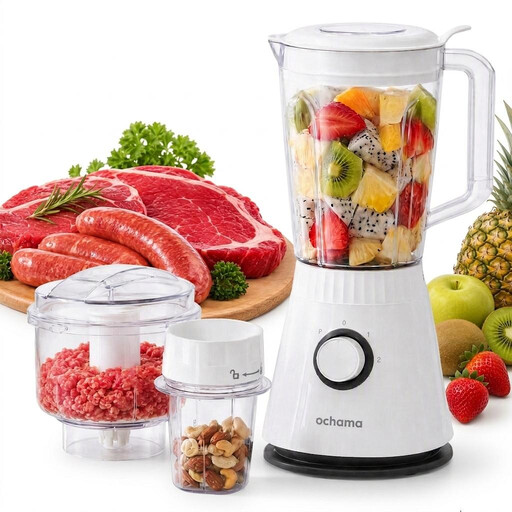 Image unavailable
Consider this if you want a multifunction blender that also lists spice grinding, rather than an appliance dedicated to curry powder.
The product name states 600W, 1.5L and three speed settings; the 1.5L figure should not be treated as a dry-spice batch limit.
Check the instructions for suitable spice quantities, the grinding vessel and its approved cleaning method before planning repeated batches.
Use the amount of spice in your recipe to assess a capacity stated for those ingredients, rather than relying on a coffee-bean figure. Cuisinart's SG21U manual gives a 90 g maximum for some spices; if your applicable limit is lower than your recipe amount, grind it in separate loads.
Separate bowls can make it easier to keep aromatic blends apart if you use one grinder for both. Cuisinart UK lists two stainless-steel bowls with lids for the SG21U, but you can also assess a single-bowl grinder by its cleaning instructions and your willingness to clean it between uses.
Only put parts in the dishwasher when the exact model's instructions allow it. Cuisinart says the SG21U removable parts can go on the top rack and directs users to wipe its motor base with a damp cloth; SharkNinja UK lists the XSKBGAUK lid, cup and blade assembly as top-rack dishwasher-safe.
Do not assume the US WSG60 has the same electrical specification as the UK-listed WSG60K. Waring Commercial specifies 120 V for the US WSG60, whereas Nisbets UK lists the WSG60K at 230 V; confirm the exact model, voltage and supplied plug before buying.