What matters when choosing
For a converted loft, settle the record formats you own, where the deck and speakers will stand, and how much tonearm handling you want before comparing features.
Automatic playback
Choose it when: You mainly play LPs or 45s and want to handle the tonearm less often; Audio-Technica specifies automatic operation and a built-in phono preamp for the AT-LP3XBT.
Bear in mind: The AT-LP3XBT supports 33⅓ and 45 RPM, so it is not the route to assume for shellac 78s.
Manual wired playback
Choose it when: You are comfortable cueing the record yourself and want a conventional wired setup; Rega Planar 1 Plus and Pro-Ject T1 EVO Phono have built-in phono stages.
Bear in mind: You must cue and return the tonearm yourself, and a built-in phono stage does not protect the deck from a vibrating support.
Playback for shellac 78s
Choose it when: Your collection includes 78 RPM shellac discs; Audio-Technica specifies 78 RPM playback for the manual AT-LP120XUSB.
Bear in mind: The speed setting alone is insufficient: confirm a compatible dedicated 78 stylus or cartridge and its setup requirements.
| Concern | What to check | Who this matters to |
|---|
| Stable placement |
Check for a level, sturdy position with room to place speakers on separate supports. |
If footsteps move the floor or speakers sit close to the deck, I want speech without distracting vibration or feedback; around 42% of consumers would put stable playback first. |
| Connection and operation |
Check your speakers’ or amplifier’s inputs and whether you want built-in phono amplification, automatic playback or Bluetooth. |
When I want to put on a record without repeatedly cueing the arm or adding another component, ease of use leads my choice; for around 33% of consumers, that would be the primary need. |
| Record compatibility |
Check the speeds in your collection; for shellac 78s, confirm a compatible 78 stylus or cartridge as well as 78 RPM operation. |
If my collection includes older shellac recordings, protecting those discs matters more than routine convenience; around 25% of consumers would prioritise 78 compatibility. |
Joybuy turntables for straightforward playback
These Sony models are choices for listeners who want Bluetooth and automatic playback of spoken-word records. Give either deck a stable position, and check the exact speed and stylus requirements before choosing one for older records.
 No image available
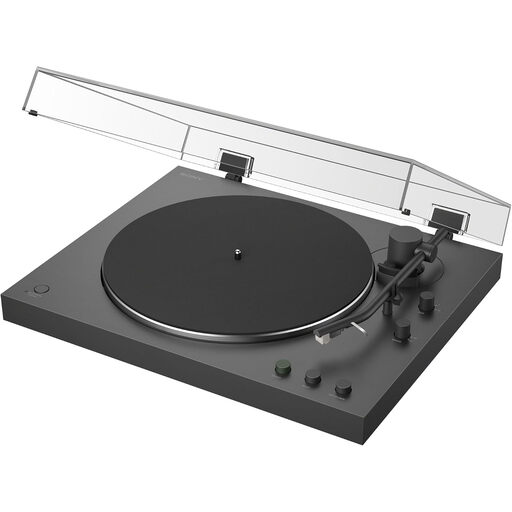
Sony PS-LX3BT Bluetooth Turntable with Auto Playback
Consider this model if you want automatic playback and Bluetooth for spoken-word listening. Check its record speeds and speaker connection options against your setup; if you own shellac 78s, confirm both 78 RPM operation and a compatible dedicated stylus before buying.
View on Joybuy
 No image available
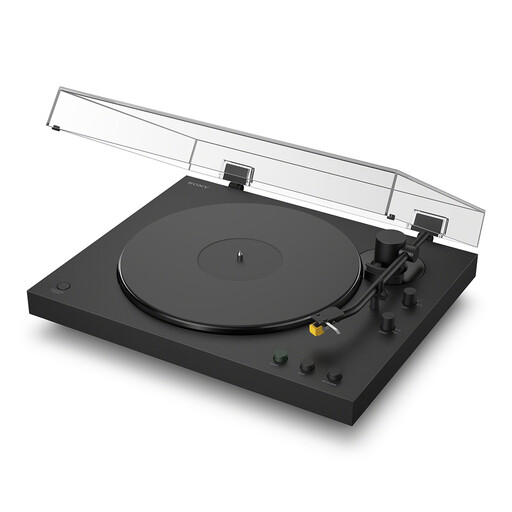
Sony PS-LX5BT Bluetooth Turntable with Auto Playback
This is another automatic-playback and Bluetooth choice for a loft listening setup. Place it on a level, stable surface away from the speakers; check its record speeds and whether a suitable dedicated stylus is available if your collection includes shellac 78s.
View on Joybuy
Common questions
Can I connect a turntable directly to active speakers?
Yes, if the turntable has a suitable built-in phono stage or the speakers have a phono input. Otherwise, a separate phono stage is needed for a wired connection to an ordinary line-level input. Check the inputs and outputs on the exact equipment you plan to pair.
Do spoken-word records need a special turntable?
Ordinary spoken-word LPs and 45s do not need a spoken-word-specific feature; match the deck’s speed settings to your records. Shellac 78s need confirmed 78 RPM playback and a suitable dedicated stylus or cartridge. Audio-Technica warns that an LP stylus can damage a shellac record and the cartridge.
Where should the turntable go in a converted loft?
Put it on a level, stable support and keep speakers on separate surfaces where practical. U-Turn Audio advises this separation to reduce speaker vibration reaching the stylus; check whether footsteps or playback at your usual volume disturb the deck.
Does playing records at a loft event require a music licence?
A licence is usually required when recorded music is played in public or at a business, according to GOV.UK. If the loft hosts an event or commercial use, check the requirements for that use; public-playback guidance does not itself establish a requirement for ordinary private home listening.
What maintenance should I allow for?
Keep the stylus clean using the maker’s instructions, and check replacement-stylus availability for the exact model you choose. Audio-Technica says dust and debris on a stylus can affect sound quality and may damage its assembly.


