Weekday commuters
If you want a glass bottle with breakfast but are not exercising, choose the drink for the occasion before choosing its container. The NHS identifies water as the preferred way to replace lost fluids.


For an ordinary weekday breakfast without demanding exercise, choose water rather than a sports drink simply because it comes in glass or is marketed for hydration. If you are planning hard exercise lasting longer than an hour, a drink containing carbohydrate may be worth considering around the session; compare the exact nutrition label and treat the glass container as a separate choice.
If you want a glass bottle with breakfast but are not exercising, choose the drink for the occasion before choosing its container. The NHS identifies water as the preferred way to replace lost fluids.
If your morning includes hard, longer-duration exercise, compare drinks in the context of that session rather than by packaging. The British Dietetic Association says carbohydrate intake during exercise can enhance performance when exercising hard for longer than an hour.
If you want to compare a hydration mix with a ready-to-drink sports drink, read the exact product label. Check sugars per 100 ml, the amount you would drink and the ingredients list rather than treating a low-sugar description as meaning sugar-free.
Start with what your morning involves. Then compare the drink’s label and decide whether you want glass packaging.
Choose this route: Have water when you want a drink with breakfast and have no demanding exercise planned.
Trade-off: Water does not provide the carbohydrate in an exercise-focused sports drink.
Consider this route: Compare carbohydrate-containing drinks if you will be exercising hard for longer than an hour.
Trade-off: Formulas differ, so check sugars and other ingredients rather than assuming every sports drink suits the session.
| Priority | What to check | Your needs |
|---|---|---|
| Activity | Consider the duration and intensity of planned exercise. The British Dietetic Association links a potential benefit from carbohydrate during exercise to working hard for longer than an hour. | For a breakfast without demanding exercise, I want a drink that suits the meal rather than an exercise formula. |
| Nutrition label | Compare sugars and carbohydrate per 100 ml with the amount you would drink; read the ingredients list for sweeteners and acids. Coca-Cola Great Britain lists 4.1 g sugars per 100 ml for the Powerade variants described on its GB page. | If I drink the whole bottle, I want to know what that amount contains—not just what a 100 ml figure says. |
| Container and format | Check whether the product is pre-filled, a mix to prepare with water or a reusable bottle. If you plan to use a drink mix, follow its preparation directions and the bottle’s care instructions. | Glass matters to me as a container preference; it does not decide which drink belongs at breakfast. |
| Drinking occasion | Check sugars and acids on the exact label if a sports drink would become a regular breakfast choice or something you sip throughout the morning. | I would rather choose deliberately for breakfast than keep sipping an exercise drink out of habit. |
A drink formulated for activity does not automatically fit a breakfast with no demanding exercise. The NHS identifies water as the preferred way to replace lost fluids, while the British Dietetic Association places carbohydrate during exercise in the context of hard sessions lasting longer than an hour.
Decide whether your morning calls for an exercise drink before comparing formulas.
Gatorade describes its Hydration Booster as low in sugar; that description is not the same as saying it contains none. Sports-drink formulas can also differ in their other ingredients.
Read the nutrition panel for sugars per 100 ml and check the ingredients list for the exact product you would use.
Glass tells you about the container, not the drink’s sugar content or its relevance to exercise.
Choose what to drink first. If you prefer glass, consider a reusable water bottle and check its care instructions before filling it with anything other than water.
These brands illustrate exercise-drink formats and labels; a brand’s inclusion does not establish that it offers a pre-filled glass-bottle option.
Lucozade presents this range as formulated for fuel and hydration during activity.
Gatorade UK presents Hydration Booster as a product mixed with water, containing carbohydrate and electrolytes.
Coca-Cola Great Britain presents Powerade as a ready-to-drink isotonic sports-drink range for exercise occasions.
This reusable glass water bottle is an option if you want to choose the container separately from your weekday breakfast drink. It is not a pre-filled sports drink.
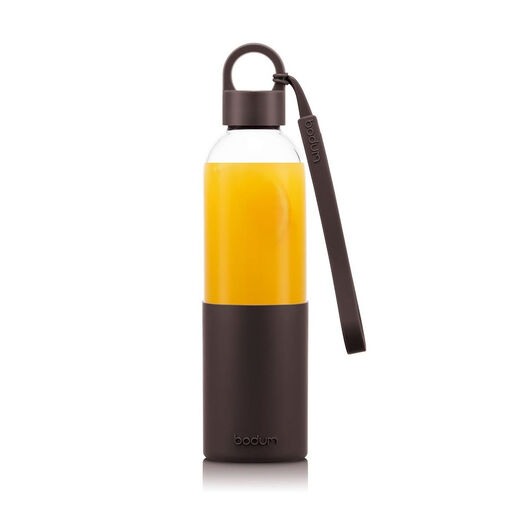 Image unavailable
For a glass container at weekday breakfast, this is a reusable 0.5L water bottle rather than a drink with its own nutrition label. Check the manufacturer’s instructions before using it for sports drinks or mixes. The supplied care guidance warns against sudden temperature changes and says to hand-wash the silicone sleeve.
If breakfast is not connected to demanding exercise, water is the simpler drink to choose rather than selecting a sports formula for its branding. The NHS identifies water as the preferred way to replace lost fluids; the British Dietetic Association discusses carbohydrate during exercise in the context of hard activity lasting longer than an hour.
No. Gatorade describes its Hydration Booster as low in sugar, but you still need the exact product’s nutrition panel to see its sugar content. For comparison, Coca-Cola Great Britain lists 4.1 g sugars per 100 ml for the Powerade variants described on its GB page; the products are different formats, so compare the amount you would actually drink.
Yes, if glass is your container preference rather than a requirement for a pre-filled sports drink. You can choose water for an ordinary breakfast and check the bottle maker’s care instructions before using the bottle with a drink mix or another beverage.
Check the exact label for sugars and acids, and consider whether the drink is intended for your exercise occasion. Northern Care Alliance NHS Foundation Trust’s guidance for children aged 3–11 identifies sports drinks among drinks that can contribute to tooth decay; that age-specific guidance should not be read as a measurement of risk for every adult.