Parents packing an ordinary holiday lunch
When no demanding exercise is planned, the main question is whether a sports drink belongs in the lunch at all. The NHS identifies water and milk as the best drinks for children.


For an ordinary child’s school-holiday lunch, choose water or milk: the NHS identifies these as the best drinks for children. If a sports drink is being considered for an older child around a planned sports session, check its intended use and nutrition label: zero-sugar and carbohydrate-containing versions serve different purposes, and neither needs to be the default lunch drink.
When no demanding exercise is planned, the main question is whether a sports drink belongs in the lunch at all. The NHS identifies water and milk as the best drinks for children.
An older child’s match or long active day may prompt a closer look at drinks sold for exercise. Check whether the product is a zero-sugar flavoured drink or a carbohydrate-containing isotonic drink, and whether its stated use fits the activity.
Regular and zero-sugar versions can have different nutrition declarations and ingredients. Compare the exact bottles, including serving size, sugars, sweeteners and any warnings relevant to the child.
Start with the purpose of the drink, then compare labels only if a sports-drink-style option is still wanted.
Choose for: An ordinary child’s lunch without a specific exercise-fuelling purpose.
Trade-off: These are not carbohydrate sports drinks, but the NHS identifies them as the best drinks for children.
Consider when: A sports-drink-style flavour is deliberately wanted while avoiding the sugar listed in standard versions.
Trade-off: Zero sugar does not make it the NHS’s recommended everyday lunch drink for children.
Consider when: An older teenager or adult deliberately wants carbohydrate around prolonged endurance exercise.
Trade-off: Its exercise-focused purpose does not make it a routine child’s lunch drink.
| Priority | What to check | Your needs |
|---|---|---|
| Everyday drink | Check whether the drink is for an ordinary lunch or a planned exercise session. The NHS identifies water and milk as the best drinks for children. | For a usual lunch, I want a drink that fits the occasion without relying on sports branding. |
| Sugars and portions | Compare sugars per 100ml, per serving and, where shown, per bottle. Check whether the product is a zero-sugar or carbohydrate-containing version. | If a whole bottle may be drunk, I want to judge its sugar content by that amount, not by a smaller serving. |
| Purpose and flavour | Read the stated exercise use and carbohydrate declaration. Lucozade Sport Orange is described by Tesco Groceries in terms of carbohydrate for prolonged endurance exercise. | I may be looking for a flavour the child likes, but I do not want to mistake that preference for an exercise-fuelling need. |
| Ingredients and handling | Read the exact pack for sweeteners, acids, cap warnings and instructions for storing the drink after opening. | Before packing a bottle for a younger child, I want to check its warning and know how to keep any remainder. |
A drink marketed for activity serves a different purpose from an everyday lunch drink. The NHS identifies water and milk as the best drinks for children.
Decide what activity is planned before choosing the drink; pack water or milk for an ordinary lunch.
Those descriptions do not tell you everything about the portion, ingredients or intended use, and versions within one brand’s range can differ.
Compare sugars, carbohydrate, serving size and ingredients on the exact product you intend to pack.
Lucozade Sport Orange is sold in 500ml bottles, while its Tesco Groceries description gives a carbohydrate figure per 250ml serving. A serving is not the whole bottle.
Use the whole-bottle declaration where available, or calculate from the stated serving size and the amount likely to be drunk.
Cap warnings and instructions for storing an opened drink can affect whether a particular bottle suits a child’s lunch.
Check the exact pack for age-relevant warnings and follow its storage instructions.
The cited UK range includes Orange isotonic drinks and a Zero Sugar Orange & Peach version.
Powerade Zero Berry Tropical is a 500ml ready-to-drink, zero-sugar product listed by Tesco Groceries.
Gatorade UK describes Hydration Booster as a powder containing carbohydrate, electrolytes and B vitamins, rather than a ready-to-drink lunch bottle.
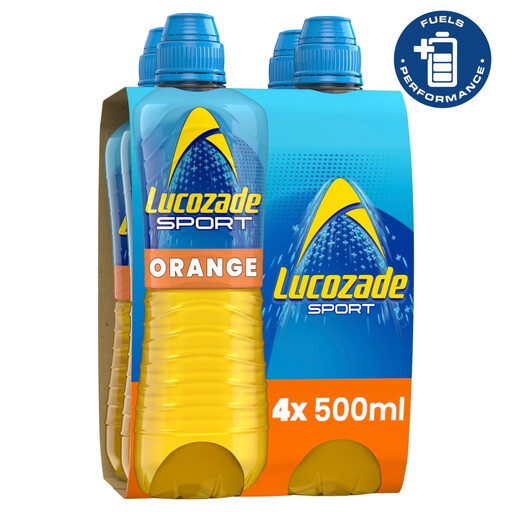
This carbohydrate-containing Lucozade Sport option is relevant when a drink for prolonged exercise is being considered, rather than for an ordinary child’s lunch.
 No image available
For an older teenager or adult considering a drink around prolonged endurance exercise, this is a carbohydrate-containing option, not the NHS’s recommended everyday lunch drink for children.
Tesco Groceries describes this Orange product as providing approximately 16g carbohydrate per 250ml serving. Check the bottle’s current sugar declaration, serving size and cap warning before packing it for a child.
No. The NHS identifies water and milk as the best drinks for children. Consider a sports drink for a specific activity-related purpose rather than treating its sports branding or flavour as a reason to pack it routinely.
No. A zero-sugar label distinguishes that version from a carbohydrate-containing sports drink, but water or milk remains the NHS’s recommended choice for children’s usual drinks. Check the exact bottle’s ingredients, including sweeteners and acids.
Consider one when an older teenager or adult deliberately wants carbohydrate around prolonged endurance exercise. Tesco Groceries describes Lucozade Sport Orange in that exercise context; the description does not make it necessary for an ordinary child’s lunch.
Check sugars for the amount likely to be drunk, whether the drink contains carbohydrate or is labelled zero sugar, and the exact pack’s ingredients and cap warning. Follow its instructions if the bottle has already been opened.