Runners planning fuel for long training runs
Choose a drink by the carbohydrate you will actually consume during the session, alongside any separate fuel. Bottle size alone does not tell you how much carbohydrate it provides.


For a long marathon-training run, plan how much carbohydrate and fluid you intend to take before choosing a bottle. Glass can suit mixing and drinking at home, but a drink in glass is not necessarily useful as running fuel; for carrying a drink on a run, check the container and the drink’s nutrition separately.
Choose a drink by the carbohydrate you will actually consume during the session, alongside any separate fuel. Bottle size alone does not tell you how much carbohydrate it provides.
A glass bottle can be part of your preparation at home. Check the powder’s prepared-serving nutrition separately: the container does not establish whether the drink contributes to your fuelling plan.
Weather, tolerance and individual sweat losses matter when planning what to carry. A 2017 review in Sports Medicine reports that sweat rate and sweat sodium concentration vary within and among athletes.
Decide whether the bottle is for preparation at home or for drinking while running, then check what the drink contributes to your session.
Consider it when: You want a drink you can carry without mixing it and can account for its carbohydrate in your plan.
Trade-off: Drinks with the same bottle volume can provide different amounts of carbohydrate; a ready-to-drink bottle need not be glass.
Consider it when: Glass matters for preparing or drinking a mix before or after your run.
Trade-off: Check carbohydrate in the prepared serving. Humantra describes its electrolyte drink as sugar-free, so its glass-bottle offer is not a substitute for carbohydrate in a fuelling plan.
Consider it when: You need to drink or refill while moving. London Marathon Events describes refills for runners with a hydration vest or hand-held running bottle.
Trade-off: Choose the drink separately, and check the rules of any event where you intend to carry the container.
| Priority | What to check | Your needs |
|---|---|---|
| Carbohydrate | Read grams per serving or per 100 ml, then calculate what you plan to consume each hour, including separate fuel. A 2015 review indexed by PubMed advises 30–60 g per hour for 1–2.5 hours of high-intensity exercise; that range has a specific duration and intensity, not every run. | I want to know what the drink adds to my long-run fuel plan, rather than assuming any drink labelled isotonic supplies the amount I intend to take. |
| Fluid and sodium | Check serving volume and any stated sodium amount. A 2017 Sports Medicine review reports variation in sweat rate and sweat sodium concentration; a 2021 Nutrients review discusses risks associated with both dehydration and overhydration. | Conditions and my tolerance may change how much I can drink. I need a plan I can practise, not someone else’s bottle count. |
| Container | Confirm the material of the exact bottle and whether it is practical for the way you will use it. If you are entering an event, check its current participant conditions before deciding what to carry. | Glass matters to me for mixing at home, but I also need a separate way to carry and drink fluid during a run. |
| Ingredients and care | Read the current ingredients, allergen information and storage instructions for the exact flavour. Follow the reusable container’s cleaning instructions after use, particularly with sugary drinks. | I need to check ingredients relevant to me and keep a bottle used for drink mix clean between sessions. |
Container material says nothing about the drink’s carbohydrate contribution. Humantra describes its electrolyte drink as sugar-free and offers a separate glass bottle.
Work out the carbohydrate in the prepared drink and any other fuel first; then decide where a glass bottle fits into your routine.
Tesco lists approximately 16 g carbohydrate per 250 ml for Lucozade Sport Orange and 4.1 g per 100 ml for Powerade Berry & Tropical. Those figures describe different drinks, despite their 500 ml bottle formats.
Calculate the amount you intend to drink per hour. If you plan to add a separate carbohydrate source, account for that too rather than changing your fluid intake solely to reach a carbohydrate figure.
Sweat losses vary within and among athletes, according to a 2017 Sports Medicine review. A 2021 Nutrients review identifies problems associated with both dehydration and overhydration.
Practise your drinking plan on representative runs and adjust it to the conditions and your tolerance. Seek qualified advice if you need an individual plan.
The details that matter may differ between flavours or pack sizes, and a retailer listing is no substitute for the label on the drink you receive.
Before buying several bottles or sachets, check the current pack’s ingredients, nutrition, allergen information and storage instructions.
These examples illustrate different drink and container choices; a brand name alone does not establish the nutrition or packaging of every variant.
A ready-to-drink option for checking carbohydrate by serving. Tesco lists approximately 16 g carbohydrate per 250 ml for Lucozade Sport Orange.
For Powerade Berry & Tropical, Tesco lists 4.1 g carbohydrate and 50 mg sodium per 100 ml.
Gatorade UK describes Hydration Booster as a carbohydrate-and-electrolyte powder sachet to mix with water.
Humantra describes its electrolyte drink as sugar-free and promotes a separate 1 L glass bottle.
Decathlon UK lists isotonic drink powders labelled for exercise over three hours.
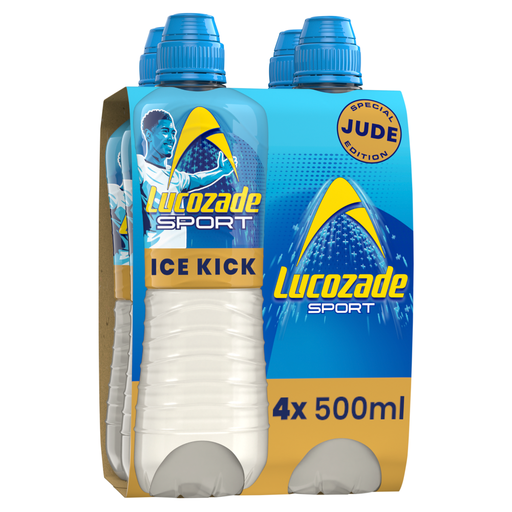
This ready-to-drink option is relevant if you are considering bottled sports drink for a long run. Check its current label and bottle material against your own fuel and glass-container preferences.
 No image available
A ready-to-drink sports drink to consider if you want to take a bottled drink on a long run. The pack contains four 500 ml bottles; check the exact pack label for its carbohydrate and sodium amounts, ingredients and bottle material before fitting it into your plan.
It depends on how much carbohydrate you consume from the drink over the session. A 2015 review indexed by PubMed advises 30–60 g per hour for 1–2.5 hours of high-intensity exercise; Tesco’s figures calculate to approximately 32 g per 500 ml of Lucozade Sport Orange and 20.5 g per 500 ml of Powerade Berry & Tropical. Check the exact drink and volume against your rehearsed plan, including any separate fuel.
No, not if your fuelling plan calls for carbohydrate from the drink. Humantra describes its electrolyte product as sugar-free; its separate glass-bottle offer does not change what the drink contributes. Check the prepared drink’s nutrition and account for carbohydrate from other sources where needed.
Read the ingredients list on the exact pack. GOV.UK guidance says any of the 14 regulated allergens present in a UK prepacked food or drink must be clearly labelled there; also check other ingredients relevant to you and ask the seller if you need clarification.
Clean the bottle and its drinking parts according to their instructions after use. UK Ministry of Defence hydration guidance warns that electrolyte drinks containing sugars can encourage bacterial growth in water bottles and hydration bladders.