Shared-house spill responders
If food and drink marks appear on a few upholstered dining seats, you may want a machine that is practical to bring out promptly and put away between uses.


For recurring spills on shared-house dining chairs, choose a portable spot cleaner with an upholstery tool and separate clean- and dirty-water tanks only if the chair’s care instructions permit water-based cleaning. Check storage and cleaning-up requirements before choosing a larger machine for several marked seats; do not use wet extraction as the default for S- or X-code upholstery.
If food and drink marks appear on a few upholstered dining seats, you may want a machine that is practical to bring out promptly and put away between uses.
When cupboard space is limited and several housemates use the cleaner, its storage size and how easily the tanks and tools can be emptied and rinsed matter alongside its cleaning attachments.
If several seats have older marks, a motorised upholstery tool and a larger tank may be worth considering, provided the fabric permits the method and the machine is manageable to move and store.
Start with the chair’s cleaning instructions: a machine’s upholstery attachment does not make every seat safe to wet-clean. Then choose around the task that matters most in your shared house.
| Concern | What to check | Who this matters to |
|---|---|---|
| Fabric compatibility | Check the chair’s care instructions for water-based cleaning approval; a W or WS code permits it, while S and X do not. | I want to remove a mark without risking a water ring on the seat. Roughly 31% of consumers put fabric compatibility first. |
| Spills and storage | Check cupboard dimensions, access to the tanks and whether the upholstery tool reaches the seat comfortably. | When small spills happen regularly, I need a cleaner that is easy to bring out and put away. Convenience is the primary concern for roughly 31% of consumers. |
| Older marks | Consider an upholstery tool and, if suitable for the fabric, a motorised brush; check tank size and the instructions for avoiding over-wetting. | Several marked seats make a longer cleaning session more likely, so I can accept a larger machine. Around 23% of consumers prioritise tackling older marks. |
| Shared upkeep | Check how the dirty-water tank and attachments are emptied and rinsed, and read the specified solution’s label. | If housemates take turns cleaning, I want the machine left ready for the next person. Upkeep comes first for roughly 15% of consumers. |
An upholstery tool does not override the chair’s care instructions. Michael Jon Designs’ guide identifies W and WS as water-cleaning codes, S as solvent-only and X as vacuuming or light brushing only.
Check the chair label or manufacturer’s instructions before buying or using a wet-extraction cleaner. On water-approved fabric, test colourfastness in a discreet area as well.
A larger machine may suit several seats, but it also has to be carried and stored. The Telegraph reported a weight of 7.45 kg for the Rug Doctor Portable Spot Cleaner.
Measure the available cupboard space and consider who will lift, fill and empty the machine before prioritising a larger tank.
Recovered debris and solution remain in the tank and tools after use, leaving the next housemate with the cleaning-up task.
Empty and rinse removable parts as the machine manual directs, follow its fill marks and use only cleaning solutions it permits.
A pictogram does not give every precaution for using and storing a solution in a shared home.
Read the full hazard and precautionary label before use, as the Health and Safety Executive advises, and follow its directions.
Vax presents its SpotWash range as portable cleaning equipment for household surfaces including upholstery.
Its Portable Spot Cleaner is an option to examine when several compatible upholstered seats need attention in one session.
BISSELL offers spot-cleaner models for household surfaces; compare the exact variant rather than treating the range as one specification.
These portable models offer options for targeted cleaning of upholstered seats that permit water-based treatment. Compare their tools and storage requirements for your shared space; none replaces the chair’s care instructions.
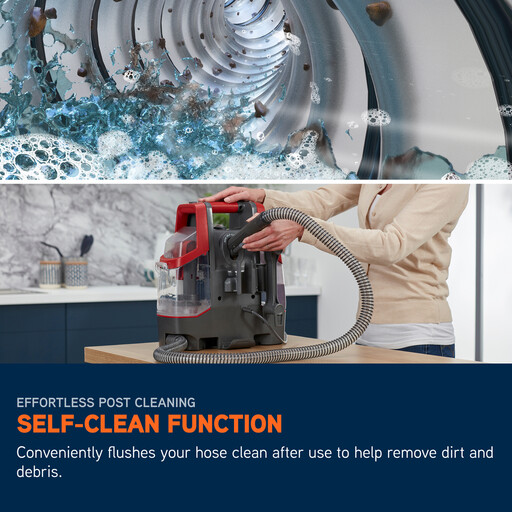 No image available
Consider this SpotWash model for targeted cleaning of water-approved upholstery. Check its dimensions against your cupboard space before buying.
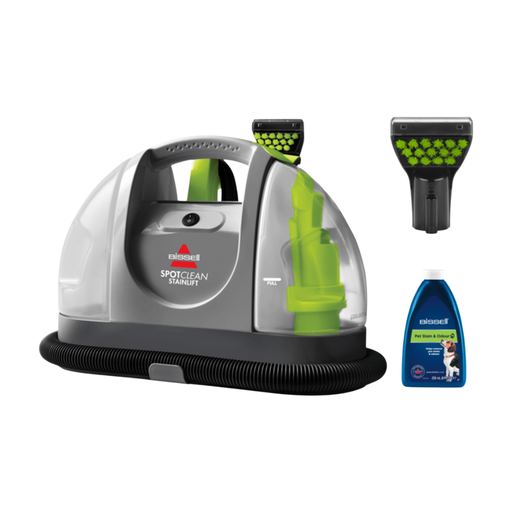 No image available
This portable cleaner is presented for upholstery as well as carpets and stairs. Its product name identifies HeatWave Technology; check the manual and chair care instructions before using it on a seat.
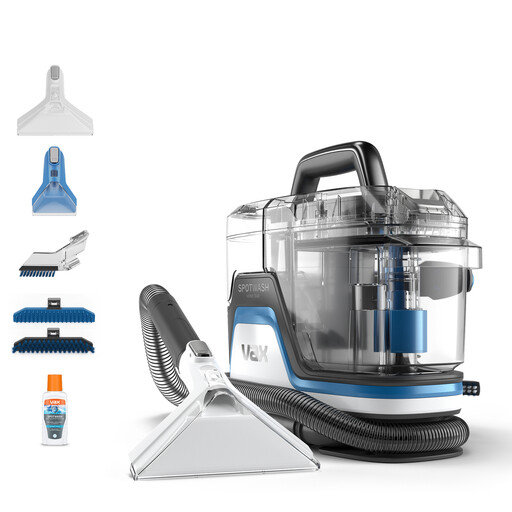 No image available
For water-approved upholstery, this is a compact-storage option to consider. Vax describes the Home Duo as just over 30 cm tall and supplies tools for different cleaning tasks; check the full dimensions for your cupboard.
 No image available
Consider this SpotWash variant if you want a portable cleaner for compatible upholstery. The Pet-Design name does not establish that a delicate or water-sensitive dining seat can be wet-cleaned.
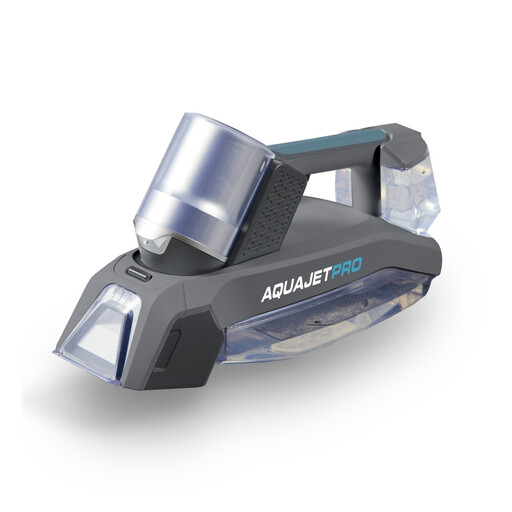 No image available
Consider cordless operation if a mains cable would make reaching the chairs awkward. The stated specifications include a rotating brush bar, an 80 W motor, a 0.3 L clean-water tank and a 0.4 L dirty-water tank; check whether those tank sizes suit the number of seats you plan to clean.
No. Check the chair’s label or manufacturer’s instructions: a W code permits water-based cleaning and WS permits water- or solvent-based cleaning, while S is solvent-only and X calls for vacuuming or light brushing. Do not treat a wet-extraction machine as the default for S- or X-code upholstery.
On fabric approved for water-based cleaning, apply solution sparingly and extract it with the nozzle against the fabric. Rug Doctor’s Portable Spot Cleaner instructions warn against over-wetting; allow the seat to dry fully before using it again.
Empty the dirty-water tank and rinse removable tanks and tools as the exact machine manual directs. Do not leave recovered dirty water in the cleaner between uses.
Follow the electrical cleaner’s instructions and read the cleaning solution’s full label before use. Great Britain’s Office for Product Safety and Standards describes safety requirements for electrical equipment placed on the GB market; the Health and Safety Executive advises reading cleaning-product labels in full to understand hazards and precautions.