Owners dealing with occasional spills
If your footstool is approved for water-based cleaning, a small upholstery tool may be enough for fresh food or drink marks. Check the furniture instructions before using a machine.


Check the footstool’s care label before choosing a water-extraction spot cleaner: fabric upholstery is not automatically suitable for water-based cleaning. A compact machine can suit occasional spills on one approved footstool; larger tanks and a choice of tools become more relevant if you also clean several upholstered items or deal with frequent messes. Consider storage, access to a socket and the cleaning the machine needs after use.
If your footstool is approved for water-based cleaning, a small upholstery tool may be enough for fresh food or drink marks. Check the furniture instructions before using a machine.
If you also plan to clean other upholstery or pet-related messes, compare clean- and dirty-water tank capacities and the tools included with the exact machine.
For a single small footstool, a machine you can store and retrieve easily may be more useful than a larger tank. Check its dimensions and whether its tool can reach the areas you need to clean.
Start with the footstool’s permitted cleaning method. Then match the machine’s tools, capacity and access to the full job you expect it to do, not just one mark.
| Concern | What to check | Who this matters to |
|---|---|---|
| Fabric compatibility | Read the footstool’s care label or manufacturer instructions for permission to use water-based cleaning or extraction. Test an approved method in a concealed area. | I want to treat a mark without risking a water-sensitive cover, so the furniture instructions come before the machine’s upholstery claim. Around 34% of consumers put fabric compatibility first. |
| Tools and capacity | Compare the included upholstery tools and the clean- and dirty-water capacities separately, especially for several items or repeated messes. | If I am cleaning the footstool alongside other upholstery, I need tools for those areas and tanks suited to a longer session. Cleaning workload is the main concern for around 33% of consumers. |
| Storage and access | Check dimensions, carrying weight and cord reach, or the stated runtime of a cordless model. | A cleaner for quick spills needs to fit where I can keep it and reach the footstool when needed. Around 20% of consumers make storage or access their first priority. |
| Upkeep | Check how the exact model’s tanks and tools are emptied and rinsed, and where you can take the electrical machine at end of life. | After a small cleaning job, I still need to empty and clean the machine before putting it away. For around 13% of consumers, upkeep is the primary concern. |
An upholstery-capable machine does not override the furniture’s care instructions. Furniture Instore’s care guidance distinguishes water-permitted fabrics from solvent-only and vacuum-only fabrics.
Find the footstool’s label or manufacturer instructions first. Use water extraction only when permitted, and test the approved method in a hidden area.
A compact machine may suit a single small mark, but cleaning sofas, rugs or frequent pet messes also makes tank capacity, tool choice and carrying weight relevant.
List everything you intend to clean, then compare both tank capacities and the tools supplied with each model.
Stain-removal language describes a machine’s intended use; it is not a guarantee for an old, previously treated or fabric-sensitive mark.
Follow the footstool and cleaner instructions, use an approved solution and test a concealed area rather than relying on a general upholstery claim.
Recovered water remains in the dirty tank after cleaning, so the machine needs attention even after a brief job.
Empty and rinse the tank and clean the tools as directed for your model. Vax specifies water no hotter than 40°C when rinsing the dirty tank of its SpotWash Max range; check a different model’s own instructions.
Vax offers compact, cordless and larger corded SpotWash models for targeted upholstery and other cleaning tasks.
BISSELL positions its portable SpotClean and Little Green machines for small-area cleaning, including upholstery spills.
Shark markets StainStriker spot cleaners for targeted cleaning on upholstery and other soft surfaces.
These spot cleaners are choices for targeted upholstery cleaning if your fabric footstool permits water-based cleaning. Consider what else you intend to clean and check the exact tools and cleaning instructions before choosing.
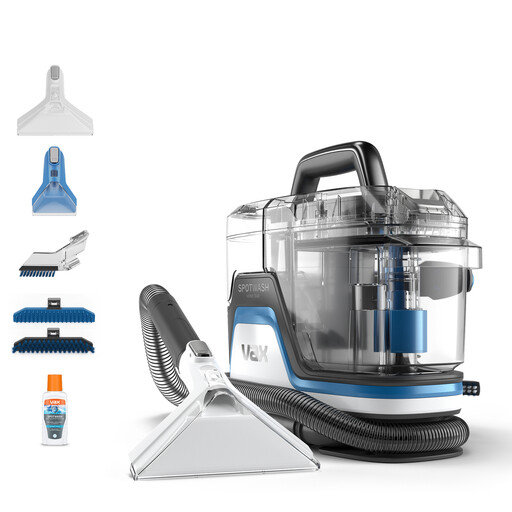 No image available
Consider this model if the footstool is one of several upholstered areas you intend to clean. Check which tools come with this variant for larger surfaces and seams, and follow both the furniture and cleaner instructions.
 No image available
This is an option to consider when an approved footstool is part of a wider set of upholstery-cleaning jobs, including pet-related messes. Check that its included tools and tank capacities suit how often you expect to use it; the Pet-Design name does not guarantee removal of every mark.
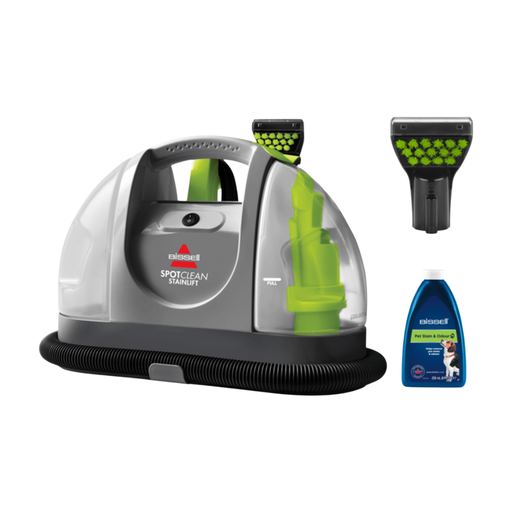 No image available
Consider this portable model for occasional targeted cleaning on a footstool approved for water-based treatment. Confirm that the supplied tool, cleaning solution and instructions suit your fabric; do not assume the Stain Lift name predicts the result on a particular mark.
No: use water extraction only if the footstool’s care label or manufacturer instructions permit it. Furniture Instore’s care guidance describes W as allowing water-based cleaning and SW as allowing water or solvent cleaning, while S is solvent-only and X is vacuum-only. Test an approved method on a concealed area first.
Blot the liquid gently rather than rubbing it into the fabric. DFS advises using a dry cloth or kitchen towel to soak up a spill; any further cleaning should follow the footstool’s care instructions.
Empty and clean its dirty-water tank and tools according to the exact model’s manual. For its SpotWash Max range, Vax instructs users to rinse the dirty tank in water no hotter than 40°C; another machine may have different requirements.
Check your local authority’s electrical-recycling arrangements or an available retailer take-back route. GOV.UK identifies the UK Waste Electrical and Electronic Equipment Regulations 2013, as amended, as the framework for electrical waste; Coventry City Council, for example, directs residents not to put electrical appliances in household bins and offers a recycling-centre route.