Parents dealing with frequent spills
If food, drink or mud lands on a seat pad, you need a cleaner that is practical to take out for a small mark and a tool that can reach around seams without soaking the filling.


Choose a water-extraction spot cleaner only if the seat-pad maker permits water-based cleaning; a washable fabric is not automatically suitable for detergent, prolonged moisture or steam. A compact cleaner suits isolated spills, while tank capacity and tool reach matter more when cleaning several pads. Consider a motorised brush or steam mode only if the pad's care instructions permit that treatment.
If food, drink or mud lands on a seat pad, you need a cleaner that is practical to take out for a small mark and a tool that can reach around seams without soaking the filling.
For several pads in one session, compare tank capacity, hose reach and the work involved in emptying and cleaning the machine. Each pad still needs time to dry fully.
The fabric, dye and filling determine which methods are suitable. The National Carpet Cleaners Association advises particular caution where a care label is absent; neither water nor steam should be assumed safe.
Consider it: For occasional, local spills on pads approved for water-based cleaning, particularly when storage space is limited.
Bear in mind: A compact machine still needs careful liquid application and may be less convenient for a session involving several pads.
Consider it: When several water-cleanable pads and their seams need attention in one session.
Bear in mind: Larger tanks do not prevent moisture from reaching the filling if a pad is saturated.
Consider it: For worked-in marks if the upholstery maker permits brushing as well as wet cleaning.
Bear in mind: Brush action may be unsuitable for delicate, loosely woven or pile-sensitive fabric.
Consider it: Only when the furniture maker permits heat and wet cleaning and you want a separate steam option.
Bear in mind: Permission to use water does not, by itself, establish that steam is suitable.
Start with the pad's care instructions, then compare the tools and handling that fit the cleaning you expect to do.
| Concern | What to check | Who this matters to |
|---|---|---|
| Fabric and heat compatibility | Check whether the pad permits water-based cleaning; confirm heat permission separately before considering steam. Follow the maker's instructions for the fabric and filling. | If my pad has a delicate covering or thick filling, I need to avoid a method that could damage it before comparing cleaning features. Around 42% of consumers put compatibility first. |
| Everyday spill response | Check the upholstery tool, access around seams and whether the machine is convenient to store, fill and take out. | When a drink or food lands on a family seat pad, I want to deal with the local mark promptly without bringing out more equipment than the job needs. For around 33% of consumers, quick spill response is the primary concern. |
| Several pads in one session | Compare clean- and dirty-water tank capacities, hose reach and machine-cleaning steps; plan for the pads to dry fully. | If I am cleaning several removable pads, repeated refilling and emptying can interrupt the job, while damp filling delays reuse. Manageable multi-pad cleaning comes first for around 25% of consumers. |
Fabric, dye and filling can respond differently to liquid, detergent and heat. The National Carpet Cleaners Association advises against liquid cleaning for X-labelled upholstery and urges caution when there is no care label.
Read the seat-pad maker's instructions before selecting a cleaning method. Check heat permission separately if you are considering steam.
An unsuitable method can leave colour changes, shrinkage or a stiffened fabric.
Liquid can travel beyond the cover into the filling. Even a machine marketed for low residual moisture cannot ensure a dry pad after repeated saturation.
Apply solution sparingly, extract it and leave the pad out of use until it is completely dry.
Wet filling can extend drying time and leave an unpleasant odour.
Cleaning-product requirements depend on the appliance. Rug Doctor's Portable Spot Cleaner manual warns against shampoo and foaming detergent.
Follow the exact model's instructions for formula type and dilution rather than substituting a general household cleaner.
A motorised tool or a suction claim does not establish that a seat pad's weave, dye or filling tolerates the method.
Rule out treatments that conflict with the pad's care instructions before comparing tools, tanks and storage.
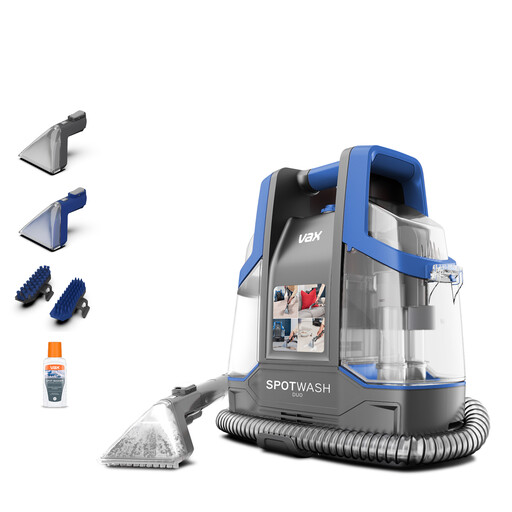
Vax positions its SpotWash Home Duo for targeted household stains and upholstery refreshing.
The SE 3 Compact Home is a spray-extraction option for buyers considering several textile surfaces in one session.
Its Portable Spot Cleaner offers a motorised hand tool for buyers whose upholstery permits brushing.
The SpotClean HydroSteam offers separate steam and water-and-formula modes for buyers considering heat as an additional option.
These portable spot cleaners are choices to consider for local cleaning on seat pads approved for water-based treatment. Check the exact pad instructions before choosing a tool or cleaning formula; none of these product names establishes permission to use steam on your furniture.
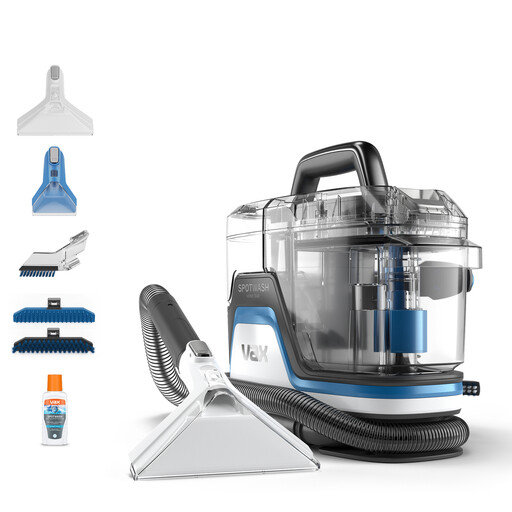 No image available
Consider this spot cleaner for local marks on seat pads that permit water-based cleaning. Check the pad instructions and the model's tool and formula guidance before use.
 No image available
Consider this model for local upholstery spills where the pad permits water-based cleaning. If using a brush attachment, confirm that the fabric also tolerates brushing.
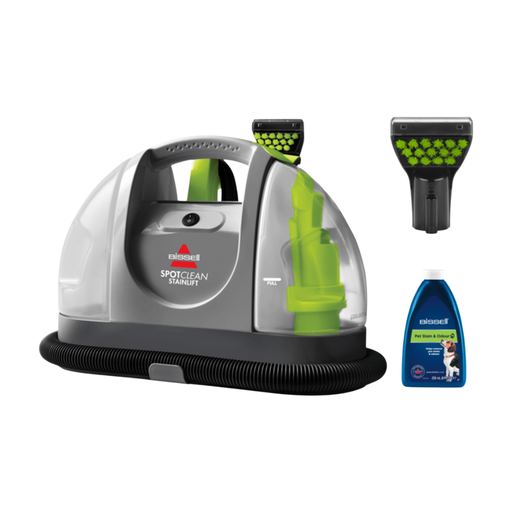
 No image available
This spot cleaner is an option for targeted cleaning on water-cleanable seat pads. Confirm that the chosen attachment and formula suit the pad, and avoid soaking its filling.
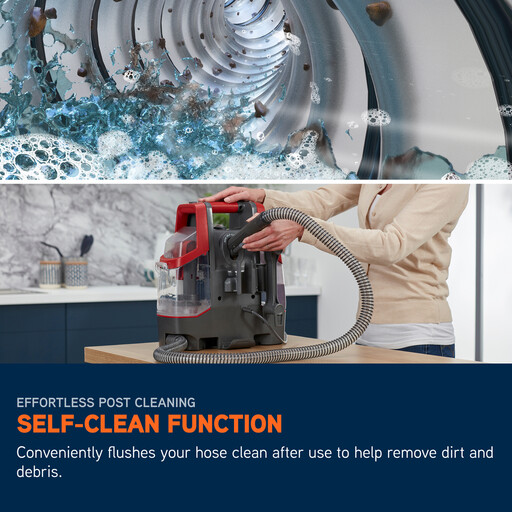
 No image available
Consider this portable cleaner for local marks if the seat pad permits water-based treatment. Check the exact model's attachment and formula instructions; its name does not establish that the pad tolerates steam or heat.
 No image available
This model is a choice for occasional local cleaning on seat pads approved for water-based methods. Match its attachment and cleaning formula to the pad's care instructions before use.
No: check the furniture maker's instructions for the cleaning method, not just the word washable. The National Carpet Cleaners Association explains that W indicates water-based cleaning, W/S allows water- or solvent-based methods, S is solvent-only and X is vacuum-only. If the label is absent, ask the maker or a professional cleaner before using liquid extraction.
No. Heat needs its own compatibility check, even when the pad permits water-based cleaning. BISSELL describes a steam mode for its SpotClean HydroSteam, but the seat-pad maker's care instructions determine whether that mode is appropriate for your furniture.
Keep liquid application controlled and extract it rather than repeatedly soaking one area. Moisture can reach the filling beneath upholstery, so leave the pad out of use until it is fully dry.
Follow the instructions for your exact model, including its formula and maintenance requirements. Rug Doctor's Portable Spot Cleaner manual, for example, says to unplug before filling, emptying or cleaning the appliance and not to use shampoo or foaming detergent.