What should you check?
Start with the recipe’s butter and seasoning requirements, then consider how you will store the finished food and how much butter you expect to use.
| Priority |
What to check |
Your needs |
| Seasoning |
Check whether the recipe specifies salted or unsalted butter. Lurpak lists 0.01g salt per 100g for its Unsalted Butter; Anchor lists 1.7g per 100g for its Original Block Butter. Those figures apply to the named products, not every butter in either category. |
I’m cooking a large batch with stock, cheese or other salty ingredients and want to adjust the final seasoning myself. |
| Formulation |
Read the ingredients before substituting a spreadable product for a block. Anchor lists 54% butter, 33% rapeseed oil and water in Original Spreadable, and recommends its regular block for cooking. Check what the recipe calls for. |
For a recipe written for block butter, I want to know whether a fridge-ready blend is a suitable substitution rather than assuming the two are identical. |
| Finished-meal storage |
Check the butter’s own date and storage instructions, then follow guidance appropriate to the completed dish. The NHS advises cooling batch-cooked baby food ideally within 1 to 2 hours before refrigerating or freezing it; that advice does not set a storage period for every adult meal. |
Once the meal is cooked, I need to store the finished portions appropriately instead of relying on the butter’s date label. |
| Pack quantity |
Check the pack weight against the amounts your recipes require and the product’s labelled date. For example, the cited Lurpak unsalted block is 200g and Sainsbury’s lists a 250g British unsalted block. |
I’m preparing several meals and want enough butter for them without choosing a pack I am unlikely to use in time. |
Brand and retailer references
These examples show why the exact product matters: a brand’s block butter and spreadable blend need not have the same ingredients or uses.
Lurpak
Lurpak offers block and spreadable formats; its Unsalted Butter 200g provides a labelled example for recipes where seasoning control matters.
- Lurpak lists a minimum fat content of 82% and 0.01g salt per 100g for this unsalted block.
- Check the exact format: those figures should not be assumed to apply to a Lurpak spreadable product.
Anchor
Anchor distinguishes its Original Block Butter, which it describes for cooking and baking, from its Original Spreadable product.
- Original Block Butter lists butter and salt as ingredients, with 1.7g salt per 100g.
- Original Spreadable also contains rapeseed oil and water; Anchor recommends the regular block for cooking.
Kerrygold
Kerrygold describes its Pure Irish Salted Butter block for cooking and baking; its spreadable product has a different formulation.
- The brand identifies its salted block as an option for cooking or baking when the recipe accommodates salted butter.
- Tesco lists Kerrygold Spreadable as a 60% fat blend containing butter, rapeseed oil and water, so check the recipe before substituting it for a block.
Tesco
Tesco’s butter listing includes own-label salted and unsalted blocks alongside named brands.
- The cited listing includes Tesco Organic Salted Butter 250g and Tesco Organic Unsalted Butter 250g.
- Check the current product label for the ingredients, allergens and storage instructions of the pack you choose.
Sainsbury's
Sainsbury’s lists British salted and unsalted block butter in more than one pack size.
- Its British Unsalted Butter 250g is labelled with a minimum 82% milk-fat content.
- Confirm the pack size and current label for the particular salted or unsalted product you select.
Joybuy product options
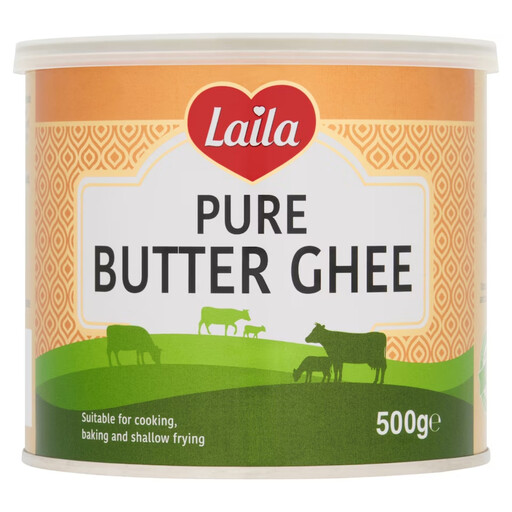
The product below is ghee, a separate ingredient choice for a recipe that calls for it—not an unsalted block, salted block or spreadable butter. Check the recipe before making a substitution.
 No image available
Laila Pure Butter Ghee 500g
For a batch recipe calling for ghee, this is a 500g pack. Check the recipe before substituting it for a butter block, and follow the pack’s date and storage instructions.
View on Joybuy
Common questions
Should I use salted or unsalted butter for batch cooking?
Use an unsalted block when you want to set the salt level across a large recipe yourself. A salted block can work in a savoury dish if you account for its salt before adding more: Lurpak lists 0.01g salt per 100g for its Unsalted Butter, compared with Anchor’s 1.7g per 100g for Original Block Butter.
Can spreadable butter replace block butter in a recipe?
Not automatically. Anchor Original Spreadable contains butter, rapeseed oil and water, while Tesco lists Kerrygold Spreadable as a 60% fat blend. If a recipe specifies block butter, check whether it allows a substitute; Anchor recommends its regular block butter for cooking.
Does adding butter make a batch-cooked meal last longer?
Do not use the butter or its date label to set the finished meal’s storage period. Follow guidance appropriate to the completed dish. The NHS advises that batch-cooked baby food should be cooled ideally within 1 to 2 hours and then refrigerated or frozen; that page does not provide a universal storage period for adult meals.
Do these named butter products contain milk?
The cited Lurpak Unsalted Butter and Anchor Original Block Butter list milk in their ingredients; Tesco’s listing for Kerrygold Spreadable also identifies milk. Check the ingredient and allergen information on the particular pack before buying, as products and formulations can differ.
How much butter should I buy for meal prep?
Add up the amounts required by your planned recipes, then choose a pack you expect to use within its labelled date and storage instructions. Pack sizes differ between products: the cited Lurpak unsalted block is 200g, while Sainsbury’s lists a 250g British unsalted block.


