
24/7 Customer Support

Free returns

Same-day & Next-day Delivery

Quality Guaranteed

Unlock Your Welcome Offers: FREE Delivery | Up to 80% OFF | Free 30-day JoyPlus trial
Download the APP
There are few moments in baking as disheartening as watching a perfectly set cheesecake or a delicate mousse cake get damaged during unmoulding. After hours of careful work, the final presentation is everything. This is precisely the problem the springform cake pan was designed to solve. Its unique design, featuring a latch that releases the sides, allows you to lift the ring away, leaving your creation perfectly intact on its base.
As the Joybuy Product Recommendation Officer, my role is to help you navigate the options available. This guide cuts through the marketing clutter to focus on the practical features that make a genuine difference to your baking, helping you select a reliable tool for your kitchen.
Selecting the right pan involves more than just picking a size. Key features determine how evenly your bakes will cook and how cleanly they will release. Here are a few points to consider.
The material of your round cake pan directly impacts its performance. Most springform pans are made from steel, often carbon steel or aluminised steel, which are known for their durability and ability to conduct heat evenly. An even distribution of heat is crucial for avoiding burnt edges and undercooked centres. Pay attention to the thickness of the metal; a pan with a gauge of around 0.8mm is less likely to warp at high temperatures and will feel more substantial and durable over time.
For a pan designed for delicate desserts, a high-quality non-stick coating is non-negotiable. It is the key feature of an easy release cake pan. A good non-stick springform pan ensures that your cheesecakes, tortes and quiches slide out without sticking or tearing. Look for pans with durable, multi-layer coatings that are free from PFOA, PFAS and BPA for peace of mind. This feature not only preserves the look of your bake but also makes cleanup significantly easier.
The defining feature of a springform pan is its latch. A well-constructed latch will close securely, creating a tight seal that minimises leaks and open smoothly when you are ready to unmould. While no springform pan is 100% leak-proof with very thin batters, a snug fit between the base and the ring is a sign of good craftsmanship. For extra security with runnier mixtures, you can always wrap the outside base of the pan in aluminium foil. This design is often considered superior to a standard loose base cake tin for extremely fragile bakes like a no-bake cheesecake pan is used for.
Based on features that deliver consistent results and user convenience, here are our recommendations for home bakers in the UK.
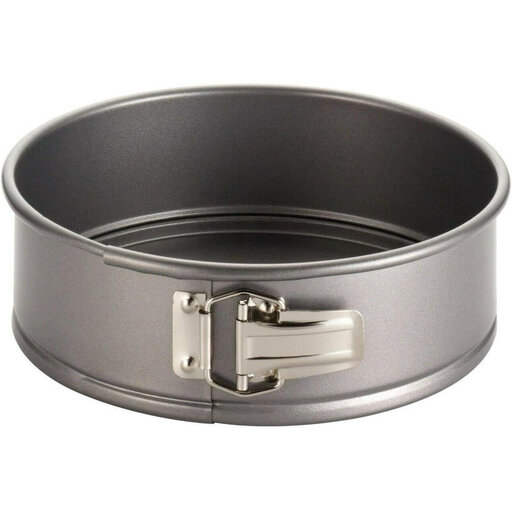
Why It Stands Out
This KitchenAid pan is built with durability and performance in mind. Its substantial construction, featuring a 0.8mm thickness, provides excellent heat distribution for uniform baking and resists warping under high oven temperatures. The non-stick coating aids in a clean release, which is essential for multi-layered cakes and desserts where appearance is paramount. The 24cm size is generous, making it a great choice for celebration cakes or larger family-sized cheesecakes.
Pros
Who is it for? This pan is well-suited for the enthusiastic baker who frequently creates larger-scale desserts and values robust, long-lasting bakeware that delivers consistent results.
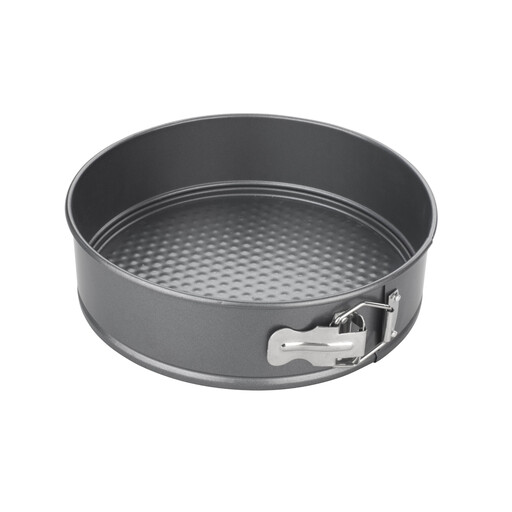
Why It Stands Out
The Chef Aid springform tin focuses on convenience and versatility. Its classic 9 inch cake tin (23cm) size is perfect for most standard recipes. The standout feature is its practicality; being dishwasher, fridge and freezer safe simplifies the entire baking process from preparation to cleanup. The Goldflon non-stick coating is made without PFAS, PTFE or BPA, offering an effective release while being mindful of materials.
Pros
Who is it for? This is an excellent choice for the everyday home baker who wants a no-fuss, reliable cheesecake pan that performs well and is incredibly easy to care for.
While these two pans are excellent all-rounders, every baker has unique needs. You might be looking for a set of mini springform pans for individual desserts or perhaps a square pan for a different presentation.
Whether you need a smaller tin for a personal treat or a different shape entirely, our full collection has something to suit your next baking project. Explore our complete range of cake tins to find your perfect match.
1. Do you still need to grease a non-stick springform pan? It is generally a good practice, especially for very delicate or sticky recipes. A light greasing with butter or oil, sometimes followed by a dusting of flour, provides an extra layer of insurance for a flawless release. For cheesecakes, many recipes also recommend lining the base with baking parchment.
2. What is the difference between a springform pan and a loose base cake tin? Both are designed for easy cake removal without inverting the tin. A springform pan has a latched ring that expands and lifts away from the base. A loose base cake tin consists of a solid outer ring and a separate bottom disc that you push upwards to release the cake. Springform pans are often favoured for softer, more fragile bakes like cheesecakes and mousses, as the removal process involves less direct contact with the dessert itself.
3. Can I use a springform pan for a regular, liquid cake batter? Yes, you can, but with a note of caution. The seal on a springform pan is not always perfectly watertight. For thinner batters, it is wise to wrap the outside of the pan with one or two layers of heavy-duty aluminium foil before placing it in the oven. This will catch any potential drips and keep your oven clean.