
24/7 Customer Support

Free returns

Same-day & Next-day Delivery

Quality Guaranteed

Unlock Your Welcome Offers: FREE Delivery | Up to 80% OFF | Free 30-day JoyPlus trial
Download the APP
A well-organised cupboard can quickly become cluttered when containers have awkward curves, loose lids or capacities that do not match everyday ingredients. Square food storage canisters can make better use of shelf space, but the shape alone does not guarantee convenient storage.
Before buying, UK households should look beyond polished product photography and check how the seal works, whether the dimensions suit existing shelves and how easily the containers can be cleaned. This guide explains the main buying pitfalls, the specifications worth prioritising and which options suit different kitchen routines.
A lid described as airtight may use a silicone seal, locking clips or a simple press-fit design. These systems differ in how securely they close and how easy they are to operate with wet or flour-dusted hands.
For airtight food storage containers, check the actual closure mechanism. Silicone seals should sit evenly around the lid, while clip systems should close without excessive force. A lid that is difficult to fit correctly may be less practical than one with a simpler design.
A container’s stated capacity does not show how much cupboard space it occupies. Tall stackable kitchen canisters may hold a substantial amount of pasta or cereal but fail to fit beneath a shelf. Conversely, a short container may fit comfortably but require frequent refilling.
Measure the shelf height, depth and width before ordering. Square designs can align neatly side by side, but only if their dimensions work with your kitchen furniture.
Clear walls make stock checking easier, yet transparency does not automatically indicate durability or food-contact suitability. Some plastics may scratch, retain odours or become cloudy after repeated washing.
Look for material information such as BPA-free plastic, phthalate-free construction where stated, impact resistance and care instructions. If you prefer a heavier material, glazed porcelain can provide a different appearance, although it needs more careful handling.
For dry food storage canisters, a secure lid helps limit exposure to household moisture and keeps ingredients contained. Consider whether you prefer:
A seal is only useful when the lid and container rim are clean and correctly aligned. Keep both parts dry before storing flour, rice, cereal or baking ingredients.
Clear food storage containers are practical for monitoring stock levels without opening the lid. Tritan plastic, used in the Sistema Ultra range described here, is presented as ultra-clear, BPA-free, phthalate-free, odourless and impact-resistant. These are product attributes rather than a guarantee of indefinite performance.
The Brabantia Tasty+ set is described as BPA-free, lightweight and impact-resistant, with dishwasher-safe components. Maison by Premier’s canister uses glazed porcelain, which can be wiped clean but may chip or break if dropped. Always follow the manufacturer’s care guidance and avoid abrasive cleaners where the surface is glazed.
Think about what each container will hold rather than selecting a matching set purely for appearance:
Square profiles help reduce unused gaps between pantry storage containers, while stackable lids can make use of vertical cupboard space. Tall containers should be reserved for shelves with enough clearance to remove them without tilting.

Why This Fits Their Persona: The compact 460ml capacity suits renters, first-time home organisers and households building a cupboard system gradually rather than buying a large collection at once.
Its stated square shape and compact footprint help avoid buying oversized containers for small quantities or narrow shelves.
Ultra-clear BPA-free Tritan plastic; easy-locking clips and an airtight lid.
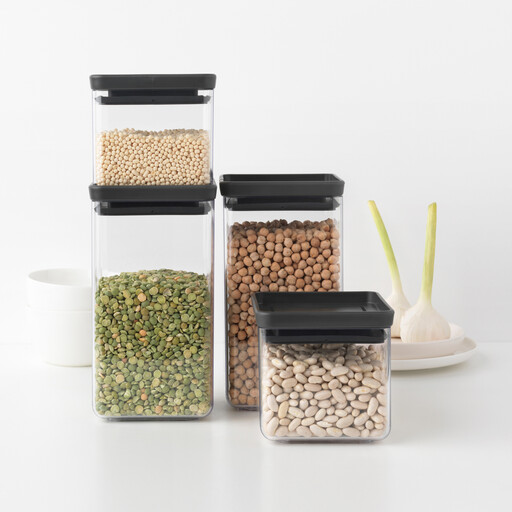
Why This Fits Their Persona: This coordinated set suits households wanting a consistent look and multiple capacities for cupboards, open shelving or a pantry.
The set includes two 0.7-litre and two 1.6-litre canisters, reducing the need to guess which size will suit different staples.
Silicone-sealed lids; dishwasher-safe components; stated five-year guarantee and service.
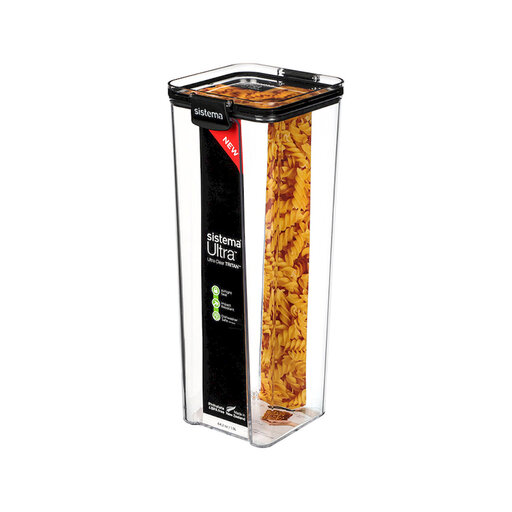
Why This Fits Their Persona: The 1.9-litre capacity is suited to families, batch cooks and households buying larger quantities of pasta, flour, snacks or other dry staples.
Its listed dimensions of 10.3 × 11.5 × 27.2cm make the tall profile clear, helping buyers check shelf clearance before purchasing.
Large 1.9-litre capacity; square stackable design; BPA-free and phthalate-free Tritan plastic.
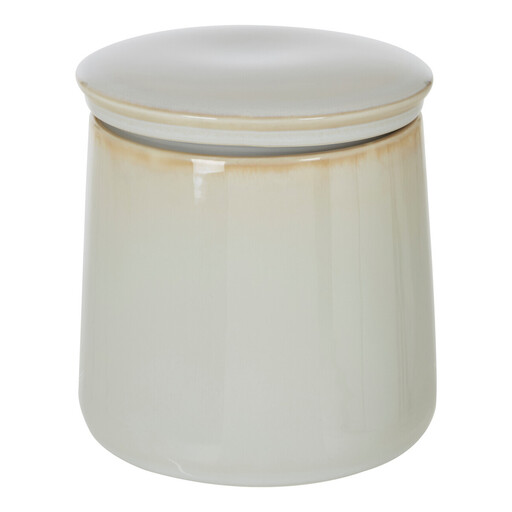
Why This Fits Their Persona: The stone-coloured porcelain design suits open shelves and worktops where visual coordination matters as much as storage.
The listed porcelain construction and glazed finish make its material clear, while the care warning highlights the need to handle it carefully.
Glazed porcelain body; matching lid; 14cm height and 12cm width and length.
For practical kitchen organisation, group ingredients by frequency of use. Keep everyday cereal, rice and snacks at eye level, while occasional baking ingredients can go on higher shelves. Label opaque lids or containers, and write the filling date when storing ingredients with a limited recommended use period.
Do not mix newly purchased ingredients with old stock. Empty, wash and fully dry each canister before refilling it. This helps prevent residual moisture from affecting dry goods and makes it easier to rotate pantry supplies.
If a tall 1.9-litre canister does not fit your cupboard, consider several shorter containers instead. The most space-efficient arrangement depends on your shelf dimensions and the shape of the ingredients you store.
We have compiled a complete, real-time list of products that fully satisfy these strict selection criteria and UK safety regulations.
They can reduce unused gaps when placed side by side, particularly on rectangular shelves. However, the actual benefit depends on the canister dimensions and cupboard layout. Measure the available width and depth before choosing a set.
Lifespan depends on the material, washing method, frequency of use and condition of the lid seal. Inspect silicone seals and locking clips regularly for distortion or damage. Replace a container if it becomes cracked, heavily scratched, stained or unable to close securely.
Many are designed for dry ingredients, but check the product’s stated material and care information first. Use clean, dry containers and avoid storing warm food unless the manufacturer specifically permits it. BPA-free status is a useful material detail, but it does not replace following the product’s instructions.