Shared-house batch roasters
If several portions need a full tray, a working communal oven lets you roast them without finding space for another appliance. Check when the oven is available and agree who cleans it afterwards.


Use an existing full-size oven when the squash wedges need a shared roasting tray; for smaller, frequent portions, consider a countertop air-fryer oven if the household permits it and the space and socket are suitable. A countertop mini oven is another portable option if its usable tray space suits your batch, while replacing a built-in oven requires permission and installation checks rather than a purchase for this task alone.
If several portions need a full tray, a working communal oven lets you roast them without finding space for another appliance. Check when the oven is available and agree who cleans it afterwards.
A countertop air-fryer oven may suit regular small batches if it holds your usual portion without repeated cooking and the household allows it on the worktop. In the small-quantity comparisons reported by Which?, air fryers often used less energy than a built-in oven; that advantage can diminish when cooking in batches.
If you cannot change the cabinetry or wiring, consider a portable countertop appliance instead of a built-in replacement. You still need household permission, a suitable place to use it and an appropriate electrical connection.
Choose it when: A full tray or several portions need roasting and a working oven is already available.
Allow for: Shared cooking times and cleaning; Which? found that an air fryer can use less energy for small quantities, depending on the cooking task.
Choose it when: You often make smaller portions and can keep an authorised appliance on a suitable worktop.
Allow for: Limited tray space and possible repeat batches, which can reduce the small-batch energy advantage reported by Which?.
Choose it when: You want portable oven-style roasting space but cannot install or replace a built-in appliance.
Allow for: Worktop space and electrical requirements; confirm the actual tray fit and placement instructions before buying.
| Concern | What to check | Who this matters to |
|---|---|---|
| Usable roasting space | Compare your usual quantity of wedges with the internal tray or basket area, not just the stated litre capacity. | If I am cooking for several housemates, I need the wedges to fit without repeated batches; roughly 42% of consumers would put usable batch space first. |
| Portable small-batch cooking | Check household permission, worktop footprint and how many batches your usual portion requires. | When I cook a small portion regularly and cannot change the installed oven, I want a portable option that suits that quantity; around 33% of consumers would make this their primary concern. |
| Safe shared use and cleaning | Confirm the socket and placement instructions, and agree who cleans the appliance after use. | With several people using the kitchen, I need a safe place for the appliance and clear cleaning responsibilities; about 25% of consumers would prioritise shared use and clean-up. |
Which? found an energy advantage for air fryers when cooking small quantities, but repeated batches can reduce it.
Think about how many trays or batches your usual squash-wedge portion needs before choosing between a countertop appliance and the communal oven.
Electrical Safety First warns that ovens and grills can overload an extension lead used with other large appliances. A shared worktop also needs room for the appliance to be placed as its manufacturer instructs.
Check the model’s power and placement instructions, socket access and household permission before buying; do not use an overloaded extension lead.
Capacity is a starting point for portion planning, not a measurement of the usable roasting surface.
Check internal dimensions and the supplied tray, rack or basket layout against the quantity you normally cook.
A built-in model must fit the housing and its electrical requirements. Electrical Safety First notes that some ovens need hardwiring into a dedicated circuit.
Get permission to alter a rented or shared kitchen, then have the exact model’s dimensions and installation requirements checked by a competent installer.
Cabinet alterations and installation work may be needed before the replacement can be used.
A reference for households authorised to choose or replace a built-in oven.
A reference for countertop air-fryer ovens, including Tower’s 12L and 30L Vortx examples.
A reference for a dual-zone countertop format rather than one large roasting chamber.
These countertop air-fryer ovens and air fryers are options to consider if your shared kitchen permits another appliance. Compare their usable cooking area with your normal batch before choosing one instead of the existing oven.
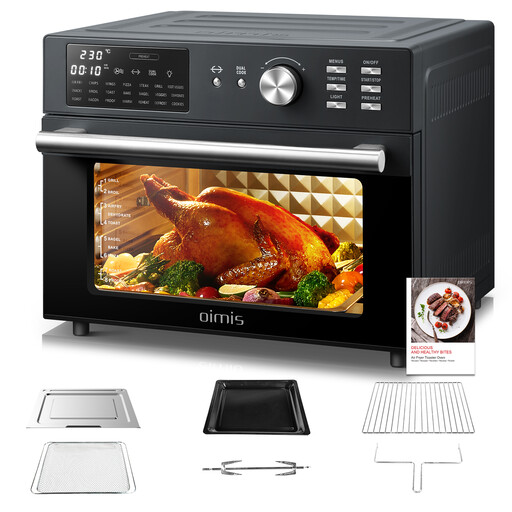 Image unavailable
Consider this countertop oven if you want to check a larger stated capacity for shared batches; confirm that its usable tray area fits your usual portion of wedges.
The product name specifies 30L capacity, 1800W power, 21 presets, a rotisserie and a dehydrator. Check the placement and electrical instructions before using it in a shared kitchen.
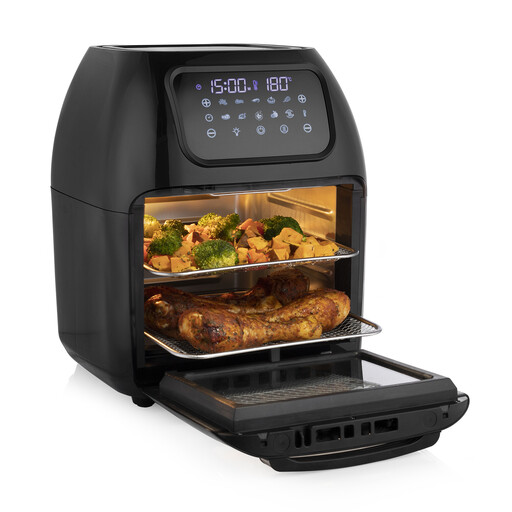 Image unavailable
Consider this countertop oven for smaller roasting batches, subject to checking the usable area of its tray or racks against your portion size.
The product name specifies 10L capacity, 1800W power, 10 programmes and dishwasher-safe parts. Confirm its placement and electrical requirements for your shared kitchen.
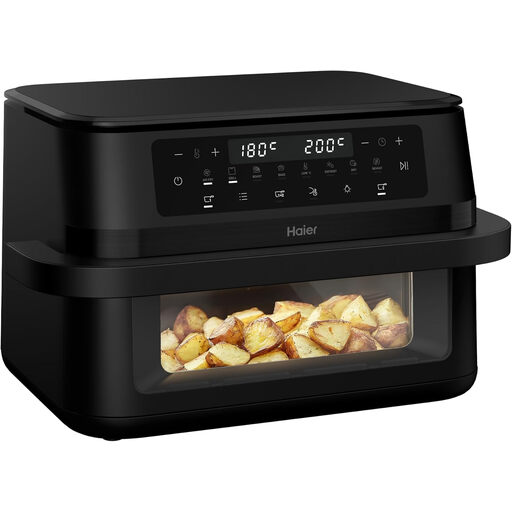 Image unavailable
Consider this basket-style air fryer if its usable basket area fits the wedges you normally roast; it is not a tray-style air-fryer oven.
The product name specifies an 11L capacity, removable divider and roast function. Its supplied instructions call for at least 10cm clearance at the back and sides and an earthed wall socket; check that the shared kitchen can meet those conditions.
Do not assume an extension lead is suitable. Electrical Safety First warns that ovens and grills can overload one when it is also used with other large appliances; check the oven’s instructions and power requirements, and ask a qualified electrician if the circuit’s suitability is uncertain.
An air-fryer oven is most worth considering for small quantities that fit in one batch. Which? reported lower energy use for air fryers in its small-quantity comparisons, but repeated batches can reduce that advantage; compare the number of batches your wedges would need.
Tower’s general starting points are 2–3L for one person and 3–5L for two. For squash wedges, also check the exact model’s basket or tray dimensions: the litre figure alone does not tell you how much roasting area is usable.
Only pursue a replacement once you have authority to change the kitchen and can check the installation requirements. Electrical Safety First says some ovens need hardwiring into a dedicated circuit; obtain the property owner’s or manager’s permission and confirm the exact oven’s cabinet fit and electrical provision before ordering.