Who these storage options suit

Photo-library protectors

If you want to recover family or personal photos after losing a laptop or phone, consider whether you have a separate backup rather than relying only on a synced library. The UK National Cyber Security Centre’s backup guidance and Apple’s iCloud Photos guidance explain why a separate copy and deletion behaviour matter.

Laptop-space reclaimers

If your laptop is filling up, choose storage for the files you plan to move and decide how you will keep a recoverable copy after clearing space. Apple’s Time Machine guidance and Microsoft’s Windows backup guidance describe different backup workflows to check.

Frequent file movers

If you regularly carry large photo folders between devices, check transfer needs alongside connector and file-system compatibility. Samsung’s product information, SanDisk’s USB flash-drive information and Apple’s external-storage guidance cover relevant device and connection considerations.

What to prioritise when choosing

Portable external SSD

Choose when: You regularly carry or copy large photo and laptop folders, and your device supports the drive’s connection.

Trade-off: A fast drive is still only one copy, and its rated maximum speed depends on the host and cable.

Portable external HDD

Choose when: Your main aim is keeping a sizeable local photo or laptop copy, and rapid transfers matter less.

Trade-off: An HDD is less compelling for frequent large-file hand-offs than an SSD; check the cable and backup software requirements.

USB flash drive

Choose when: You mainly want to carry selected files between devices with compatible connectors.

Trade-off: Treat a convenient transfer copy as separate from a regularly checked backup.

Cloud storage

Choose when: You need to access files away from your laptop or keep a copy in another location.

Trade-off: Check how the service handles deletions. Apple says iCloud Photos deletions propagate across participating devices.

Concern What to check when buying Who this matters to
Keeping a recoverable copy Check where the original and separate copy will live, whether copied files can be opened or restored, and how backups will be updated. If I am clearing laptop space, I want to know another copy will still be recoverable if files are deleted or a device is lost. Around 36% of consumers put recoverability first.
Capacity for a growing collection Check the size of the folders and devices you plan to cover, and the capacity required by your backup software. For Mac Time Machine, Apple recommends a device with at least twice the Mac’s storage capacity. For a growing photo collection or a full laptop, I need enough room for the files and the backup method I plan to use. Around 29% of consumers put capacity first.
Transfer time Check the drive interface, laptop port and supplied cable; rated maximum speeds depend on host and cable support. When I move large folders regularly, I want transfers to suit my routine without assuming a drive’s rated maximum will match my laptop. Around 21% of consumers put transfer time first.
Device and software compatibility Check each device’s port, cable or adapter, file system and intended backup application before transferring or reformatting files. If I need files on both my laptop and phone, I want the storage format and connection to work with the devices and apps I use. Around 14% of consumers put compatibility first.

Backup and compatibility pitfalls

  • Deleting originals as soon as files are moved

    Moving files to a new drive does not by itself leave you with a separate recoverable backup.

    Open or restore a sample of the copied files and arrange another independent copy before removing the originals.

  • Assuming cloud photo sync preserves deleted files

    Apple says iCloud Photos deletions propagate across participating devices, so synchronised copies may not provide an independent backup.

    Check the service’s recovery behaviour and keep a separate copy of your photo library.

  • Choosing by headline speed or connector shape alone

    A drive’s rated maximum speed depends on the host device and cable, while a matching plug does not establish file-system or backup-app compatibility.

    Check the exact device, interface, cable and required file system before buying or reformatting. An unsuitable port, cable, adapter or format can prevent the intended use.

Relevant brands to consider

Samsung

Samsung’s portable T7 SSD line is relevant if you often transfer large files; the separately identified T7 Shield is a variant to consider when enclosure protection matters.

  • Samsung rates the blue 1 TB T7 at up to 1,050 MB/s. Samsung says the T7 Shield’s IP65 protection is based on controlled testing, and results can vary with conditions.
  • The ordinary T7 and T7 Shield are not interchangeable descriptions. Samsung excludes liquid, dust and drop damage from its stated T7 Shield warranty coverage.

Seagate

The Expansion Portable HDD line is an example to consider for carrying or keeping a sizeable local copy.

  • Seagate’s datasheet identifies STKM2000400 as a black 2 TB variant and lists a USB 3.0 cable.
  • Seagate says Time Machine use requires reformatting and compatibility varies with the hardware and operating system. Check the exact product’s warranty and any recovery-service terms.

Kingston

The XS1000 portable SSD line is relevant if you are considering compact storage and USB-C or USB-A connectivity.

  • Kingston advertises USB 3.2 Gen 2 speeds of up to 1,050 MB/s and capacities up to 2 TB for the line.
  • These are manufacturer-rated, line-level figures; check the exact variant and the host device before comparing specifications.

SanDisk

The Ultra Dual Drive Go USB Type-C flash-drive line is relevant for moving selected files between compatible USB-C and USB-A devices.

  • SanDisk identifies a 128 GB variant with both USB-C and USB-A connector types.
  • Check the receiving device’s file-system support and keep a separate recoverable copy if the files matter.

Joybuy products for local storage

The listings below focus on portable SSDs for carrying and transferring photo files, alongside a portable HDD for a local copy.

Samsung Portable SSD T7 4 TB, Grey

Samsung Portable SSD T7 4 TB, Grey

Consider this portable SSD for photo storage and frequent large-file transfers.

4 TB capacity; USB 3.2 Gen 2; rated up to 1,050 MB/s read and 1,000 MB/s write. USB-C-to-C and USB-C-to-A cables are included.

This T7 is not IP-rated for water resistance; keep it away from liquids and moisture.

Joybuy

Samsung Portable SSD T7 2 TB, Grey

Samsung Portable SSD T7 2 TB, Grey

Consider this portable SSD for a local photo and file collection that you also carry between locations.

2 TB capacity; USB 3.2 Gen 2; rated up to 1,050 MB/s read and 1,000 MB/s write. USB-C-to-C and USB-C-to-A cables are included.

This T7 is not waterproof or dustproof; avoid liquids and excessive moisture.

Joybuy

Samsung T7 Shield MU-PE1T0S 1TB, Black

Samsung T7 Shield MU-PE1T0S 1TB, Black

Consider this portable SSD if you want local storage for large files and an enclosure with stated dust and water protection.

1 TB capacity; USB 3.2 Gen 2; rated up to 1,050 MB/s read and 1,000 MB/s write. The listing specifies IP65 protection and drop resistance up to 3 metres; it warns not to submerge the drive. Samsung says T7 Shield protection ratings are based on controlled testing and can vary with conditions.

Joybuy

SanDisk Portable SSD 2TB

SanDisk Portable SSD 2TB

Consider this portable SSD for carrying a local photo, video and file collection.

2 TB capacity; the listing specifies read speeds up to 800 MB/s and drop protection up to 2 metres. It also describes a compact drive with a rubber hook for carrying or attachment.

Joybuy
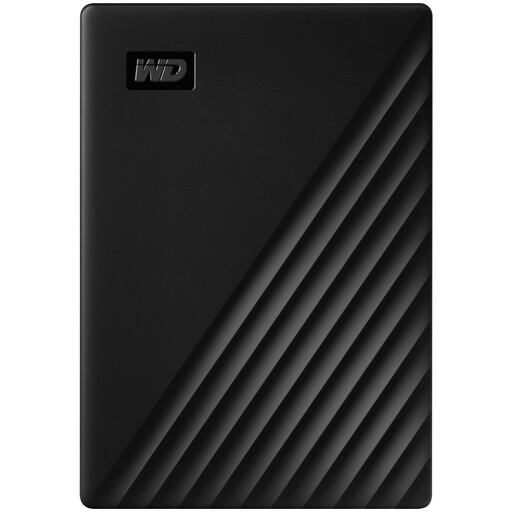
Western Digital My Passport 4TB Portable Hard Drive, Black

Western Digital My Passport 4TB Portable Hard Drive, Black

Consider this USB-powered portable HDD for keeping a sizeable local copy and scheduled backups of selected files.

4 TB capacity; USB 3.2 Gen 1; 256-bit AES hardware encryption and password protection.

The listing says Mac read/write use requires an NTFS compatibility driver. The enclosure is not IP-rated for water resistance and cannot withstand direct liquid exposure.

Joybuy

Questions about external storage

Does moving my photos to an external drive count as a backup?

Only if another recoverable copy remains elsewhere. Before deleting originals to free laptop space, check that the copied files open and decide where the additional copy will live. The UK National Cyber Security Centre defines a backup as a copy kept in a separate safe location.

What should I check for a Mac Time Machine or Windows File History drive?

For Time Machine, check the Mac’s port and capacity: Apple recommends a device with at least twice the Mac’s storage and prefers APFS or APFS Encrypted. Apple warns that reformatting a Windows-formatted disk removes its existing data. Microsoft describes selecting an external drive or network location for File History; connecting a drive alone does not establish that a backup workflow is running.

Can I use the same external drive with my phone and laptop?

Check the specific phone, ports, adapters, power requirements and file system before relying on one drive across devices. For storage connected to an iPhone through Files, Apple specifies one data partition and supported formats including exFAT and APFS; an adapter may be needed. Check the documentation for a particular non-Apple phone rather than assuming it has the same support.

Does iCloud Photos replace a separate photo backup?

Do not assume it does: Apple says deletions in iCloud Photos propagate across participating devices and advises keeping backup copies of the library. Check the service’s recovery behaviour before relying on it as your only copy.

What rights apply if an external drive bought online is faulty?

GOV.UK says goods that are faulty, not as described or unfit for their stated purpose can qualify for remedies. It separately describes a distance-purchase cancellation right, including notifying the seller within 14 days of receipt; that change-of-mind route is distinct from faulty-goods rights. Check the seller’s process, and do not treat a manufacturer’s warranty as a replacement for statutory rights.