
24/7 Customer Support

Free returns

Same-day & Next-day Delivery

Quality Guaranteed

Unlock Your Welcome Offers: FREE Delivery | Up to 80% OFF | Free 30-day JoyPlus trial
Download the APP
Stackable plastic storage boxes can make a loft, cupboard, garage or spare room easier to manage—but only when the box suits the job. A container that looks spacious online may have a lid that flexes, dimensions that do not fit your shelving, or a capacity that is unsuitable for heavy contents.
Before buying clear plastic storage boxes, look beyond the litre figure and promotional wording. The following guide explains the practical details that matter, common buying traps and suitable options for different UK households.
A stated capacity such as 35L or 50L describes the approximate internal volume, but the external dimensions determine whether the box fits beneath a bed, inside a wardrobe or on garage shelving. Reinforced corners, sloping walls and lid fittings can also reduce usable space.
Measure the storage location first, including door openings and shelf depth. For documents, records and clothing, check the internal dimensions where available rather than relying on capacity alone.
Transparent storage containers are convenient because you can identify contents without opening them. However, visibility does not indicate structural strength. Lightweight plastic may be suitable for stationery but less appropriate for tools, books or densely packed files.
For heavier items, look for polypropylene construction, reinforced bases, secure handles and a stated load limit. Do not exceed the manufacturer’s guidance, particularly when stacking several full boxes.
Stackable storage bins need more than a flat lid. A stable design should allow the base of one box to sit securely on the lid of another. Recessed lids, anti-slip bases and reinforced corners can help reduce movement, but the floor or shelving must also be level and strong enough for the combined weight.
Avoid creating tall towers in busy areas, near children’s play spaces or where a falling box could cause an obstruction.
Choose the size around the contents and the available space:
A large storage box can reduce the number of containers required, but it may become difficult to lift once filled. Splitting books, tools or seasonal items across smaller boxes can make handling safer.
Reusable polypropylene storage boxes are widely used for household and workplace storage because they are washable and available in rigid formats. Check whether the product uses recycled or recyclable material, but do not assume this alone indicates a particular strength rating.
Useful structural details include:
Keep plastic boxes away from open flames and prolonged high heat. In lofts, sheds and garages, consider temperature variation and avoid storing contents that require controlled environmental conditions.
Storage boxes with lids help reduce exposure to dust and everyday dirt. A simple clip-on lid may be suitable for cupboard storage, while storage boxes with clip-lock lids and integrated handles offer more security when boxes are moved regularly.
Check that the lid closes evenly on every side. A lid that is difficult to clip into place may become frustrating with frequent use. For long-term storage, label the outside even when the box is clear, as contents may become difficult to identify when boxes are stacked.
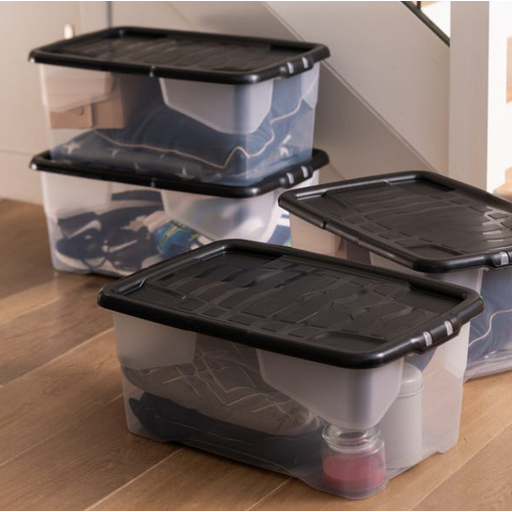
Why This Fits Their Persona: Four matching 42-litre boxes provide a straightforward starting point for renters, families and anyone organising several rooms at once.
The clear/translucent body supports quick identification, while solid clip-on lids and stackable construction address dust and vertical-space concerns.
Four 42L boxes; recycled plastic construction; listed dimensions of 60 x 40 x 40cm per box.

Why This Fits Their Persona: A three-box set suits home organisers and office users who want a consistent system for documents, crafts, clothing and equipment.
The product specification identifies polypropylene construction, transparent sides, reinforced bases and clip-lock lids rather than relying only on appearance.
Pack of three; 33L capacity per box; listed dimensions of 710 x 440 x 165mm.

Why This Fits Their Persona: The larger format is aimed at DIY users, garages, workshops and small businesses handling tools, equipment, textiles or larger stock.
Snap-locking clips, a reinforced base and recyclable polypropylene are specified for this larger-capacity format; weight should still be distributed evenly.
Two 64L boxes; external dimensions of 710 x 440 x 310mm; designed for stacking.

Why This Fits Their Persona: The low-profile four-pack works for desks, student rooms, craft areas and shelves where smaller compartments are easier to label and access.
A compact capacity prevents the common mistake of filling one oversized box with mixed items that become difficult to find.
Four 4L boxes; transparent polypropylene; suitable for A4 paper packs, files and craft supplies.
Place stackable plastic storage boxes on a stable, dry surface and keep heavier containers lower in the stack. Fill boxes evenly rather than concentrating weight at one end. Make sure every clip or handle is fully secured before stacking.
For clothing and textiles, allow items to dry fully before storage. For paper, photographs and collectibles, choose a cool, dry area and avoid direct sunlight. Wipe boxes with a damp cloth or mild soapy water; avoid abrasive cleaners and solvents that may cloud or damage plastic.
Use labels on the short side if boxes will sit on shelving, and keep a simple contents list for seasonal items stored in a loft or garage.
We have compiled a complete, real-time list of products that fully satisfy these strict selection criteria and UK safety regulations.
They can be suitable for general household items, provided they are kept away from open flames, excessive heat and prolonged direct sunlight. Check the product’s temperature guidance where available, and do not use ordinary storage boxes for hazardous liquids or materials.
There is no universal safe height. Follow the manufacturer’s instructions, distribute weight evenly and keep the stack stable. Larger or heavily loaded boxes should generally be placed at the bottom. Avoid stacking where the tower could be knocked or where access would require climbing.