
24/7 Customer Support

Free returns

Same-day & Next-day Delivery

Quality Guaranteed

Unlock Your Welcome Offers: FREE Delivery | Up to 80% OFF | Free 30-day JoyPlus trial
Download the APP
A reliable baking tray is a cornerstone of any British kitchen, but finding one that lasts can be a challenge. If you're tired of trays that warp, rust or have coatings that peel into your food, you're not alone. The market is filled with options that look promising but fail to deliver, leading to wasted money and frustration.
As a Joybuy Product Recommendation Officer, my role is to help you navigate these choices. This guide focuses on the stainless steel baking tray with rack, a versatile tool for any home cook. We'll uncover the common pitfalls to avoid and highlight the essential features that truly matter, ensuring your next purchase is a durable and valuable addition to your kitchen.
Before you buy, be aware of these frequent issues that catch many shoppers out:
To make a smart investment, focus on these three non-negotiable parameters. They are the difference between a tray that lasts for years and one that disappoints after a few months.
This is the most critical factor. For any kitchenware that comes into direct contact with your food, look for food-contact grade 304 stainless steel. This is also known as 18/8 steel, which refers to its composition of 18% chromium and 8% nickel. This combination provides excellent resistance to rust, corrosion and acids from foods like tomatoes or citrus. It's a durable, non-reactive material that won't leach unwanted substances into your cooking.
A set that includes a separate oven tray with cooling rack offers maximum versatility.
Consider the size of your oven and your typical cooking needs. A tray around 23-26 cm is great for smaller households, while larger families might need something 30-40 cm wide. A mirror or brushed finish is largely aesthetic, but a smooth, seamless interior with rounded corners is far easier to clean than one with sharp angles where food can get trapped.
We've matched some products to different user needs, focusing on how they address the common pitfalls and meet the core quality standards discussed above.
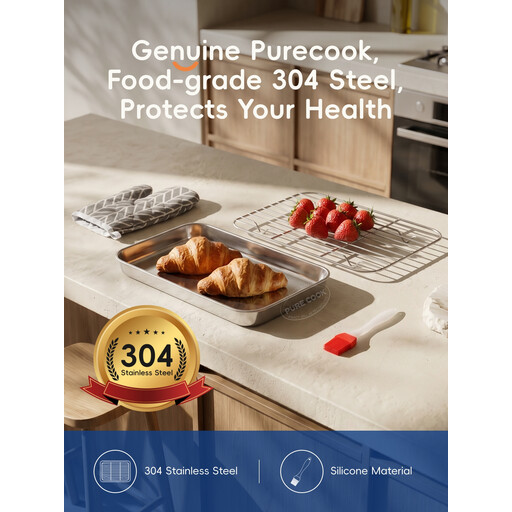
Why This Fits Their Persona: This set is ideal for someone who enjoys a variety of kitchen tasks, from baking biscuits and roasting a chicken for Sunday lunch to draining fried foods. It's a practical, multi-functional workhorse for the everyday UK kitchen.
It is made from food-contact grade 304 stainless steel, directly addressing the risk of rust and corrosion found in lower-grade steel. It has no chemical non-stick coating, avoiding any concerns about flaking.
A complete, versatile set. The detachable tray and rack can be used for baking, roasting, crisping and cooling. The included accessories add immediate value.
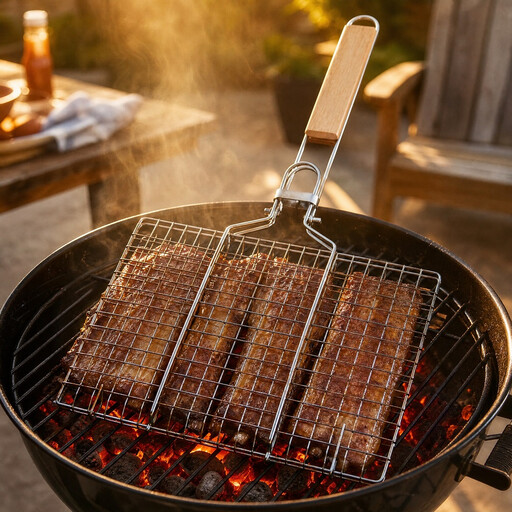
Why This Fits Their Persona: This is for the cook who wants to maximise their air fryer's capacity or cook multiple layers of food in a conventional oven. It's perfect for dehydrating fruits, making jerky or crisping several items at once.
As a dedicated grill pan with rack, its stainless steel construction is a durable upgrade from standard-issue air fryer accessories, which are often coated and less robust. The mesh design ensures optimal air circulation, avoiding soggy results.
The multi-layer, stackable design dramatically increases cooking capacity. It is detachable for easy cleaning and compact storage.
We have compiled a complete, real-time list of products that fully satisfy these strict selection criteria and UK safety regulations.
Here are answers to a few common questions people ask about using and caring for stainless steel kitchenware.
While it doesn't have a synthetic non-stick coating, you can easily prevent sticking. The most effective methods are lining the tray with parchment paper or a silicone baking mat. Alternatively, for roasting, you can lightly grease the tray with oil or butter. Pre-heating the tray with the fat before adding your food can also help create a naturally stick-resistant surface.
Most high-quality 304 stainless steel trays and racks are dishwasher safe. The material is robust enough to handle the heat and detergents. However, for the best long-term results and to maintain a bright finish, hand washing is often a good practice. A non-abrasive sponge should be used to avoid scratching the surface. For the rack, a small brush can help clean between the wires. Always check the manufacturer's specific care instructions.
Warping is primarily an issue with thin, low-quality metal trays. A heavy-gauge stainless steel tray, especially one with a reinforced rolled edge, is highly resistant to warping. To minimise the risk, avoid subjecting the tray to extreme temperature shocks, such as running a hot pan under cold water.